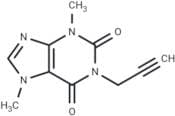
CAS 14114-46-6
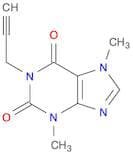
:3,7-Dimetil-1-propargilxantina
Descrição:
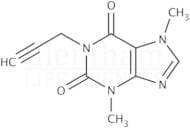
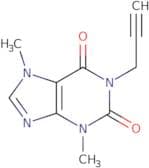
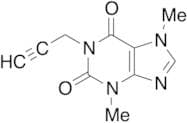
3,7-Dimetil-1-propargilxantina, com o número CAS 14114-46-6, é um derivado de xantina que exibe modificações estruturais típicas desta classe de compostos. Apresenta uma estrutura de xantina, caracterizada por uma estrutura bicíclica fundida contendo átomos de nitrogênio. A presença de dois grupos metila nas posições 3 e 7, juntamente com um grupo propargílico na posição 1, contribui para suas propriedades químicas únicas e atividade biológica. Este composto é conhecido por seu potencial como inibidor da fosfodiesterase, o que pode influenciar as vias de sinalização celular ao aumentar os níveis de nucleotídeos cíclicos. Como resultado, pode ter implicações em várias áreas terapêuticas, incluindo distúrbios cardiovasculares e neurológicos. A solubilidade e estabilidade de 3,7-Dimetil-1-propargilxantina podem variar dependendo do solvente e das condições, o que é importante para sua aplicação em pesquisa e uso medicinal potencial. No geral, suas características estruturais e atividade biológica fazem dele um composto de interesse em estudos farmacológicos.
Fórmula:C10H10N4O2
InChI:InChI=1S/C10H10N4O2/c1-4-5-14-9(15)7-8(11-6-12(7)2)13(3)10(14)16/h1,6H,5H2,2-3H3
Chave InChI:InChIKey=IORPOFJLSIHJOG-UHFFFAOYSA-N
SMILES:O=C1C2=C(N(C)C(=O)N1CC#C)N=CN2C
Sinónimos:- 1H-Purine-2,6-dione, 3,7-dihydro-3,7-dimethyl-1-(2-propynyl)-
- 3,7-Dihydro-3,7-dimethyl-1-(2-propyn-1-yl)-1H-purine-2,6-dione
- 3,7-Dimethyl-1-propargylxanthine
- 1H-Purine-2,6-dione, 3,7-dihydro-3,7-dimethyl-1-(2-propyn-1-yl)-
- Theobromine, 1-(2-propynyl)-
Ordenar por
Pureza (%)
0
100
|
0
|
50
|
90
|
95
|
100
6 produtos.
3,7-Dimethyl-1-Propargylxanthine
CAS:Fórmula:C10H10N4O2Pureza:98%Cor e Forma:SolidPeso molecular:218.21203,7-Dimethyl-1-propargylxanthine
CAS:Produto Controlado3,7-Dimethyl-1-propargylxanthine is a cyclase inhibitor that has been shown to have pharmacological effects. It has been shown to be effective in vivo models of Parkinson's disease and has reduced locomotor activity. This drug also inhibits the production of adenosine and dopamine, leading to neuronal death. The 3,7-dimethyl-1-propargylxanthine shows high selectivity for adenosine A3 receptors and is an antagonist at these receptors. It prevents mitochondrial membrane potential from decreasing, which may be due to inhibition of the production of reactive oxygen species by mitochondria. 3,7-Dimethyl-1-propargylxanthine also inhibits platelet aggregation by blocking the activation of phospholipase C and enhances platelet aggregation by inhibiting phosphodiesterase activity.Fórmula:C10H10N4O2Pureza:Min. 95%Cor e Forma:PowderPeso molecular:218.21 g/mol3,7-Dimethyl-1-propargylxanthine
CAS:Produto ControladoApplications A selective A2 adenosine receptor antagonist. Pharmacology: Ki vs [3H]NECA at A2 receptors in rat striatal membranes: 11± 3 uM; Ki vs [3H]CHA at A1 receptors in rat cerebral cortical membranes: 45 ± 4 uM.
References Alfinito, P., et al.: J. Neurosci., 23, 10982 (2003), Golembiowska, K., et al.: Neuropharmacol., 47, 414 (2004), Solinas, M., et al.: Psychopharmacol., 179, 576 (2005), Panjehpour, M., et al.: Oncol. Res., 16, 575 (2007),Fórmula:C10H10N4O2Cor e Forma:NeatPeso molecular:218.21DMPX
CAS:DMPX (3,7-Dimethyl-1-propargylxanthine) is a caffeine-like compound capable of crossing the blood-brain barrier. It serves as an A2-selective adenosine receptor (AR) antagonist, effectively and selectively blocking the hypothermia and behavioral inhibition induced by A2 adenosine receptor agonists, such as NECA. DMPX is utilized in research on diseases like Parkinson's disease.Fórmula:C10H10N4O2Cor e Forma:SolidPeso molecular:218.212