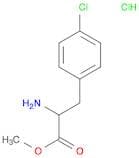
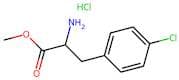
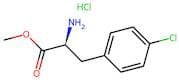
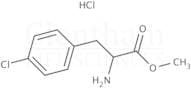
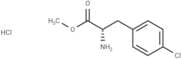
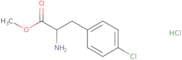
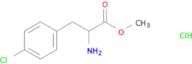
CAS 14173-40-1
:Fenilalanina, 4-cloro-, éster metílico, cloridrato (1:1)
Descrição:
Fenilalanina, 4-cloro-, éster metílico, cloridrato (1:1) é um composto químico caracterizado por sua estrutura, que inclui uma espinha dorsal de fenilalanina modificada por um átomo de cloro na posição para e um grupo funcional de éster metílico. Este composto é tipicamente encontrado como um sal de cloridrato, o que melhora sua solubilidade em água e pode influenciar sua estabilidade e reatividade. A presença do substituinte de cloro pode afetar a atividade biológica do composto e sua interação com enzimas ou receptores. Como um derivado de aminoácido, pode desempenhar um papel em vários processos bioquímicos, incluindo a síntese de proteínas e vias metabólicas. A forma de éster metílico sugere aplicações potenciais em química medicinal, onde pode servir como um pró-fármaco ou um bloco de construção para moléculas mais complexas. Devem ser observadas precauções de segurança e manuseio, como com muitas substâncias químicas, devido à possível toxicidade ou reatividade. No geral, este composto é de interesse tanto em contextos de pesquisa quanto farmacêuticos, particularmente em estudos relacionados ao metabolismo de aminoácidos e ao design de fármacos.
Fórmula:C10H12ClNO2·ClH
InChI:InChI=1S/C10H12ClNO2.ClH/c1-14-10(13)9(12)6-7-2-4-8(11)5-3-7;/h2-5,9H,6,12H2,1H3;1H
Chave InChI:InChIKey=GCBCWTWQAFLKJG-UHFFFAOYSA-N
SMILES:C(C(C(OC)=O)N)C1=CC=C(Cl)C=C1.Cl
Sinónimos:- (2R)-3-(4-chlorophenyl)-1-methoxy-1-oxopropan-2-aminium
- (2S)-3-(4-chlorophenyl)-1-methoxy-1-oxopropan-2-aminium
- 3-(4-Chlorophenyl)-1-Methoxy-1-Oxopropan-2-Aminium Chloride
- 4-Chloro-DL-Phe-OMe・HCl
- 4-Chlorophenylalanine methyl ester hydrochloride
- <span class="text-smallcaps">DL</span>-(4-Chlorophenyl)alanine methyl ester hydrochloride
- <span class="text-smallcaps">DL</span>-(p-Chlorophenyl)alanine methyl ester hydrochloride
- <span class="text-smallcaps">DL</span>-Phenylalanine, 4-chloro-, methyl ester, hydrochloride
- Alanine, 3-(p-chlorophenyl)-, methyl ester, hydrochloride, <span class="text-smallcaps">DL</span>-
- Alanine, 3-(p-chlorophenyl)-, methyl ester, hydrochloride, DL-
- DL-3-(p-Chlorophenyl)alanine methyl ester hydrochloride
- DL-4-chlorophenylalanine methyl ester hydrochloride
- DL-Pcpa methyl ester hydrochloride
- DL-Phenylalanine, 4-chloro-, methyl ester, hydrochloride
- DL-p-Chlorophenylalanine methyl ester hydrochloride
- H-DL-Phe(4-Cl)-OMe・HCl
- Methyl 4-Chlorophenylalaninate
- Phenylalanine, 4-chloro-, methyl ester, hydrochloride
- Phenylalanine, 4-chloro-, methyl ester, hydrochloride (1:1)
- p-Chlorophenylalanine methyl ester hydrochloride
- Methyl 4-chloro-3-phenyl-DL-alaninate hydrochloride
- Ver mais sinónimos
Ordenar por
Pureza (%)
0
100
|
0
|
50
|
90
|
95
|
100
7 produtos.
Phenylalanine, 4-chloro-, methyl ester, hydrochloride (1:1)
CAS:Fórmula:C10H13Cl2NO2Pureza:98%Cor e Forma:SolidPeso molecular:250.1217Methyl 2-Amino-3-(4-Chlorophenyl)Propanoate Hydrochloride
CAS:Methyl 2-Amino-3-(4-Chlorophenyl)Propanoate HydrochloridePureza:98%Peso molecular:250.12g/molpCPA methyl ester hydrochloride
CAS:pCPA methyl ester hydrochloridePureza:≥98%Peso molecular:250.12g/molpCPA methyl ester hydrochloride
CAS:pCPA methyl ester HCl inhibits tryptophan hydroxylase, 5-HT synthesis, crosses blood-brain barrier, lowers central 5-HT.
Fórmula:C10H13Cl2NO2Pureza:99.73% - 99.88%Cor e Forma:SolidPeso molecular:250.124-Chloro-DL-phenylalanine methyl ester hydrochloride
CAS:4-Chloro-DL-phenylalanine methyl ester hydrochloride is a dopamine receptor agonist that has been shown to have antinociceptive properties in animal models of pain. It has also been shown to inhibit the release of lactogenic hormones, which are hormones that stimulate milk production. Dopamine is a neurotransmitter that plays a role in locomotor activity and reward mechanisms. 4-Chloro-DL-phenylalanine methyl ester hydrochloride binds to the dopamine receptor, inducing activation of the G protein and subsequent phospholipase C activation. This stimulates the synthesis of inositol triphosphate (IP3) and diacylglycerol (DAG). IP3 causes an increase in intracellular calcium ions, leading to muscle contraction, while DAG activates protein kinase C (PKC), which can inhibit adenyl cyclase and thus lead to decreased cAMP levels. The 5HT2AFórmula:C10H12ClNO2·HClPureza:Min. 98 Area-%Cor e Forma:PowderPeso molecular:250.10 g/mol4-Chloro-DL-Phe-OMe.HCl
CAS:M03172 - 4-Chloro-DL-Phe-OMe.HCl
Fórmula:C10H13Cl2NO2Pureza:98%Cor e Forma:Solid, White powderPeso molecular:250.12