CAS 144449-86-5
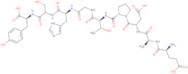
:H-Glu-Ala-Asp-Pro-Thr-Gly-His-Ser-Tyr-OH
Descrição:
A substância química com o nome "H-Glu-Ala-Asp-Pro-Thr-Gly-His-Ser-Tyr-OH" é um peptídeo composto por uma sequência de aminoácidos, especificamente ácido glutâmico (Glu), alanina (Ala), ácido aspártico (Asp), prolina (Pro), treonina (Thr), glicina (Gly), histidina (His), serina (Ser) e tirosina (Tyr). O prefixo "H-" indica que é uma forma protegida do peptídeo, normalmente denotando que possui um grupo amino N-terminal. A presença de vários aminoácidos sugere que este peptídeo pode ter diversas funções biológicas, potencialmente envolvendo papéis em sinalização, atividade enzimática ou componentes estruturais em proteínas. O número CAS 144449-86-5 identifica exclusivamente este peptídeo específico em bancos de dados químicos, facilitando seu estudo e aplicação em contextos de pesquisa e farmacêuticos. Peptídeos como este são frequentemente sintetizados para uso no desenvolvimento de medicamentos, aplicações terapêuticas ou como ferramentas de pesquisa em bioquímica e biologia molecular. Suas propriedades, como solubilidade, estabilidade e atividade biológica, podem variar significativamente com base em sua composição e sequência de aminoácidos.
Fórmula:C41H57N11O17
Sinónimos:- Glu-Ala-Asp-Pro-Thr-Gly-His-Ser-Tyr
- H2N-Eadptghsy-Oh
- Melanoma-Associated Antigen 1 (161-169) (Human)
- Mage 1 Antigen (161-169) [Homo Sapiens]
- MAGE-1 Antigen (161-169) (human)
- MAGE-1 antigen (161-169), human (3)
- Mage-1 (161-169), human
Ordenar por
Pureza (%)
0
100
|
0
|
50
|
90
|
95
|
100
2 produtos.
Mage-1 Antigen (161-169), human
CAS:Custom research peptide; min purity 95%. For different specs please use the Peptide Quote Tool
Fórmula:C41H57N11O17Peso molecular:975.97 g/molMAGE-1 Antigen (161-169) (human) acetate salt
CAS:MAGE-1 is a costimulatory molecule that is expressed on the surface of antigen presenting cells. It has been shown to be a very potent target for monoclonal antibodies. MAGE-1 can be used as an antigen in diagnostic tests, such as ELISA and Western blotting. It can also be used to generate monoclonal antibodies for use as therapeutic agents in cancer therapy and for the treatment of viral infections such as influenza virus. The MAGE-1 antigen has been shown to have high affinity binding with the paratope of Papilloma virus, which may help explain its clinical relevance in these diseases.Fórmula:C41H57N11O17Pureza:Min. 95%Peso molecular:975.96 g/mol