CAS 145626-87-5
:Bis(2-mercaptoetil) sulfona
Descrição:
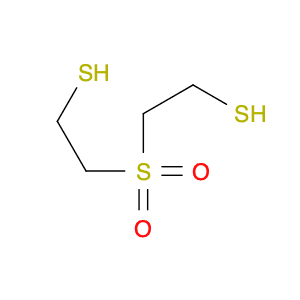
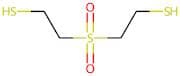
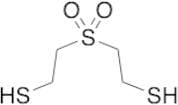
Bis(2-mercaptoetil) sulfona, também conhecido pelo seu número CAS 145626-87-5, é um composto organossulfurado caracterizado pela presença de dois grupos mercaptoetila ligados a uma moiety de sulfona. Este composto geralmente aparece como um líquido incolor a amarelo pálido ou sólido, dependendo de sua forma específica e pureza. É solúvel em solventes polares como água e álcoois, devido à presença dos grupos tiol, que podem participar de ligações de hidrogênio. Os grupos mercaptoetila contribuem para sua reatividade, permitindo que participe de várias reações químicas, incluindo troca tiol-disulfeto e substituições nucleofílicas. Bis(2-mercaptoetil) sulfona é frequentemente utilizado na síntese de polímeros, como agente de reticulação, e na formulação de vários produtos químicos devido à sua capacidade de melhorar as propriedades dos materiais. Além disso, pode exibir atividade biológica, tornando-o de interesse na química medicinal e na ciência dos materiais. O manuseio adequado e as precauções de segurança são essenciais devido à reatividade potencial dos grupos tiol.
Fórmula:C4H10O2S3
InChI:InChI=1/C4H10O2S3/c5-9(6,3-1-7)4-2-8/h7-8H,1-4H2
SMILES:C(CS(=O)(=O)CCS)S
Sinónimos:- 2,2'-Sulfonyldiethanethiol
- Bis(2-mercaptoethyl)sulfone
Ordenar por
Pureza (%)
0
100
|
0
|
50
|
90
|
95
|
100
4 produtos.
2,2'-Sulphonyldiethane-1-thiol
CAS:2,2'-Sulphonyldiethane-1-thiolFórmula:C4H10O2S3Pureza:≥95%Cor e Forma: pale yellow solidPeso molecular:186.32g/molBis(2-mercaptoethyl)sulfone
CAS:Produto ControladoStability Air Sensitive, Moisture Sensitive
Applications A useful reagent for the reduction of disulfides in aquous solutions. A superior substitute for DTT.
References Lamoureux, G.V., et al.: J. Org. Chem., 58, 633 (1993), Singh, R., et al.: Protein Sci., 3, suppl 1, 430T (1994)Fórmula:C4H10O2S3Cor e Forma:NeatPeso molecular:186.32Bis(2-mercaptoethyl)sulfone
CAS:Bis(2-mercaptoethyl)sulfone (BMS) is a chemical that can be used to modify the properties of proteins. BMS can be used to increase the solubility of proteins, which can then be purified using liquid chromatography. It also has an extracellular modification capability, which can be activated by adding sodium borohydride or dithiothreitol in order to form a disulfide bond. This reversible reaction is endoplasmic reticulum-dependent and not found in bacteria. BMS binds to DNA with a redox potential of -0.78 V and fluoresces at 564 nm in dimethyl sulfoxide solution. It has been shown to have biochemical properties that are similar to cysteine and glutathione, but does not react with thiols such as mercaptoethanol or glutathione.Fórmula:C4H10O2S3Pureza:Min. 97 Area-%Cor e Forma:White PowderPeso molecular:186.32 g/mol