CAS 14618-59-8
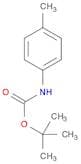
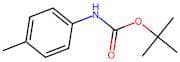
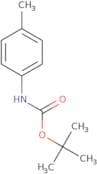
:Ácido carbâmico, N-(4-metilfenil)-, éster 1,1-dimetiletil
Descrição:
Ácido carbâmico, N-(4-metilfenil)-, éster 1,1-dimetiletil, comumente referido pelo seu número CAS 14618-59-8, é um composto orgânico que pertence à classe dos carbamatos. Esta substância é caracterizada pelo seu grupo funcional éster, que é formado a partir da reação do ácido carbâmico e um álcool. Normalmente aparece como um líquido incolor a amarelo pálido com um odor distintivo. O composto é conhecido por sua solubilidade moderada em solventes orgânicos e solubilidade limitada em água, que é uma característica comum entre muitos carbamatos. Exibe propriedades como ser um potencial intermediário na síntese orgânica e pode ter aplicações na agricultura como pesticida ou herbicida. Além disso, como muitos derivados de carbamato, pode possuir atividade biológica, influenciando seu uso em vários processos químicos. Dados de segurança devem ser consultados, pois os carbamatos podem apresentar toxicidade para humanos e vida selvagem, exigindo manuseio e uso cuidadosos em ambientes laboratoriais e industriais.
Fórmula:C12H17NO2
InChI:InChI=1S/C12H17NO2/c1-9-5-7-10(8-6-9)13-11(14)15-12(2,3)4/h5-8H,1-4H3,(H,13,14)
Chave InChI:InChIKey=GNUJXPOJGTXSEZ-UHFFFAOYSA-N
SMILES:N(C(OC(C)(C)C)=O)C1=CC=C(C)C=C1
Sinónimos:- tert-Butyl p-tolylcarbamate
- Carbamic acid, N-(4-methylphenyl)-, 1,1-dimethylethyl ester
- Carbamic acid, (4-methylphenyl)-, 1,1-dimethylethyl ester
- tert-Butyl p-methylphenylcarbamate
- Carbanilic acid, p-methyl-, tert-butyl ester
Ordenar por
Pureza (%)
0
100
|
0
|
50
|
90
|
95
|
100
4 produtos.
tert-Butyl N-(4-methylphenyl)carbamate
CAS:Fórmula:C12H17NO2Pureza:98%Cor e Forma:SolidPeso molecular:207.2689tert-Butyl N-(4-methylphenyl)carbamate
CAS:Tert-butyl N-(4-methylphenyl)carbamate is a reusable, efficient method for the synthesis of tert-butyl carbamates from amines and carbon dioxide. This reaction is an example of a C–H bond activation that proceeds through an anion intermediate. The reaction time can be reduced by irradiation to increase the efficiency. Electrons are unpaired during this process, which is modeled with quantum mechanics software. Chloride is used as a catalyst to activate the electron and generate a reactive intermediate. Amine functionalities are added to the molecule in order to give it desired properties. The chloride group can be replaced with other anions such as bromide or iodide, which will also introduce different reactivity patterns.Fórmula:C12H17NO2Pureza:Min. 95%Peso molecular:207.27 g/mol