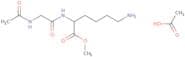
CAS 14752-92-2
:L-Lisina, N-acetilglicil-, éster metílico, acetato (1:1)
Descrição:
L-Lisina, N-acetilglicil-, éster metílico, acetato (1:1) é um composto químico que apresenta uma combinação de aminoácidos e grupos funcionais. É derivado da lisina, um aminoácido essencial, que desempenha um papel crucial na síntese de proteínas e em vários processos metabólicos. A presença do grupo N-acetilglicilo indica que a lisina foi modificada, potencialmente melhorando sua solubilidade e biodisponibilidade. A funcionalidade do éster metílico sugere que o composto pode exibir propriedades diferentes em comparação com sua forma ácida livre, como reatividade e estabilidade alteradas. O componente acetato implica que o composto está em forma de sal, o que pode influenciar sua solubilidade em soluções aquosas. Este composto pode ser de interesse na pesquisa bioquímica, farmacêutica e em aplicações nutricionais devido aos seus papéis potenciais nas funções celulares e como bloco de construção para peptídeos. No entanto, aplicações específicas e atividades biológicas dependeriam de estudos adicionais e do contexto em relação ao seu uso.
Fórmula:C11H21N3O4·C2H4O2
InChI:InChI=1S/C11H21N3O4.C2H4O2/c1-8(15)13-7-10(16)14-9(11(17)18-2)5-3-4-6-12;1-2(3)4/h9H,3-7,12H2,1-2H3,(H,13,15)(H,14,16);1H3,(H,3,4)/t9-;/m0./s1
Chave InChI:InChIKey=UNWQLIOZIACTGA-FVGYRXGTSA-N
SMILES:[C@H](NC(CNC(C)=O)=O)(CCCCN)C(OC)=O.C(C)(O)=O
Sinónimos:- <span class="text-smallcaps">L</span>-Lysine, N-acetylglycyl-, methyl ester, acetate (1:1)
- <span class="text-smallcaps">L</span>-Lysine, N-acetylglycyl-, methyl ester, monoacetate
- <span class="text-smallcaps">L</span>-Lysine, N<sup>2</sup>-(N-acetylglycyl)-, methyl ester, monoacetate
- Ac-Gly-Lys-OMe
- Lysine, N<sup>2</sup>-(N-acetylglycyl)-, methyl ester, monoacetate, <span class="text-smallcaps">L</span>-
- Methyl 6-[(2-Acetamidoacetyl)Amino]-2-Amino-Hexanoate
- N-?-Acetylglycyl-L-lysine methyl ester acetate
- N-Acetyl-Gly-Lys Methyl Ester Acetate Salt
- N-Acetylglycyl-<span class="text-smallcaps">L</span>-lysine methyl ester acetate
- L-Lysine, N2-(N-acetylglycyl)-, methyl ester, monoacetate
- Lysine, N2-(N-acetylglycyl)-, methyl ester, monoacetate, L-
- L-Lysine, N-acetylglycyl-, methyl ester, acetate (1:1)
- Ver mais sinónimos
Ordenar por
Pureza (%)
0
100
|
0
|
50
|
90
|
95
|
100
3 produtos.
Ac-Gly-Lys-OMe acetate
CAS:Produto ControladoAc-Gly-Lys-OMe acetate salt is a reactive chemical compound that is used in the synthesis of peptides. This salt is synthesized by reacting glycine with lysine and formaldehyde. Ac-Gly-Lys-OMe acetate salt has been shown to have hemolytic activity and can be used as a synthetic substrate for kinetic studies. It has also been found to activate complement, which may be due to its disulfide bond formation. Ac-Gly-Lys-OMe acetate salt has been shown to inhibit fibrinogen and nitrosylation, which may result in thrombotic disorders.Fórmula:C11H21N3O4•C2H4O2Pureza:Min. 95%Cor e Forma:PowderPeso molecular:319.35 g/molAc-Gly-Lys-OMe • AcOH [AGLME]
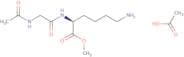
CAS:Ac-Gly-Lys-OMe • AcOH is a synthetic substrate that is used in enzymatic reactions. This product is a peptide that contains an amide bond and a disulfide bond. It has been shown to be inactive when exposed to human serum for up to 30 minutes. Ac-Gly-Lys-OMe • AcOH has been shown to have inhibitory effects on the activity of monoclonal antibodies as well as dodecyl, which belongs to the group of lipids found in blood plasma. The rate of this reaction increases with increasing temperature and pH, but decreases with increasing concentrations of AGLME or dodecanol.Fórmula:C11H21N3O4•CH3COOHPureza:Min. 95%Peso molecular:319.35 g/molAc-Val-Asp-Val-Ala-Asp-AMC
CAS:Produto ControladoAc-Val-Asp-Val-Ala-Asp-AMC is a research tool used to study the function of ion channels. It is an activator that binds to the receptor site on ATP sensitive potassium channels. Ac-Val-Asp-Val-Ala-Asp-AMC has been shown to inhibit calcium and sodium ion flux through ion channels, as well as high purity and good solubility. This peptide is useful for studying protein interactions, pharmacology, and life science research.
Fórmula:C33H44N6O12Pureza:Min. 95%Peso molecular:716.74 g/mol

![Ac-Gly-Lys-OMe • AcOH [AGLME]](/_next/image/?url=https%3A%2Fstatic.cymitquimica.com%2Fproducts%2F3D%2Fthumb%2FSGK-3058.jpg&w=3840&q=75)