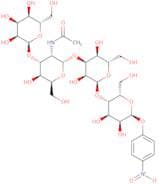
CAS 148705-09-3
:N-[(2S,3S,4R,5S,6S)-2-[(2S,3S,4S,5S,6S)-2-[(2S,3S,4R,5S,6S)-4,5-diidroxi-2-(hidroximetil)-6-(4-nitrofenoxi)tetrahidropirano-3-il]oxi-3,5-diidroxi-6-(hidroximetil)tetrahidropirano-4-il]oxi-5-hidroxi-6-(hidroximetil)-4-[(2R,3S,4S,5R,6S)-3,4,5-triidroxi
Gal β(1-3)GlcNAc β(1-3)Gal β(1-4)Glc-β-pNP
CAS:Fórmula:C32H48N2O23Pureza:97.0%Peso molecular:828.7231gal β(1-3)glcNAc β(1-3)gal β(1-4)glc-β-pNP
CAS:gal β(1-3)glcNAc β(1-3)gal β(1-4)glc-β-pNPPureza:>97.0%Galβ(1-3)GlcNAcβ(1-3)Galβ(1-4)Glc-β-pNP
CAS:Fórmula:C32H48N2O23Pureza:>97.0%(HPLC)Cor e Forma:White to Almost white powder to crystalPeso molecular:828.734-Nitrophenyl lacto-N-tetraoside
CAS:4-Nitrophenyl lacto-N-tetraoside is a chromogenic substrate for enzymes that cleave lactose-specific linkages, such as beta-galactosidases. Upon enzyme cleavage, the pNP group is released, resulting in a yellow-colored solution that can be spectrophotometrically quantified at 405 nm. This substrate is commonly used in detecting lactose hydrolysis activity, such as in dairy industry for production optimization studies, or in microbiology for bacterial lactose fermentation assays. Its tetrasaccharide structure resembles that of lactose and makes it a specific substrate for lactose-utilizing enzymes. The properties of 4-nitrophenyl lacto-N-tetraoside make it a useful tool in enzyme kinetics studies and screening of new lactose-utilizing microorganisms.
Pureza:Min. 95%Peso molecular:828.72 g/mol