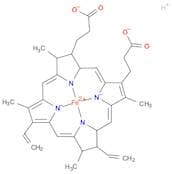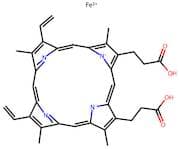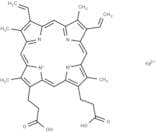
CAS 14875-96-8
:heme
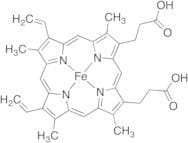
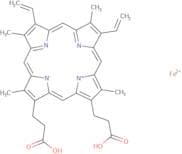
- 1,3,5,8-Tetramethyl-2,4-divinylporphine-6,7-dipropionic acid ferrous complex
- 21H,23H-Porphine, ferrate(2-) deriv.
- 21H,23H-Porphine-2,18-dipropanoic acid, 7,12-diethenyl-3,8,13,17-tetramethyl-, iron complex
- Ferrate(2-), [7,12-diethenyl-3,8,13,17-tetramethyl-21H,23H-porphine-2,18-dipropanoato(4-)-N21,N22,N23,N24]-, dihydrogen, (SP-4-2)-
- Ferrate(2-), [7,12-diethenyl-3,8,13,17-tetramethyl-21H,23H-porphine-2,18-dipropanoato(4-)-N<sup>21</sup>,N<sup>22</sup>,N<sup>23</sup>,N<sup>24</sup>]-, dihydrogen, (SP-4-2)-
- Ferrate(2-), [7,12-diethenyl-3,8,13,17-tetramethyl-21H,23H-porphine-2,18-dipropanoato(4-)-κN21,κN22,κN23,κN24]-, hydrogen (1:2), (SP-4-2)-
- Ferrate(2-), [7,12-diethenyl-3,8,13,17-tetramethyl-21H,23H-porphine-2,18-dipropanoato(4-)-κN<sup>21</sup>,κN<sup>22</sup>,κN<sup>23</sup>,κN<sup>24</sup>]-, dihydrogen, (SP-4-2)-
- Ferrate(2-), [7,12-diethenyl-3,8,13,17-tetramethyl-21H,23H-porphine-2,18-dipropanoato(4-)-κN<sup>21</sup>,κN<sup>22</sup>,κN<sup>23</sup>,κN<sup>24</sup>]-, hydrogen (1:2), (SP-4-2)-
- Ferroheme
- Ferroprotoporphyrin IX
- Hem Fe
- Heme
- Heme b
- Hydrogen [7,12-diethenyl-3,8,13,17-tetramethyl-21H,23H-porphine-2,18-dipropanoato(4-)-κN<sup>21</sup>,κN<sup>22</sup>,κN<sup>23</sup>,κN<sup>24</sup>]ferrate (heme)
- Iron protoporphyrin
- Iron protoporphyrin IX
- Iron(II) protoporphyrin IX
- Nsc 267100
- Protoheme
- Protoheme IX
- Protoporphyrin IX, iron deriv.
- Protoporphyrin, iron complex
- Reduced hematin
- [3,8,13,17-Tetramethyl-7,12-divinyl-21H,23H-porphine-2,8-dipropanoato(4-)-N21,N22,N23,N24]ferrate(2-) de dihydrogene (SP-4-2)
- [Dihydrogen 3,7,12,17-tetramethyl-8,13-divinyl-2,18-porphinedipropionato(2-)]iron
- Ver mais sinónimos
Ref: IN-DA00AOIN
1mg107,00€2mg124,00€5mg198,00€10mg176,00€25mg306,00€50mg613,00€100mg89,00€500mgA consultarFerroheme
CAS:Ferroheme: iron-containing porphyrin in hemoglobin and other hemeproteins; colors tissues.Fórmula:C34H32FeN4O4Pureza:97.63%Cor e Forma:SolidPeso molecular:616.49Ferroprotoporphyrin IX
CAS:Stability Light Sensitive
Applications Ferroprotoporphyrin IX is a metabolite formed during biosynthesis and is used to evaluate iron nutrition and metabolism. It is also an iron containing cofactor that is involved with a wide range of cellular functions including oxygen transport.
References Labbe, R.F., et. al.: Clin. Chem., 45, 146 (1999); Yuan, X., et al.: Proc. Natl. Acad. Sci. USA 113, E5144 (2016);Fórmula:C34H32FeN4O42Cor e Forma:NeatPeso molecular:616.49HEME
CAS:Heme is an iron-containing, non-protein molecule that is essential for life. Heme has a variety of biochemical properties and is important in the regulation of vital biological processes such as oxygen transport and metabolism of nitrogenous compounds. Heme can be found in two forms: heme A and heme B. The former consists of the protein globin combined with ferrous ion, while the latter is formed by the combination of protoporphyrin IX with ferrous ion. The synthesis of heme occurs through a series of reactions that involve oxidation and reduction reactions. The protoheme synthesis pathway results in the production of erythrocruorin, which is then converted to hemes A or B depending on its position in the globin protein chain. In addition to being an important cofactor for enzymes such as cytochrome c oxidase (complex IV), heme also functions as a substrate for heme oxygenase, which removes it from circulation to produce biliver
Fórmula:C34H32FeN4O4Pureza:Min. 95%Peso molecular:616.5 g/mol