CAS 149635-73-4
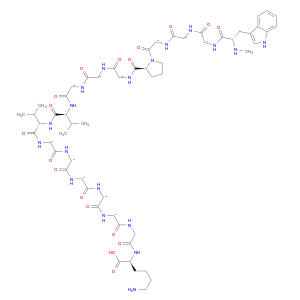
:H-Met-Glu-Val-Gly-Trp-Tyr-Arg-Ser-Pro-Phe-Ser-Arg-Val-Val-His-Leu-Tyr-Arg-Asn-Gly-Lys-OH
- H-Met-Glu-Val-Gly-Trp-Tyr-Arg-Ser-Pro-Phe-Ser-Arg-Val-Val-His-Leu-Tyr-Arg-Asn-Gly-Lys-Oh (Mouse, Rat)
- Met-Glu-Val-Gly-Trp-Tyr-Arg-Ser-Pro-Phe-Ser-Arg-Val-Val-His-Leu-Tyr-Arg-Asn-Gly-Lys
- Mevgwyrspfsrvvhlyrngk
- Myelin Oligodendrocyte Glycoprotein Peptide (35-55) (rat, mouse)
- Myelin Oligodendrocyte Glycoprotein Peptide Fragment 35-55 Rat, Mouse
- Myelin Oligodendrocyte Glycoprotein (35-55) (Mouse, Rat)
- Myelin Oligodendrocyte Glycoprotein (35-55), Rat
L-Methionyl-L-α-glutamyl-L-valylglycyl-L-tryptophyl-L-tyrosyl-L-arginyl-L-seryl-L-prolyl-L-phenylalanyl-L-seryl-L-arginyl-L-valyl-L-valyl-L-histidyl-L-leucyl-L-tyrosyl-L-arginyl-L-asparaginylglycyl-L-lysine
CAS:Fórmula:C118H177N35O29SPureza:98%Cor e Forma:SolidPeso molecular:2581.9501MOG (35-55) mouse, rat
CAS:Myelin Oligodendrocyte Glycoprotein Peptide (35-55), mouse, rat (MOG (35-55)) is a minor component of the central nervous system myelin.Cost-effective and quality-assured.Fórmula:C118H177N35O29SPureza:93.16% - 99.88%Cor e Forma:SolidPeso molecular:2581.95Myelin Oligodendrocyte Glycoprotein(35-55), rat MOG(35-55)
CAS:Myelin oligodendrocyte glycoprotein (MOG) is a type I integral membrane glycoprotein of the immunoglobulin superfamily (Ig) found exclusively in mammals. The 26-28 kDa protein is located on the external surface of the oligodendrocyte membrane, mostly on the peripheral lamellae of myelin sheaths of the Central nervous system (CNS). The immunodominant 35-55 epitope of MOG (MOG 35-55) is a primary target for both cellular and humoral immune responses1. Anti-MOG antibodies and the abnormal activation of encepalitogenic T cells upon recognition of MOG (35-55) peptide cause the destruction of myelin sheath during Multiple sclerosis (MS), a common inflammatory autoimmune disorder of the CNS. Although MOG is a minor component of the CNS, the 35-55 epitope of MOG (MOG 35-55) is strongly immunogenic and therefore is widely used for in vivo biological evaluation and immunological studies of the Experimental Autoimmune Encephalomyelitis (EAE), a mouse animal model for T-cell-mediated inflammatory demyelinating autoimmune diseases of the CNS. Administration of MOG (35-55) peptide in mice produces anti-MOG antibodies that cause demyelination and a chronic Experimental Autoimmune Encephalomyelitis. Anti-MOG antibodies are observed in cerebrospinal fluid (CFS) and the serum of MS pateints. There is a direct correlation between the severity of the MS symptomes and anti-MOG titers. The progression of Multiple sclerosis is rapid and relapses occur more frequently in presence of anti-MOG antibodies. Therefore, anti-MOG antibodies are an indicator for the prognosis and progression of Multiple sclerosis. They can be detected by MOG (35-55) epitope-coated ELISA for quantification. MOG (35-55)-induced EAE models can help elucidating the immunopathological mechanism of Multiple sclerosis and promote the developement of novel therapeutics. One therapeutic approach consists on the administration of a mixture of peptides, representing immunodominant epitopes of different myelin proteins including MOG peptide at a proper dose to modulate the immune response and induce tolerance.Fórmula:C118H177N35O29SPureza:Min. 95%Peso molecular:2,582 g/molMyelin Oligodendrocyte Glycoprotein (35-55) (mouse, rat)
CAS:MOG peptide (35-55) is highly encephalitogenic and can induce strong T and B cell responses. A single injection of this peptide produces a relapsing-remitting neurologic disease with extensive plaque-like demyelination. Because of the clinical, histopathologic, and immunologic similarities with multiple sclerosis (MS), this MOG-induced demyelinating encephalomyelitis may serve as a model for investigating MS.Fórmula:C118H177N35O29SPureza:97.2%Cor e Forma:Whitish LyophilisatePeso molecular:2581.99Myelin Oligodendrocyte Glycoprotein(35-55), rat MOG(35-55)
CAS:Custom research peptide; min purity 95%. For different specs please use the Peptide Quote Tool
Fórmula:C118H177N35O29SPeso molecular:2,582 g/molMyelin Oligodendrocyte Glycoprotein (35-55) (mouse, rat) trifluoroacetate
CAS:Myelin oligodendrocyte glycoprotein (MOG) is a myelin protein found in the central nervous system. MOG is a ligand for CD200, which is an inhibitory receptor expressed by astrocytes. It has been shown that MOG can induce the proliferation and differentiation of primary cultures of rat astrocytes in vitro. MOG induces the production of reactive oxygen species in mitochondria and increases the expression of acid-binding protein, which are both important factors in the demyelination process. MOG has also been implicated as a potential factor in the development of multiple sclerosis. Further research into this protein may lead to new treatments or cures for disorders such as encephalomyelitis, nervous system diseases, or even cancer.
Fórmula:C118H177N35O29S•C2HO2F3Pureza:Min. 95%Cor e Forma:PowderPeso molecular:2,695.98 g/molRef: 3D-FM109206
Produto descontinuado