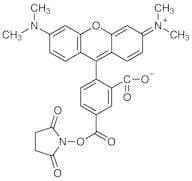
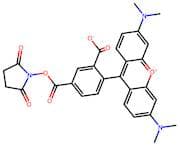
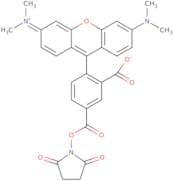
CAS 150810-68-7
:Éster N-hidroxisuccinimida de 6-carboxitetrametilrodamina
- Xanthylium, 9-2-carboxy-4-(2,5-dioxo-1-pyrrolidinyl)oxycarbonylphenyl-3,6-bis(dimethylamino)-, inner salt
- 5-Carboxytetramethylrhodamine
- 5-Tamra,Se
- 2-[6-(dimethylamino)-3-(dimethyliminio)-3H-xanthen-9-yl]-5-{[(2,5-dioxopyrrolidin-1-yl)oxy]carbonyl}benzoate
- 5-Carboxytetramethylrhodamine succinimidyl ester
- 5-TAMRA, SE [5-Carboxytetramethylrhodamine, succinimidyl ester] *Single isomer*
- 5-TAMRA-SEor5-TAMRA-NHS
- 2-(3,6-Bis(dimethylamino)xanthylium-9-yl)-5-(((2,5-dioxopyrrolidin-1-yl)oxy)carbonyl)benzoate
- CS-2126
- "4-Carboxytetramethylrhodamine N-succinimidyl ester"
- 6-CARBOXYTETRAMETHYLRHODAMINE N-HYDROXYSUCCINIMIDE ESTER
- 5-TAMRASE
- 5-TAMRA, SE [5-Carboxytetramethylrhodamine, succinimidyl ester] *CAS#: 150810-68-7*
- 5-TAMRA N-succinimidyl ester (5-Carboxy-tetramethylrhodamine N-succinimidyl ester)
- 5-TAMRA,SE, >95%
- Ver mais sinónimos
5-TAMRA SE
CAS:Fórmula:C29H25N3O7Pureza:>90.0%(HPLC)Cor e Forma:Purple to Dark purple to Brown powder to crystalPeso molecular:527.535-TAMRA-SE
CAS:5-TAMRA-SE binds amines, gives stable orange-red fluorescence, exc/em ~546/579nm, pH-insensitive.Fórmula:C29H25N3O7Pureza:97.96%Cor e Forma:SolidPeso molecular:527.535-Carboxytetramethylrhodamine succinimidyl ester
CAS:Fórmula:C29H25N3O7Pureza:95%Cor e Forma:SolidPeso molecular:527.5247Ref: IN-DA001MVZ
1gA consultar2gA consultar5gA consultar10gA consultar5mg81,00€25mg131,00€50mg144,00€100mg175,00€250mg331,00€5(6)-Carboxytetramethylrhodamine N-hydroxysuccinimide ester
CAS:5(6)-Carboxytetramethylrhodamine N-hydroxysuccinimide esterPeso molecular:527.52g/mol5-Carboxytetramethylrhodamine succinimidyl ester
CAS:5-Carboxytetramethylrhodamine succinimidyl ester is a widely employed fluorescent dye (orange/red) that is suitable for different uses. In PCR applications, it has been used as both a reporter at the 5â or as a quencher at the 3â end. TAMRA-labelled oligonucleotides have been used to study interactions with DNA or DNA/protein interactions. It is an excellent fluorescent acceptor for FRET applications with a suitable dye pair. It is used as a protein/antibody labelling agent for structural studies, immunochemistry and flow cytometry. Bioconjugation is generally performed through coupling of the carboxylic acid to a primary amine at the N-terminus of a protein, on lysine side chains or amino-modified oligonucleotide. Carboxylic acids that are activated with succinimidyl esters react with primary amines.
Fórmula:C29H25N3O7Pureza:Min. 95 Area-%Cor e Forma:Red PowderPeso molecular:527.52 g/mol