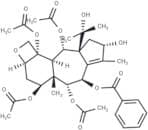
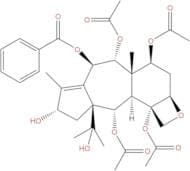
![1H-Azuleno[5',6':3,4]benz[1,2-b]oxete-4,5,6,8,10,10b(2aH)-hexol,3,4,4a,5,6,8,9,9a,10,10a-decahydro…](/_next/image/?url=https%3A%2Fstatic.cymitquimica.com%2Fcas-image%2Fthumb-webp%2F400114-1h-azuleno-5-6-34-benz-12-b-oxete-45681010b-2ah-hexol-344a-56899a-1010a-decahydro-9a-1-hydroxy-1-methylethyl-4a-7-dimethyl-451010b-tetraacetate-6-benzoate-2ar-4s-4as-5r-6r-8s-9as-10s-10ar-10bs.webp&w=3840&q=75)
CAS 153229-31-3
:1H-Azuleno[5',6':3,4]benz[1,2-b]oxete-4,5,6,8,10,10b(2aH)-hexol,3,4,4a,5,6,8,9,9a,10,10a-decahidro-9a-(1-hidroxi-1-metiletil)-4a,7-dimetil-,4,5,10,10b-tetraacetato 6-benzoato, (2aR,4S,4aS,5R,6R,8S,9aS,10S,10aR,10bS)-
Descrição:
1H-Azuleno[5',6':3,4]benz[1,2-b]oxete-4,5,6,8,10,10b(2aH)-hexol, comumente referido pelo seu número CAS 153229-31-3, é um composto orgânico complexo caracterizado por suas características estruturais únicas, incluindo múltiplos sistemas de anéis fundidos e grupos hidroxila. Este composto pertence a uma classe de moléculas conhecidas por sua potencial atividade biológica, frequentemente exibindo propriedades como antioxidante, anti-inflamatório ou efeitos antimicrobianos. A presença de múltiplos grupos funcionais acetila e benzoato sugere que pode ter solubilidade e estabilidade aprimoradas, o que pode ser vantajoso em aplicações farmacêuticas. A estereoquímica indicada pelo seu nome sistemático sugere arranjos espaciais específicos de átomos que podem influenciar sua reatividade e interação com alvos biológicos. No geral, a estrutura intrincada deste composto e seus grupos funcionais o tornam um tema de interesse na química medicinal e na síntese orgânica, onde entender suas propriedades pode levar ao desenvolvimento de novos agentes terapêuticos.
Fórmula:C35H44O13
Sinónimos:- 1H-Azuleno[5',6':3,4]benz[1,2-b]oxete-4,5,6,8,10,10b(2aH)-hexol,3,4,4a,5,6,8,9,9a,10,10a-decahydro-9a-(1-hydroxy-1-methylethyl)-4a,7-dimethyl-,4,5,10,10b-tetraacetate 6-benzoate, [2aR-(2aa,4b,4ab,5a,6b,8a,9ab,10a,10aa,10ba)]-
- 13-Decinnamoyltaxchinin B
- Taxayunnansin A
- Taxayuntin
Ordenar por
Pureza (%)
0
100
|
0
|
50
|
90
|
95
|
100
4 produtos.
Taxayunnansin A
CAS:Taxayunnansin A has anticancer activity.Fórmula:C35H44O13Pureza:98%Cor e Forma:SolidPeso molecular:672.72Taxayunnansin A
CAS:Taxayunnansin A is a diterpenoid alkaloid, which is derived from the plant Delphinium anthriscifolium var. savatieri. This compound exhibits its biological effects primarily through modulation of inflammatory pathways, potentially by interacting with specific cellular receptors and enzymes involved in inflammation. Taxayunnansin A has been studied for its anti-inflammatory properties, which are of significant interest in the treatment of inflammatory diseases. Its potential to act as a neuroprotective agent also indicates promising applications in neurodegenerative disorders. These effects are in part attributed to its influence on cellular signaling pathways that regulate cell survival and apoptosis. Current research is focused on elucidating the precise molecular mechanisms of Taxayunnansin A and exploring its efficacy in various biological models, which could pave the way for the development of new therapeutic strategies in the management of inflammation-related and neurodegenerative conditions.Fórmula:C35H44O13Pureza:Min. 95%Peso molecular:672.7 g/mol