CAS 15483-27-9
:L-arginil-L-arginina
Descrição:
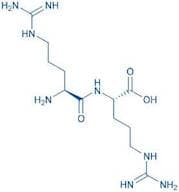
L-arginil-L-arginina, também conhecido como Arg-Arg, é um dipeptídeo composto por dois resíduos do aminoácido L-arginina ligados por uma ligação peptídica. É caracterizado por sua natureza básica devido à presença do grupo guanidínio na cadeia lateral da arginina, que contribui para sua carga positiva em pH fisiológico. Este composto é solúvel em água e exibe uma alta afinidade para se ligar a vários receptores biológicos, tornando-o relevante em estudos bioquímicos e farmacológicos. L-arginil-L-arginina desempenha um papel na síntese de óxido nítrico, uma molécula de sinalização crítica envolvida em vários processos fisiológicos, incluindo vasodilatação e resposta imunológica. Suas aplicações potenciais se estendem a áreas como saúde cardiovascular, cicatrização de feridas e melhoria do desempenho atlético. Além disso, pode servir como substrato para a produção de outros compostos bioativos. Assim como muitos peptídeos, sua estabilidade e biodisponibilidade podem ser influenciadas por fatores como pH e a presença de enzimas. No geral, L-arginil-L-arginina é um composto significativo tanto em contextos de pesquisa quanto terapêuticos.
Fórmula:C12H26N8O3
InChI:InChI=1S/C12H26N8O3/c13-7(3-1-5-18-11(14)15)9(21)20-8(10(22)23)4-2-6-19-12(16)17/h7-8H,1-6,13H2,(H,20,21)(H,22,23)(H4,14,15,18)(H4,16,17,19)/t7-,8-/m0/s1
Chave InChI:InChIKey=OMLWNBVRVJYMBQ-YUMQZZPRSA-N
SMILES:[C@H](NC([C@H](CCCNC(=N)N)N)=O)(CCCNC(=N)N)C(O)=O
Sinónimos:- 108: PN: WO2021061872 SEQID: 108 claimed protein
- 162: PN: EP2161028 PAGE: 9 claimed protein
- 1688: PN: WO2007124090 PAGE: 83 claimed protein
- 204: PN: WO2010059829 SEQID: 221 unclaimed protein
- 43: PN: WO2010045512 SEQID: 41 unclaimed protein
- 43: PN: WO2020027640 SEQID: 106 claimed protein
- 83: PN: US20090175923 SEQID: 83 unclaimed protein
- 83: PN: US20110202000 SEQID: 83 unclaimed protein
- 83: PN: WO2011149461 SEQID: 83 unclaimed protein
- 85-86-Protein TIM-1 (human fragment)
- <span class="text-smallcaps">L</smallcap>-Arginine, <smallcap>L</span>-arginyl-
- <span class="text-smallcaps">L</smallcap>-Arginine, N<sup>2</sup>-<smallcap>L</span>-arginyl-
- <span class="text-smallcaps">L</smallcap>-Arginyl-<smallcap>L</span>-arginine
- Arg-arg
- Arginine, N<sup>2</sup>-<span class="text-smallcaps">L</smallcap>-arginyl-, <smallcap>L</span>-
- Arginyl-L-arginine
- Arginylarginine
- H-Arg-Arg-Oh Acetate Salt
- L-Arginine, N2-L-arginyl-
- N~5~-(diaminomethylidene)-L-ornithyl-N~5~-(diaminomethylidene)-L-ornithine
- N~5~-(diaminomethylidene)ornithyl-N~5~-(diaminomethylidene)ornithine
- Arginine, N2-L-arginyl-, L-
- L-Arginyl-L-arginine
- Ver mais sinónimos
Ordenar por
Pureza (%)
0
100
|
0
|
50
|
90
|
95
|
100
5 produtos.
H-Arg-Arg-OH
CAS:Arginine-containing dipeptides as RR and RF are used by nitric oxide synthase as substrates in place of Arg.Fórmula:C12H26N8O3Pureza:> 98%Cor e Forma:White PowderPeso molecular:330.39H-Arg-Arg-OH Acetate Salt
CAS:Produto ControladoFórmula:C12H26N8O3Cor e Forma:NeatPeso molecular:330.387H-Arg-Arg-OH acetate salt
CAS:H-Arg-Arg-OH acetate salt is a protease inhibitor. It has been shown to inhibit the activity of serine proteases, such as trypsin and chymotrypsin, in vitro. H-Arg-Arg-OH acetate salt binds to the active site of the enzyme and prevents substrate binding. The acidity of the environment where this inhibitor is active can be used to control its activity. At acidic pH, H-Arg-Arg-OH acetate salt is more potent than at neutral pH. When it comes into contact with a protein substrate, H-Arg-Arg-OH acetate salt will bind to a hydroxyl group on the protein molecule and prevent it from hydrolyzing its substrate. This process can be reversed by adding an alkaline buffer to increase the pH of the system or by adding an acid buffer to decrease it.br>br> H-Arg-Arg-OH acetate salt is found in cyanobFórmula:C12H26N8O3Pureza:Min. 95%Peso molecular:330.39 g/mol