CAS 156251-01-3
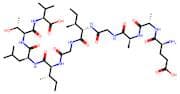
:H-GLU-ALA-ALA-GLY-ILE-GLY-ILE-LEU-THR-VAL-OH
Descrição:
A substância química com o nome "H-GLU-ALA-ALA-GLY-ILE-GLY-ILE-LEU-THR-VAL-OH" e número CAS "156251-01-3" é um peptídeo composto por uma sequência de aminoácidos. Este peptídeo apresenta uma combinação de resíduos hidrofílicos e hidrofóbicos, o que pode influenciar sua solubilidade e interação com membranas biológicas. A presença de ácido glutâmico (GLU) introduz uma cadeia lateral carregada negativamente, enquanto os aminoácidos de cadeia ramificada como a isoleucina (ILE) e a leucina (LEU) contribuem para seu caráter hidrofóbico. O grupo hidroxila terminal (OH) sugere que pode ter algumas características polares, potencialmente aumentando sua solubilidade em ambientes aquosos. Peptídeos como este podem desempenhar papéis significativos em processos biológicos, incluindo sinalização, atividade enzimática e funções estruturais em proteínas. A sequência e composição específicas também podem afetar sua atividade biológica, estabilidade e potenciais aplicações em farmacêutica ou biotecnologia. Compreender as propriedades de tais peptídeos é crucial para sua utilização em contextos de pesquisa e terapêuticos.
Fórmula:C42H74N10O14
Sinónimos:- Glu-Ala-Ala-Gly-Ile-Gly-Ile-Leu-Thr-Val
- Eaagigiltv
- Antigen Sk29-Aa (26-35) (Human)
- Antigen Lb39-Aa (26-35) (Human)
- Mart 1 (26-35)
- Mart-1 (26-35) (Human)
- Melanoma Antigen Recognized By T-Cells 1 (26-35) (Human)
Ordenar por
Pureza (%)
0
100
|
0
|
50
|
90
|
95
|
100
6 produtos.
MART-1 (26-35) (human)
CAS:MART-1 (26-35) has been shown to be better recognized by a number of polyclonal and monoclonal populations of tumor-reactive HLA-A*0201-restricted cytotoxic T lymphocytes (CTL) than MART-1 (27-35) (human).Fórmula:C42H74N10O14Pureza:96.7%Cor e Forma:WhitePeso molecular:943.11MART-1 (26-35) (human)
CAS:MART-1 (26-35) (human) (MART-1 (26-35) human) is a peptide fragment of MART-1 protein.Fórmula:C42H74N10O14Pureza:>99.99%Cor e Forma:SolidPeso molecular:943.1MART-1 (26-35)
CAS:Native Melan-A (26-35) decapeptide derives from the melanocyte lineage-specific protein Melan-A/MART-1, which is expressed in almost 75-100% of primary and metastatic melanomas. The region 26-35 of Melan-A protein acts as an antigenic peptide that is recognized by CD8+ tumor-reactive cytolytic T lymphocytes (CTLs) for designing antigen-specific cancer vaccines1. It has been shown that CD8+ Melan-A-specific CTLs isolated from melanoma patients efficiently lyse the Melan-A-expressing HLA-A*0201+ melanoma cell line. However, CTLs preferentially recognize the Melan-A (26-35) peptide as compared with the Melan-A (27-35) peptide. Moreover, the Melan-A (26-35) A27L analog (ELAGIGILTV) has a higher binding affinity to HLA-A*0201 than the native Melan-A (26-35) peptide (EAAGIGILTV), and consequently displays more potent antigenicity and immunogenicity. It has been reported that the concentration of Melan-A (26-35) A27L analog required to obtain 50% of maximal antigenic activity (EC50) is 0.01nM, whereas that of the native Melan-A (26-35) peptide is 0.25nM1. Therefore, the relative activity of Melan-A (26-35) A27L analog is 25 fold higher than that of the native Melan-A (26-35) peptide. Furthermore, functional competition assay has shown that the concentration of Melan-A (26-35) A27L analog required to achieve 50% inhibition (IC50) of tumor lysis is 2nM, which is 10 fold lower than that of the native Melan-A (26-35) peptide. Regarding peptide stability in human serum, the half-lifes (t1/2) of the native Melan-A (26-35) peptide and the A27L analog are quite similar (45 and 40min, respectively) as measured by HPLC-ESI-MS, but much higher than that of the Melan-A (27-35) nonapeptide (5min).Fórmula:C42H74N10O14Cor e Forma:PowderPeso molecular:943.1 g/molMART-1 (26-35) (human)
CAS:Native Melan-A (26-35) decapeptide derives from the melanocyte lineage-specific protein Melan-A/MART-1, which is expressed in almost 75-100% of primary and metastatic melanomas. The region 26-35 of Melan-A protein acts as an antigenic peptide that is recognized by CD8+ tumor-reactive cytolytic T lymphocytes (CTLs) for designing antigen-specific cancer vaccines1. It has been shown that CD8+ Melan-A-specific CTLs isolated from melanoma patients efficiently lyse the Melan-A-expressing HLA-A*0201+ melanoma cell line. However, CTLs preferentially recognize the Melan-A (26-35) peptide as compared with the Melan-A (27-35) peptide. Moreover, the Melan-A (26-35) A27L analog (ELAGIGILTV) has a higher binding affinity to HLA-A*0201 than the native Melan-A (26-35) peptide (EAAGIGILTV), and consequently displays more potent antigenicity and immunogenicity. It has been reported that the concentration of Melan-A (26-35) A27L analog required to obtain 50% of maximal antigenic activity (EC50) is 0.01nM, whereas that of the native Melan-A (26-35) peptide is 0.25nM1. Therefore, the relative activity of Melan-A (26-35) A27L analog is 25 fold higher than that of the native Melan-A (26-35) peptide. Furthermore, functional competition assay has shown that the concentration of Melan-A (26-35) A27L analog required to achieve 50% inhibition (IC50) of tumor lysis is 2nM, which is 10 fold lower than that of the native Melan-A (26-35) peptide. Regarding peptide stability in human serum, the half-lifes (t1/2) of the native Melan-A (26-35) peptide and the A27L analog are quite similar (45 and 40min, respectively) as measured by HPLC-ESI-MS, but much higher than that of the Melan-A (27-35) nonapeptide (5min).Fórmula:C42H74N10O14Peso molecular:943.11 g/molMART-1 (26-35) (human) trifluoroacetate salt
CAS:Native Melan-A (26-35) decapeptide derives from the melanocyte lineage-specific protein Melan-A/MART-1, which is expressed in almost 75-100% of primary and metastatic melanomas. The region 26-35 of Melan-A protein acts as an antigenic peptide that is recognized by CD8+ tumor-reactive cytolytic T lymphocytes (CTLs) for designing antigen-specific cancer vaccines1. It has been shown that CD8+ Melan-A-specific CTLs isolated from melanoma patients efficiently lyse the Melan-A-expressing HLA-A*0201+ melanoma cell line. However, CTLs preferentially recognize the Melan-A (26-35) peptide as compared with the Melan-A (27-35) peptide. Moreover, the Melan-A (26-35) A27L analog (ELAGIGILTV) has a higher binding affinity to HLA-A*0201 than the native Melan-A (26-35) peptide (EAAGIGILTV), and consequently displays more potent antigenicity and immunogenicity. It has been reported that the concentration of Melan-A (26-35) A27L analog required to obtain 50% of maximal antigenic activity (EC50) is 0.01nM, whereas that of the native Melan-A (26-35) peptide is 0.25nM1. Therefore, the relative activity of Melan-A (26-35) A27L analog is 25 fold higher than that of the native Melan-A (26-35) peptide. Furthermore, functional competition assay has shown that the concentration of Melan-A (26-35) A27L analog required to achieve 50% inhibition (IC50) of tumor lysis is 2nM, which is 10 fold lower than that of the native Melan-A (26-35) peptide. Regarding peptide stability in human serum, the half-lifes (t1/2) of the native Melan-A (26-35) peptide and the A27L analog are quite similar (45 and 40min, respectively) as measured by HPLC-ESI-MS, but much higher than that of the Melan-A (27-35) nonapeptide (5min).Fórmula:C42H74N10O14Pureza:Min. 95%Peso molecular:943.1 g/mol