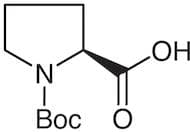
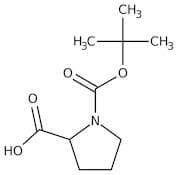
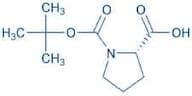
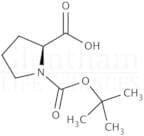
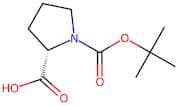
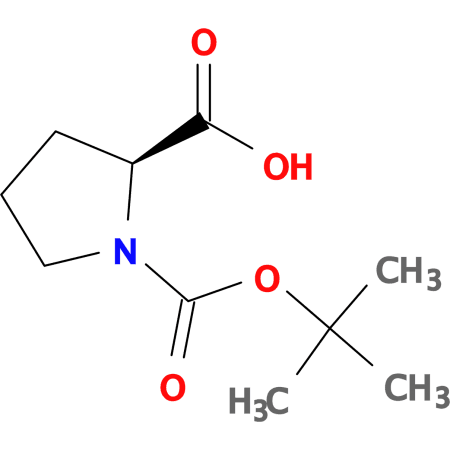
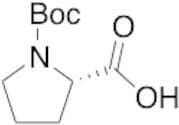
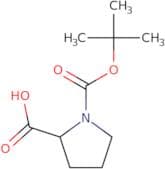
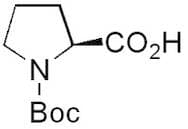
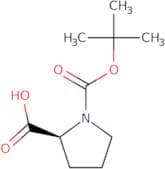
CAS 15761-39-4
:BOC-L-Prolina
- (2S)-1,2-Pyrrolidinedicarboxylic acid 1-(1,1-dimethylethyl) ester
- (2S)-1-(tert-butoxycarbonyl)pyrrolidine-2-carboxylate
- (2S)-1-Boc-pyrrolidine-2-carboxylic acid
- (2S)-1-[(2-Methylpropan-2-yl)oxycarbonyl]pyrrolidine-2-carboxylic acid
- (2S)-1-tert-Butoxycarbonylpyrrolidine-2-carboxylic acid
- (S)-1,2-Pyrrolidinedicarboxylic acid 1-(1,1-dimethylethyl) ester
- (S)-1-(tert-Butoxycarbonyl)-2-pyrrolidinecarboxylic acid
- (S)-1-Boc-β-proline
- (S)-N-tert-Butoxycarbonylproline
- (S)-Pyrrolidine-1,2-dicarboxylic acid 1-tert-butyl ester
- 1,2-Pyrrolidinedicarboxylic acid, 1-(1,1-dimethylethyl) ester, (2S)-
- 1,2-Pyrrolidinedicarboxylic acid, 1-(1,1-dimethylethyl) ester, (S)-
- 1,2-Pyrrolidinedicarboxylic acid, 1-tert-butyl ester, <span class="text-smallcaps">L</span>-
- 1,2-Pyrrolidinedicarboxylic acid, 1-tert-butyl ester, L-
- 1-(Tert-Butoxycarbonyl)Proline
- 1-(tert-Butoxycarbonyl)-(2S)-pyrrolidine-2-carboxylic acid
- 1-(tert-Butoxycarbonyl)-(S)-proline
- 1-(tert-Butyl)hydrogen-(S)-pyrrolidin-1,2-dicarboxylat
- 1-(tert-butoxycarbonyl)-L-proline
- 1-(tert-butyl) hydrogen (S)-pyrrolidine-1,2-dicarboxylate
- 1-Boc-L-Proline
- 1-tert-Butoxycarbonyl-<span class="text-smallcaps">L</span>-proline
- 1-tert-Butyl (S)-pyrrolidine-1,2-dicarboxylate
- 1-tert-Butyloxycarbonyl-<span class="text-smallcaps">L</span>-proline
- 1-tert-Butyloxycarbonyl-L-proline
- <span class="text-smallcaps">L</span>-N-Boc-proline
- BOC-<span class="text-smallcaps">L</span>-Proline
- Boc-<span class="text-smallcaps">L</span>-Pro
- Boc-L-Pro-OH
- Boc-Pro-OH
- Hydrogeno-(S)-pyrrolidine-1,2-dicarboxylate de 1-(tert-butyle)
- L-N-Boc-proline
- N-(t-Butoxycarbonyl)proline
- N-(tert-Butoxycarbonyl)-(S)-proline
- N-(tert-Butoxycarbonyl)-<span class="text-smallcaps">L</span>-proline
- N-(tert-Butoxycarbonyl)-L-proline
- N-(tert-Butoxycarbonyl)proline
- N-(tert-Butyloxycarbonyl)-<span class="text-smallcaps">L</span>-proline
- N-(tert-Butyloxycarbonyl)-L-proline
- N-Boc-(S)-proline
- N-Boc-<span class="text-smallcaps">L</span>-proline
- N-Boc-L-proline
- N-[(1,1-Dimethylethoxy)carbonyl]-(S)-proline
- N-alpha-tert-BOC-L-proline
- Nsc 164660
- hidrogeno-(S)-pirrolidina-1,2-dicarboxilato de 1-(terc-butilo)
- tert-Butoxycarbonyl-L-proline
- tert-Butyloxycarbonyl-L-proline
- trans-N-(tert-Butoxycarbonyl)-4-hydroxy-<span class="text-smallcaps">L</span>-proline
- BOC-L-PROLINE-OH
- N-ALPHA-T-BUTOXYCARBONYL-L-PROLINE
- BOC-L-PRO
- N-ALPHA-TERT-BUTYLOXYCARBONYL-L-PROLINE
- N-T-BOC-L-PROLINE
- BOC-L-PROLINE
- N-ALPHA-T-BOC-L-PROLINE
- BOC-PRO
- N-T-BUTOXYCARBONYL-L-PROLINE
- BOC-PYRD(2)-OH
- N-(TERT-BUTOXYCARBONYL)-L-PROILNE
- N-ALPHA-T-BUTOXYCARBONYL-L-PYRROLIDINE-2-CARBOXYLIC ACID
- Ver mais sinónimos
N-(tert-Butoxycarbonyl)-L-proline
CAS:Fórmula:C10H17NO4Pureza:>99.0%(T)Cor e Forma:White to Almost white powder to crystalPeso molecular:215.25N-Boc-L-proline, 99%
CAS:N-Boc-L-proline is used as an intermediate in organic synthesis. It is also used to prepare daclatasvir, which inhibits the hepatitis C virus (HCV) non-structural 5A (NS5A) protein. Further, it is used as a drug in the treatment of hepatitis C virus (HCV). This Thermo Scientific Chemicals brand prod
Fórmula:C10H17NO4Pureza:99%Cor e Forma:Crystals or powder or crystalline powder, WhitePeso molecular:215.25Boc-Pro-OH
CAS:Bachem ID: 4000220.
Fórmula:C10H17NO4Pureza:> 99%Cor e Forma:WhitePeso molecular:215.25N-(tert-Butoxycarbonyl)-L-proline
CAS:Fórmula:C10H17NO4Pureza:97%Cor e Forma:SolidPeso molecular:215.2463(2S)-Pyrrolidine-2-carboxylic acid, N-BOC protected
CAS:(2S)-Pyrrolidine-2-carboxylic acid, N-BOC protectedFórmula:C10H17NO4Pureza:99%Cor e Forma: white solidPeso molecular:215.25g/molN-Boc-L-proline
CAS:Produto ControladoApplications N-Boc-L-proline is a useful synthetic intermediate. It is used to synthesize Daclatasvir (D101500) which nhibits the HCV protein NS5A. Daclatasvir (D101500) can be used as a drug candidate for the treatment of hepatitis C (HCV).
References Gao, M., et al.: Nature, 465(7294), 96 (2010); Bell, T. W., Chem. Med. Chem., 5(10), 1663 (2010);Fórmula:C10H17NO4Cor e Forma:NeatPeso molecular:215.25Boc-Pro-OH
CAS:Boc-Pro-OH is a synthetic amino acid that is used in the preparation of samples for gas chromatography. Boc-Pro-OH has antiinflammatory activity, and can be used to treat cancer. It is also used as an intermediate in the synthesis of amides, which are important in pharmaceuticals. Boc-Pro-OH is soluble in water and carbonate buffer solutions, but insoluble in ethanol. The chemical structure of this molecule is unusual because it contains a Boc group.
Fórmula:C10H17NO4Pureza:Min. 95%Peso molecular:215.25 g/molBOC-L-Proline extrapure, 99%
CAS:Fórmula:C10H17NO4Pureza:min. 99%Cor e Forma:White, Crystalline powderPeso molecular:215.30N-Boc-L-proline
CAS:N-Boc-L-proline is a proline derivative that has been synthesized as a drug candidate for cancer treatment. It has been shown to inhibit the activity of the enzyme, buserelin, which is involved in the synthesis of histamine and other substances. N-Boc-L-proline has also been shown to cause neuronal death by hydrogen bond formation with nitrogen nucleophiles in the brain, leading to apoptosis. The chromatographic method was used to analyze reaction products from N-Boc-L-proline with sodium carbonate. This compound has solubility data and an intramolecular hydrogen bond that can be detected by nmr spectroscopy. Trifluoroacetic acid was used as a solvent for this experiment.Fórmula:C10H17NO4Pureza:Min. 95%Cor e Forma:White PowderPeso molecular:215.25 g/mol