CAS 1596-67-4
:L-tironina
Descrição:
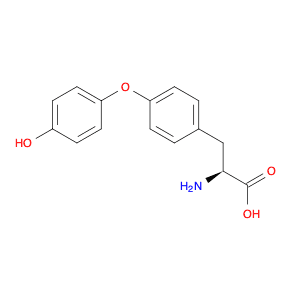
L-tironina, também conhecido como L-T4 ou tiroxina, é uma forma sintética do hormônio tireoidiano tiroxina, que desempenha um papel crucial na regulação do metabolismo, crescimento e desenvolvimento no corpo. É um pó cristalino branco a off-white que é solúvel em água e tem um sabor ligeiramente amargo. A fórmula química de L-tironina é C15H11I4NNaO4, e contém iodo, que é essencial para sua atividade biológica. L-tironina é usado principalmente no tratamento do hipotireoidismo e certos tipos de bócio, pois ajuda a restaurar os níveis normais de hormônio tireoidiano. Seu mecanismo de ação envolve a ligação aos receptores de hormônios tireoidianos, influenciando a expressão gênica e os processos metabólicos. A substância é tipicamente administrada por via oral e é bem absorvida no trato gastrointestinal. Os efeitos colaterais podem incluir sintomas de hipertireoidismo se houver overdose. Devido à sua importância na função tireoidiana, L-tironina é um agente terapêutico crítico em endocrinologia.
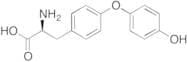
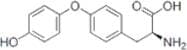
Fórmula:C15H15NO4
InChI:InChI=1/C15H15NO4/c16-14(15(18)19)9-10-1-5-12(6-2-10)20-13-7-3-11(17)4-8-13/h1-8,14,17H,9,16H2,(H,18,19)
Chave InChI:InChIKey=KKCIOUWDFWQUBT-AWEZNQCLSA-N
SMILES:O(C1=CC=C(C[C@@H](C(O)=O)N)C=C1)C2=CC=C(O)C=C2
Sinónimos:- <span class="text-smallcaps">L</span>-Thyronine
- <span class="text-smallcaps">L</span>-Tyrosine, O-(4-hydroxyphenyl)-
- Desiodothyroxine
- O-(4-Hydroxyphenyl)-<span class="text-smallcaps">L</span>-tyrosine
- O-(4-Hydroxyphenyl)-L-tyrosine
- O-(4-Hydroxyphenyl)tyrosine
- Thyronine
- Thyronine, <span class="text-smallcaps">L</span>-
- β-(p-Hydroxyphenoxy)phenylalanine
- L-Thyronine
- L-Tyrosine, O-(4-hydroxyphenyl)-
- Thyronine, L-
- 3-[P-(P-HYDROXYPHENOXY)PHENYL]-L-ALANINE
- TYROSINE(4-HYDROXYPHENYL)-OH
- ALPHA-AMINO-BETA-(4-HYDROXYPHENOXYPHENYL) PROPIONIC ACID
- H-4-(4-HYDROXYPHENOXY)-PHE-OH
- H-TYR(4-HYDROXYPHENYL)-OH
- H-BETA-[4-(4-HYDROXYPHENOXY)-PHENYL]-ALA-OH
- S-THYRONINE
- H-THY-OH
- H-4-(4-Htdroxyphenoxy)-Phe-OH
- A-AMINO-B-(4-HYDROXYPHENOXYPHENYL) PROPIONIC ACID
- Ver mais sinónimos
Ordenar por
Pureza (%)
0
100
|
0
|
50
|
90
|
95
|
100
8 produtos.
L-Tyrosine, O-(4-hydroxyphenyl)-
CAS:Fórmula:C15H15NO4Pureza:98%Cor e Forma:SolidPeso molecular:273.2839L-Thyronine
CAS:L-Thyronine is a hormone that is synthesized in the thyroid gland and has a variety of biological functions. It is used to treat congestive heart failure, atherosclerosis, and other types of heart disease. L-Thyronine binds to receptors on cells and activates them, which stimulates production of energy for the cell. L-Thyronine also increases the number of mitochondria in cells and regulates the production of nitric oxide, which plays an important role in vascular relaxation. L-Thyronine can be administered orally or intravenously as a solution. The clinical response to treatment is evaluated by measurement of serum thyroxin levels before and after administration of L-Thyronine.Fórmula:C15H15NO4Pureza:Min. 95%Cor e Forma:PowderPeso molecular:273.28 g/molL-Thyronine, 95%
CAS:Applications L-Thyronine is a type of thyroid hormone. Thyroid hormones are important regulators of growth and maturation before birth in mammals.
References Harris, Shelley E., et al.: J. Physiol., 595, 3331 (2017);Fórmula:C15H15NO4Pureza:95%Cor e Forma:NeatPeso molecular:273.28L-Thyronine-13C6
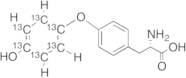
CAS:Produto ControladoApplications L-Thyronine-13C6 is a labeled version of L-Thyronine (T922700). L-Thyronine (T922700) can be used in biological study for hyperphosphatemia, phosphoprotein phosphatases, and microparticle release in vascular endothelial cells.
References Abbasian, N., et al.: J. Am. Soc. Nephrol., 26, 2152-2162 (2016);Fórmula:C6C9H15NO4Cor e Forma:NeatPeso molecular:279.24