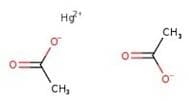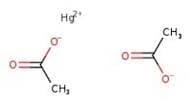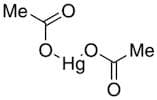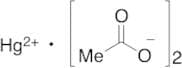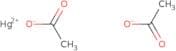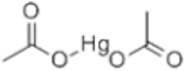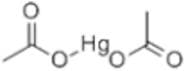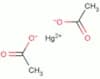
CAS 1600-27-7
:Acetato de mercúrio
- Acetate, Mercury (Ii)
- Acetate, Mercury Salt
- Acetate, Mercury Salt (1:1)
- Acetic acid, mercuridi-
- Acetic acid, mercury salt
- Acetic acid, mercury(2+) salt
- Acetic acid, mercury(2+) salt (2:1)
- Aceticacid,mercury(2+)salt
- Ai3-04458
- Bis(Acetyloxy)Mercury
- Di(Acetato) De Mercurio
- Di(acetate) de mercure
- Diacetoxymercury
- Epapesticidechemicalcode052104
- Mercuriacetate
- Mercuric Acetate
- Mercuric diacetate
- Mercuric(II) acetate
- Mercuricdiacetate
- Mercury - Acetic Acid (1:2)
- Mercury Di(Acetate)
- Mercury Diacetate
- Mercury acetate (Hg(O2C2H3)2)
- Mercury acetate (Hg(O<sub>2</sub>C<sub>2</sub>H<sub>3</sub>)<sub>2</sub>)
- Mercury ii acetate
- Mercury(2+) acetate
- Mercury(II) diacetate
- Quecksilberdi(acetat)
- Ver mais sinónimos
Mercury(II) acetate, 98+%
CAS:Mercury(II) acetate is used as a reagent to prepare organomercury compounds and to remove the acetamidomethyl protecting group in organic synthesis. It is also involved in the oxymercuration reactions as well as to prepare dithiocarbonates from thiocarboantes.It finds application as a catalyst in orFórmula:C4H6HgO4Pureza:98+%Cor e Forma:White, PowderPeso molecular:318.68Mercury(II) acetate, ACS, 98.0% min
CAS:Mercuric acetate is used as an oxidizing agent in organic synthesis. It is used in oxymercuration of double bonds. Mercuric acetate is used in non-aqueous titration. It is employed in the manufacture of phenyl mercury compounds which have pharmaceutical applications. It removes the acetamidomethFórmula:C4H6HgO4Pureza:98.0%Peso molecular:318.68Reagecon Mercury (II) Acetate 0.05 g/mL in Acetic Acid Analytical Volumetric Solution (AVL)
CAS:Reagecon's Mercury (II) Acetate 0.05 g/mL in Acetic Acid Analytical Volumetric Solution (AVL) is a fully factorised, high purity, stable product, developed and tested for titrations. This Analytical Volumetric Solution, also called titrant, standard titrant or standard solution, is tested to a specification of ± 0.1%. It is a reagent of known concentration, that is dispensed from a burette or other dispensing apparatus to a sample (analyte), until a reaction between the two liquids is judged to be complete. The product may be used for manual titrations, or more commonly automatic titrations, to determine the end points by detection of any of several properties. - Titration is a rapid, economical and versatile analytical tool. This Reagecon titrant is accurate, stable, reproducible and fully factorised. Titrations performed with this product, exhibit defined stoichiometry, are quantitative, establish an equilibrium that is definitive and fast and provide unambiguous results. Stability is proven (either opened or unopened) for the shelf life of this product.Cor e Forma:LiquidMercury(II) acetate, 98.5+%
CAS:Fórmula:C4H6HgO4Pureza:≥ 98.5%Cor e Forma:White powderPeso molecular:318.68Mercury(II) acetate, 98%
CAS:Mercury(II) acetate, 98%
Fórmula:Hg(OOCCH3)2Pureza:98%Cor e Forma:white to light yellow pwdr.Peso molecular:318.68Mercury(II) Acetate
CAS:Produto ControladoApplications Mercury(II) acetate is a reagent that is used in the investigation of diastereoselective acyclic α-alkoxydithioacetal substitutions involving thiacarbenium intermediates.
Not a dangerous good if item is equal to or less than 1g/ml and there is less than 100g/ml in the package
References Prevost, M., et al.: J. Org. Chem. 79, 10504 (2014);Fórmula:C4H6HgO4Cor e Forma:NeatPeso molecular:318.68Mercuric acetate
CAS:Produto ControladoMercuric acetate is a salt of mercuric and acetic acid. It is used as an antiseptic, disinfectant, and preservative in the food industry. Mercuric acetate has been shown to have anti-inflammatory properties and is used for the treatment of inflammatory bowel disease. The ester linkage between the two molecules allows it to be hydrolysed into its components by enzymes such as esterases or glucuronidases, which may be one of the reasons for its therapeutic effects. Mercuric acetate also reacts with biological molecules, including proteins, nucleic acids, and carbohydrates. This reaction mechanism may contribute to its other biological properties such as lowering blood sugar levels and inhibiting glycolysis in cells that depend on sodium-dependent glucose transport mechanisms.
Fórmula:C4H6HgO4Pureza:Min. 95%Peso molecular:318.68 g/molMercuric Acetate ACS, ExiPlus, Multi-Compendial, 98%
CAS:Fórmula:C4H6HgO4Pureza:min. 98%Cor e Forma:White, Crystalline powder, Clear to slight hazyPeso molecular:318.68Mercuric Acetate pure, 98%
CAS:Fórmula:C4H6HgO4Pureza:min. 98%Cor e Forma:White to off white to slight yellow, Crystalline powder, Clear to slight hazyPeso molecular:318.68