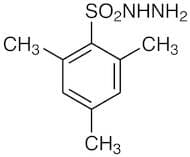
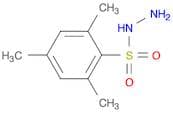
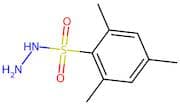
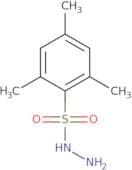
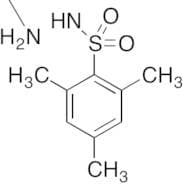
CAS 16182-15-3
:Ácido benzenossulfônico, 2,4,6-trimetil-, hidrazida
- (2,4,6-Trimethylbenzenesulfonyl)hydrazine
- (Mesitylsulfonyl)hydrazine
- 2,4,6-Trimethylbenzene-1-sulfonohydrazide
- 2,4,6-Trimethylbenzenesulfonic acid hydrazide
- 2,4,6-Trimethylbenzenesulfonohydrazide
- 2-Mesitylenesulfonic acid, hydrazide
- 2-Mesitylenesulfonohydrazide
- Benzenesulfonic acid, 2,4,6-trimethyl-, hydrazide
- MSH
- Mesitylenesulfonic hydrazide
- Mesitylenesulfonohydrazide
- Mesitylenesulfonyl hydrazide
- N-(2,4,6-Trimethylphenylsulfonyl)hydrazine
- Ver mais sinónimos
2-Mesitylenesulfonyl Hydrazide
CAS:Fórmula:C9H14N2O2SPureza:>97.0%(T)Cor e Forma:White to Almost white powder to crystalPeso molecular:214.28Benzenesulfonic acid, 2,4,6-trimethyl-, hydrazide
CAS:Fórmula:C9H14N2O2SPureza:97%Cor e Forma:SolidPeso molecular:214.28472,4,6-Trimethylbenzenesulfonohydrazide
CAS:2,4,6-TrimethylbenzenesulfonohydrazidePureza:98%Peso molecular:214.28g/mol2,4,6-Trimethylbenzenesulfonohydrazide
CAS:2,4,6-Trimethylbenzenesulfonohydrazide is a hydrazide that has been shown to have the ability to reduce the level of vitamin D3 in the body. It binds with chloride ions and hydroxyl groups on furan rings and hydrogenates them. This reaction leads to an increase in the amount of 2,4,6-trimethylbenzenesulfonic acid (2,4,6-TMS) and a decrease in vitamin D3. The physiological activity of 2,4,6-TMS is unknown; however it has been shown to react with sodium hypochlorite to form hydroxyl radicals. Hydroxyl radicals are known for their strong oxidizing properties and can be used in medicine as antibiotics. Hydroxyl radicals also react with cyclic compounds like phenols or amines leading to alkylation reactions that may lead to DNA damage or cancer cell death.
Fórmula:C9H14N2O2SPureza:Min. 95%Peso molecular:214.29 g/mol2,4,6-Trimethylbenzenesulfonohydrazide
CAS:Fórmula:C9H14N2O2SPureza:95%Cor e Forma:SolidPeso molecular:214.282,4,6-Trimethylbenzenesulfonohydrazide
CAS:Produto ControladoApplications 2,4,6-Trimethylbenzenesulfonohydrazide is a reagent that generates intermediates for organic synthesis, and is applied mainly in the formation of diazine, hyrazones, Eschenmoser fragmentation and regioselective sulfonylation of pyridine/quinoline.
Not a dangerous good if item is equal to or less than 1g/ml and there is less than 100g/ml in the package
References Wang, R., et al.: Org. Biomol. Chem., 14, 5317 (2016); Chamberlin, A. R., et al.: e-EROS Encyclopedia of Reagents for Organic Synthesis, 1 (2001)Fórmula:C9H14N2O2SCor e Forma:NeatPeso molecular:214.28