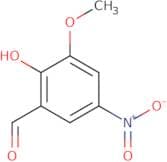
CAS 17028-61-4
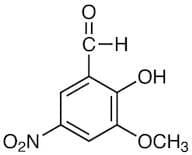
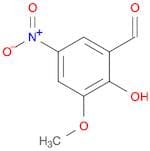
:2-Hidroxi-3-metoxi-5-nitrobenzaldeído
- 3-Methoxy-5-nitrosalicylaldehyde
- 2-Formyl-6-Methoxy-4-Nitrophenolate
2-Hydroxy-5-nitro-m-anisaldehyde
CAS:Fórmula:C8H7NO5Pureza:>99.0%(GC)(T)Cor e Forma:Light orange to Yellow to Green powder to crystalPeso molecular:197.152-Hydroxy-3-methoxy-5-nitrobenzaldehyde, 98%
CAS:2-Hydroxy-3-methoxy-5-nitrobenzaldehyde is used for the syntheses of zinc-selective spiropyran-based fluorescent and photoregenerable receptor, (E)-2,4-dihydroxy-N?-(2-hydroxy-3-methoxy-5-nitrobenzylidene)benzohydrazide dihydrate, ethyl 4-(8-methoxy-3?,3?-dimethyl-6-nitrospiro[chromene-2,2?-indoline
Fórmula:C8H7NO5Pureza:98%Cor e Forma:Powder, Cream to yellow or brown or grey to grey/greenPeso molecular:197.152-Hydroxy-3-methoxy-5-nitrobenzaldehyde
CAS:Fórmula:C8H7NO5Pureza:98%Cor e Forma:SolidPeso molecular:197.14492-Hydroxy-3-methoxy-5-nitrobenzaldehyde
CAS:2-Hydroxy-3-methoxy-5-nitrobenzaldehydePureza:98%Peso molecular:197.14g/mol2-Hydroxy-3-methoxy-5-nitrobenzaldehyde
CAS:2-Hydroxy-3-methoxy-5-nitrobenzaldehyde (2HMOBA) is a molecule that has been studied computationally and experimentally. The antibacterial activity of this molecule is due to its ability to bind to metal ions, such as Cu(II), Fe(III), and Mn(IV). It also undergoes photochromism in the presence of light. 2HMOBA has been shown to bind to the hydroxyl group of salicylaldehyde, which may be responsible for its binding affinity. 2HMOBA binds with a higher affinity than salicylaldehyde does, which could be due to the benzyl group on this molecule. In functional theory, 2HMOBA can be interpreted as an electron donor or acceptor.
Fórmula:C8H7NO5Pureza:Min. 97.5 Area-%Cor e Forma:PowderPeso molecular:197.14 g/mol2-Hydroxy-3-methoxy-5-nitrobenzaldehyde
CAS:Fórmula:C8H7NO5Pureza:98%Cor e Forma:Solid, Slightly pale yellow to yellow powderPeso molecular:197.146