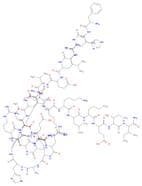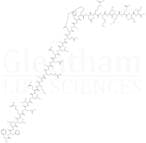
CAS 170809-51-5
:astressina
Descrição:
astressina, com o número CAS 170809-51-5, é um peptídeo sintético que atua como um antagonista do fator liberador de corticotropina (CRF). É utilizado principalmente em pesquisas para estudar o papel do CRF nas respostas ao estresse e em processos fisiológicos relacionados. astressina é caracterizado por sua capacidade de inibir as ações do CRF, que está envolvido no eixo hipotálamo-hipófise-adrenal (HPA) e desempenha um papel crucial na resposta do corpo ao estresse. O peptídeo é tipicamente administrado em ambientes experimentais para investigar seus efeitos sobre ansiedade, depressão e outros distúrbios relacionados ao estresse. A estrutura de astressina consiste em uma sequência de aminoácidos que confere sua atividade biológica, e é frequentemente utilizado em modelos animais para explorar aplicações terapêuticas potenciais. Devido à sua ação específica sobre os receptores de CRF, astressina é valioso em estudos farmacológicos destinados a entender os mecanismos do estresse e desenvolver tratamentos para condições relacionadas ao estresse.
Fórmula:C161H269N49O42
InChI:InChI=1/C161H269N49O42/c1-23-27-41-96(189-145(239)107(52-59-123(217)218)199-152(246)114(71-84(13)14)207-157(251)126(85(15)16)208-147(241)108(53-60-124(219)220)197-140(234)102(47-38-66-179-161(172)173)193-151(245)112(69-82(9)10)204-153(247)113(70-83(11)12)205-155(249)116(74-94-77-175-79-181-94)201-134(228)95(163)72-92-39-30-29-31-40-92)135(229)182-88(19)130(224)186-100(45-36-64-177-159(168)169)136(230)183-89(20)131(225)188-106(51-58-122(215)216)144(238)195-104(49-56-119(165)212)146(240)202-110(67-80(5)6)149(243)185-90(21)132(226)187-103(48-55-118(164)211)143(237)196-105-50-57-121(214)176-63-35-33-44-99(192-154(248)115(73-93-76-174-78-180-93)200-133(227)91(22)184-137(105)231)142(236)206-117(75-120(166)213)156(250)194-101(46-37-65-178-160(170)171)139(233)190-98(43-32-34-62-162)141(235)203-111(68-81(7)8)150(244)191-97(42-28-24-2)138(232)198-109(54-61-125(221)222)148(242)210-128(87(18)26-4)158(252)209-127(129(167)223)86(17)25-3/h29-31,39-40,76-91,95-117,126-128H,23-28,32-38,41-75,162-163H2,1-22H3,(H2,164,211)(H2,165,212)(H2,166,213)(H2,167,223)(H,174,180)(H,175,181)(H,176,214)(H,182,229)(H,183,230)(H,184,231)(H,185,243)(H,186,224)(H,187,226)(H,188,225)(H,189,239)(H,190,233)(H,191,244)(H,192,248)(H,193,245)(H,194,250)(H,195,238)(H,196,237)(H,197,234)(H,198,232)(H,199,246)(H,200,227)(H,201,228)(H,202,240)(H,203,235)(H,204,247)(H,205,249)(H,206,236)(H,207,251)(H,208,241)(H,209,252)(H,210,242)(H,215,216)(H,217,218)(H,219,220)(H,221,222)(H4,168,169,177)(H4,170,171,178)(H4,172,173,179)/t86-,87-,88-,89-,90-,91-,95+,96-,97-,98-,99-,100-,101-,102-,103-,104-,105-,106-,107-,108-,109-,110-,111-,112-,113-,114-,115-,116-,117-,126-,127-,128-/m0/s1
Sinónimos:- H-D-Phe-His-Leu-Leu-Arg-Glu-Val-Leu-Glu-Nle-Ala-Arg-Ala-Glu-Gln-Leu-Ala-Gln-cyclo(-Glu-Ala-His-Lys)-Asn-Arg-Lys-Leu-Nle-Glu-Ile-Ile-NH2
Ordenar por
Pureza (%)
0
100
|
0
|
50
|
90
|
95
|
100
5 produtos.
Astressin trifluoroacetate salt H-D-Phe-His-Leu-Leu-Arg-Glu-Val-Leu-Glu-Nle-Ala-Arg-Ala-Glu-Gln-Leu-Ala-Gln-cyclo(-Glu-Ala-His-Lys)-Asn-Arg-Lys-Leu-Nle-Glu-Ile-Ile-NH2 trifluoroacetate salt
CAS:Fórmula:C161H269N49O42Pureza:96%Cor e Forma:SolidPeso molecular:3563.1617Astressin
CAS:Astressin is a truncated CRF analog; binds strongly to receptor's extracellular domain, likely acting as a neutral competitive antagonist.Fórmula:C161H269N49O42Pureza:98%Cor e Forma:SolidPeso molecular:3563.16Astressin trifluoroacetate salt
CAS:Astressin trifluoroacetate salt H-D-Phe-His-Leu-Leu-Arg-Glu-Val-Leu-Glu-Nle-Ala-Arg-Ala-Glu-Gln is a cyclic peptide that has been shown to have biological properties as an inhibitor of cyclases. Astressin has shown efficacy in treating some types of autoimmune diseases and bowel diseases, although it is not effective against all types of these disorders. Astressin also has receptor activity and can induce locomotor activity. This compound has been shown to be an inhibitor of the Toll like receptor 4 (TLR4). In this role, astressin blocks the inflammatory response by preventing the binding of endotoxin to TLR4 receptors on cells.Fórmula:C161H269N49O42Pureza:Min. 95%Peso molecular:3,563.16 g/molAstressin
CAS:The Glu³⁰ to Lys³³ lactam bridge constrains astressin in an α-helical conformation which seems to be responsible for its especially high CRF antagonist activity. Astressin is 100 times more potent than α-helical CRF (9-41) at inhibiting ACTH secretion in vitro, and more than 10 times more potent in vivo than any other CRF antagonist reported to date.Fórmula:C161H269N49O42Pureza:97.4%Cor e Forma:White PowderPeso molecular:3563.24