CAS 173833-08-4
:ostabolin
Descrição:
ostabolin, identificado pelo seu número CAS 173833-08-4, é um composto sintético que tem atraído atenção no campo da bioquímica e farmacologia. É conhecido principalmente por suas potenciais propriedades anabólicas, que podem influenciar o crescimento muscular e a densidade óssea. ostabolin é frequentemente categorizado como um modulador seletivo do receptor androgênico (SARM), o que significa que visa seletivamente os receptores androgênicos nos tecidos musculares e ósseos, potencialmente minimizando os efeitos colaterais tipicamente associados aos esteroides anabólicos. O composto é caracterizado por sua capacidade de promover atividade anabólica enquanto reduz os efeitos androgênicos em tecidos não-alvo. Essa seletividade o torna um assunto de interesse para pesquisas sobre tratamentos para condições como perda muscular e osteoporose. No entanto, é importante notar que a segurança, eficácia e efeitos a longo prazo de ostabolin em humanos ainda estão sob investigação, e não é aprovado para uso médico em muitas regiões. Assim como com qualquer produto químico de pesquisa, é aconselhável cautela em relação ao seu uso e possíveis implicações legais.
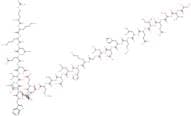
Fórmula:C162H270N50O46S2
InChI:InChI=1/C162H270N50O46S2/c1-21-86(18)130(211-143(240)101(42-47-124(223)224)190-154(251)117(75-215)207-157(254)127(83(12)13)208-133(230)93(168)73-213)159(256)193-100(41-45-119(170)217)139(236)197-107(60-80(6)7)145(242)191-103(49-56-259-19)141(238)202-112(65-89-71-178-77-184-89)149(246)204-113(66-120(171)218)150(247)195-105(58-78(2)3)134(231)182-72-122(220)185-95(35-24-27-51-163)135(232)201-111(64-88-70-177-76-183-88)148(245)198-108(61-81(8)9)146(243)203-114(67-121(172)219)151(248)206-116(74-214)155(252)194-104(50-57-260-20)160(257)258-126(227)48-43-102(192-156(253)128(84(14)15)209-142(239)98(38-31-55-180-162(175)176)187-132(229)92(167)39-46-123(221)222)140(237)200-110(63-87-69-181-94-34-23-22-32-90(87)94)147(244)199-109(62-82(10)11)153(250)212-158(255)129(85(16)17)210-152(249)115(68-125(225)226)205-138(235)99(40-44-118(169)216)189-144(241)106(59-79(4)5)196-137(234)97(37-26-29-53-165)188-136(233)96(36-25-28-52-164)186-131(228)91(166)33-30-54-179-161(173)174/h22-23,32,34,69-71,76-86,88-89,91-93,95-117,127-130,181,213-215H,21,24-31,33,35-68,72-75,163-168H2,1-20H3,(H2,169,216)(H2,170,217)(H2,171,218)(H2,172,219)(H,182,231)(H,185,220)(H,186,228)(H,187,229)(H,188,233)(H,189,241)(H,190,251)(H,191,242)(H,192,253)(H,193,256)(H,194,252)(H,195,247)(H,196,234)(H,197,236)(H,198,245)(H,199,244)(H,200,237)(H,201,232)(H,202,238)(H,203,243)(H,204,246)(H,205,235)(H,206,248)(H,207,254)(H,208,230)(H,209,239)(H,210,249)(H,211,240)(H,221,222)(H,223,224)(H,225,226)(H4,173,174,179)(H4,175,176,180)(H,212,250,255)/t86-,88?,89?,91-,92-,93-,95-,96-,97-,98-,99-,100-,101-,102-,103-,104-,105-,106-,107-,108-,109-,110-,111-,112-,113-,114-,115-,116-,117-,127-,128-,129-,130-/m0/s1
SMILES:CC[C@H](C)[C@@H](C(=N[C@@H](CCC(=N)O)C(=N[C@@H](CC(C)C)C(=N[C@@H](CCSC)C(=N[C@@H](CC1C=NC=N1)C(=N[C@@H](CC(=N)O)C(=N[C@@H](CC(C)C)C(=NCC(=N[C@@H](CCCCN)C(=N[C@@H](CC1C=NC=N1)C(=N[C@@H](CC(C)C)C(=N[C@@H](CC(=N)O)C(=N[C@@H](CO)C(=N[C@@H](CCSC)C(=O)OC(=O)CC[C@@H](C(=N[C@@H](Cc1c[nH]c2ccccc12)C(=N[C@@H](CC(C)C)C(=NC(=O)[C@H](C(C)C)N=C([C@H](CC(=O)O)N=C([C@H](CCC(=N)O)N=C([C@H](CC(C)C)N=C([C@H](CCCCN)N=C([C@H](CCCCN)N=C([C@H](CCCNC(=N)N)N)O)O)O)O)O)O)O)O)O)N=C([C@H](C(C)C)N=C([C@H](CCCNC(=N)N)N=C([C@H](CCC(=O)O)N)O)O)O)O)O)O)O)O)O)O)O)O)O)O)O)O)N=C([C@H](CCC(=O)O)N=C([C@H](CO)N=C([C@H](C(C)C)N=C([C@H](CO)N)O)O)O)O
Sinónimos:- Hpth-(1-31)NH2
- Human parathyroid hormone (1-31) amide
- L-Seryl-L-valyl-L-seryl-L-alpha-glutamyl-L-isoleucyl-L-glutaminyl-L-leucyl-L-methionyl-L-histidyl-L-asparaginyl-L-leucylglycyl-L-lysyl-L-histidyl-L-leucyl-L-asparaginyl-L-seryl-L-methionyl-L-alpha-glutamyl-L-arginyl-L-valyl-L-alpha-glutamyl-L-tryptophyl-L-leucyl-L-arginyl-L-lysyl-L-lysyl-L-leucyl-L-glutaminyl-L-alpha-aspartyl-L-valinamide
- Parathyroid hormone (1-31) amide
- Pth (1-31) amide
- L-Valinamide, L-seryl-L-valyl-L-seryl-L-alpha-glutamyl-L-isoleucyl-L-glutaminyl-L-leucyl-L-methionyl-L-histidyl-L-asparaginyl-L-leucylglycyl-L-lysyl-L-histidyl-L-leucyl-L-asparaginyl-L-seryl-L-methionyl-L-alpha-glutamyl-L-arginyl-L-valyl-L-alpha-glutamyl-L-tryptophyl-L-leucyl-L-arginyl-L-lysyl-L-leucyl-L-glutaminyl-L-alpha-aspartyl-
Ordenar por
Pureza (%)
0
100
|
0
|
50
|
90
|
95
|
100
4 produtos.
pTH (1-31) amide (human)
CAS:pTH (1-31) amide appears so far to be the smallest of the potently osteogenic pTH fragments. The osteogenic activity of this pTH fragment seems to be related to its ability to activate adenylyl cyclase. Unlike pTH, this fragment does not activate phospholipase C and should therefore have fewer side-effects and find application in the osteoporosis treatment.Fórmula:C162H270N50O46S2Pureza:96.7%Peso molecular:3718.37Human PTH-(1-31) amide
CAS:Human PTH-(1-31) amide, an analog of PTH, effectively stimulates phosphatidylcholine hydrolysis and promotes the release of adenylyl cyclase [1].Fórmula:C162H270N50O46S2Cor e Forma:SolidPeso molecular:3718.31Parathyroid Hormone (Human, 1-31 Amide)
CAS:This product which is available as a 0.5mg vial is amino acids 1-31 of the 84 amino acid parathyroid hormone (PTH) and can be used as an adenylate cyclase and bone growth stimulating peptide.
PTH is a peptide hormone that is secreted from the parathyroid gland in the event of abnormal serum calcium levels and it ultimately regulates calcium and phosphate levels in the body. The PTH exerts its activity through binding to the G-protein coupled receptor type 1 PTH receptor, which activates adenylate cyclase or phospholipase C thus activating pathways involved in the mediation of bone resorption and bone formation. This product is suitable for life science applications.Fórmula:C162H270N50O46S2Pureza:Min. 95%Peso molecular:3,718.3 g/molpTH (1-31) amide (human)
CAS:pTH (1-31) amide is a polymer conjugate that is used to treat osteoporosis. It has been shown to be effective in reducing the risk of fracture and increasing bone mineral density in animals. The compound binds to the extracellular domain of the estrogen receptor, altering its conformation and preventing it from interacting with other proteins in the nucleus. pTH (1-31) amide has also been shown to reduce blood pressure in animals by inhibiting angiotensin-converting enzyme. Clinical data on this drug are limited, but it has been well tolerated so far.Fórmula:C162H270N50O46S2Pureza:Min. 95%Peso molecular:3,718.32 g/molRef: 3D-FP108995
Produto descontinuado