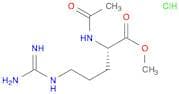
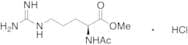
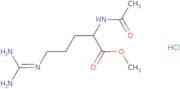
CAS 1784-05-0
:L-Arginina, N2-acetil-, éster metílico, cloridrato (1:1)
Descrição:
L-Arginina, N2-acetil-, éster metílico, cloridrato (1:1) é um derivado do aminoácido L-arginina, que desempenha um papel crucial em vários processos fisiológicos, incluindo a síntese de proteínas e a produção de óxido nítrico. Este composto apresenta um grupo acetil e uma modificação de éster metílico, melhorando sua solubilidade e biodisponibilidade. Como sal de cloridrato, é tipicamente mais estável e mais fácil de manusear em ambientes de laboratório e farmacêuticos. A presença do grupo éster metílico pode influenciar sua farmacocinética, permitindo potencialmente uma melhor absorção e transporte através das membranas celulares. Os derivados de L-arginina são frequentemente estudados por suas potenciais aplicações terapêuticas, incluindo saúde cardiovascular, função imunológica e cicatrização de feridas. Além disso, este composto pode exibir diferentes atividades biológicas em comparação com seu aminoácido pai, tornando-o de interesse na pesquisa relacionada a vias metabólicas e desenvolvimento de medicamentos. Assim como com qualquer substância química, o manuseio adequado e as precauções de segurança são essenciais, dada sua potencial biológica e interações.
Fórmula:C9H19ClN4O3
InChI:InChI=1/C9H18N4O3.ClH/c1-6(14)13-7(8(15)16-2)4-3-5-12-9(10)11;/h7H,3-5H2,1-2H3,(H,13,14)(H4,10,11,12);1H
Chave InChI:InChIKey=FIUSXBMWQFBXLZ-FJXQXJEOSA-N
SMILES:[C@H](CCCNC(=N)N)(C(OC)=O)NC(C)=O.Cl
Sinónimos:- <span class="text-smallcaps">L</span>-Arginine, N<sup>2</sup>-acetyl-, methyl ester, hydrochloride (1:1)
- <span class="text-smallcaps">L</span>-Arginine, N<sup>2</sup>-acetyl-, methyl ester, monohydrochloride
- Ac-Arg-Ome hydrochloride
- Ac-Arginine-Ome Hcl
- Acetyl-L-Arg Methyl Ester Hcl
- Acetyl-L-Arginine Methyl Ester Hydrochloride
- Acetyl-L-Arginine Methyl Ester Monohydrochloride
- Arginine, N<sup>2</sup>-acetyl-, methyl ester, monohydrochloride, <span class="text-smallcaps">L</span>-
- N-Acetyl-L-Arginine Methyl Ester Hydrochloride
- N-Alpha-Acetyl-Arginine Methyl Ester Hydrochloride
- L-Arginine, N2-acetyl-, methyl ester, monohydrochloride
- Arginine, N2-acetyl-, methyl ester, monohydrochloride, L-
- L-Arginine, N2-acetyl-, methyl ester, hydrochloride (1:1)
- 2-acetamido-5-(diaminomethylideneamino)pentanoic acid methyl ester hydrochloride
- Ac-Arg-OMe
- Nα-Acetyl-L-arginine methyl ester hydrochloride
- Ac-L-Arg-OMe·HCl
- Nα-Acetyl-L-arginine methyl ester hydrochloride≥ 95% (HPLC)
- AC-ARG-OME HCL
- Methyl-N2-Acetylargininate Hydrochloride
- (S)-Methyl 2-acetaMido-5-guanidinopentanoate hydrochloride
- Ver mais sinónimos
Ordenar por
Pureza (%)
0
100
|
0
|
50
|
90
|
95
|
100
6 produtos.
Ac-Arg-OMe · HCl
CAS:Substrate for pancreatic and intestinal kallikreins from different species. It is also hydrolyzed by trypsin.Fórmula:C9H18N4O3·HClPureza:> 99%Cor e Forma:White PowderPeso molecular:266.73(S)-Methyl 2-acetamido-5-guanidinopentanoate hydrochloride
CAS:Fórmula:C9H19ClN4O3Pureza:95.0%Peso molecular:266.73N-alpha-Acetyl-L-arginine methyl ester hydrochloride
CAS:N-alpha-Acetyl-L-arginine methyl ester hydrochloride is an enzyme that catalyzes the conversion of arginine to citrulline. It is a part of a group of enzymes called kallikreins. Kinetic constants for this enzyme have been determined in both porcine and human pancreatic preparations. The efficiency of this enzyme has been found to be increased in the presence of L-phenylalanine, and it was found that the C-terminal subsite is responsible for this effect.Fórmula:C9H18N4O3·HClPureza:Min. 95%Cor e Forma:White PowderPeso molecular:266.73 g/molN-Acetyl-L-arginine Methyl Ester Hydrochloride
CAS:Produto ControladoApplications N-Acetyl-L-arginine Methyl Ester is used in the synthetic route to biologically important L-arginine peptides.
References Levison, P.R., et al.: Synthetic Communic., 13, 167 (1983),Fórmula:C9H18N4O3·ClHCor e Forma:NeatPeso molecular:266.725Ac-Arg-OMe • HCl
CAS:Ac-Arg-OMe • HCl is a labile peptide that has been shown to be homologous to the human Arg-Gly-Asp (RGD) sequence. Ac-Arg-OMe • HCl is activated by trypsin and trypsin-like proteases, but inactivated by hemolytic activity and conformation. Ac-Arg-OMe • HCl is an enzyme substrate for peptidases such as trypsin and trypsin like proteases. It has been shown to be a molecule that interacts with various proteins, including hemoglobin.
Fórmula:C9H18N4O3•HCIPureza:Min. 95%Peso molecular:266.72 g/mol