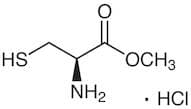
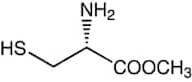
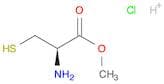
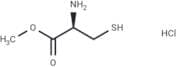
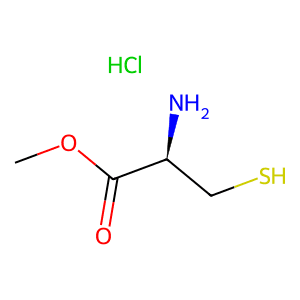
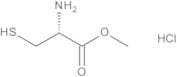
CAS 18598-63-5
:L-Cisteína, éster metílico, cloridrato
- (2R)-1-methoxy-1-oxo-3-sulfanylpropan-2-aminium chloride
- (2S)-1-methoxy-1-oxo-3-sulfanylpropan-2-aminium chloride
- (R)-Cysteine methyl ester hydrochloride
- (R)-Methyl 2-amino-3-mercaptopropanoate hydrochloride
- <span class="text-smallcaps">L</span>-Cysteine, methyl ester, hydrochloride
- <span class="text-smallcaps">L</span>-Cysteine, methyl ester, hydrochloride (1:1)
- Acdrile
- Actiol
- Cysteine methyl ester hydrochloride
- Cysteine, methyl ester, hydrochloride, <span class="text-smallcaps">L</span>-
- H-Cys-OMe.HCl
- H-Cys-OMe・HCl
- Lj 48
- Mecysteine hydrochloride
- Methyl (R)-2-amino-3-mercaptopropanoate hydrochloride
- Methyl 2-amino-3-mercaptopropionate hydrochloride
- Methyl <span class="text-smallcaps">L</span>-cysteinate hydrochloride
- Methyl Cysteinate Hydrochloride (1:1)
- Methyl cysteinate hydrochloride
- Methyl cysteine hydrochloride
- Methyl α-amino-β-mercaptopropionate hydrochloride
- Methyl β-mercaptoalanine hydrochloride
- NSC 161611
- Pectite
- Visclair
- Zeotin
- L-Cysteine, methyl ester, hydrochloride
- L-Cysteine, methyl ester, hydrochloride (1:1)
- Cysteine, methyl ester, hydrochloride, L-
- L-Cysteine Methyl Ester HCl
- L-CYSTEIN METHYL ESTER HYDROCHLORIDE
- L-Cystein methyl ester HCl
- H-CYS(ME)-OH . HCL
- L-CYSTEINE METHYL ESTER HYDROCHLORIDECRY STALLINE
- methylester,hydrochloride,l-cystein
- H-CYS(ME)OH HYDROCHLORIDE
- L-CYSTEINE METHYL ESTER MONOHYDROCHLORIDE
- L-CYSTEINE METHYL ESTER HYDROCHLORIDE, 9 8%
- l.j.48
- Ver mais sinónimos
L-Cysteine Methyl Ester Hydrochloride
CAS:Fórmula:C4H9NO2S·HClPureza:>99.0%(T)Cor e Forma:White to Almost white powder to crystalinePeso molecular:171.64L-Cysteine methyl ester hydrochloride
CAS:L-Cysteine methyl ester hydrochloride is a biochemical shown to inhibit binding of ethynylestradiol metabolites to protein and nucleic acids. It used in the synthesis of peptides, Preparation of thiazolidine-4-carboxylates with carbonyl compounds. This Thermo Scientific Chemicals brand product was oFórmula:C4H9NO2S•HClPeso molecular:171.65L-Cysteine methyl ester hydrochloride
CAS:L-Cysteine methyl ester hydrochloride (L-Cysteine methyl ester hydrochloride (Acdrile)) is an antitussive and an expectorant agent, used to relieve breathingFórmula:C4H10ClNO2SPureza:99.91%Cor e Forma:White PowderPeso molecular:171.65L-Cysteine methyl ester hydrochloride
CAS:L-Cysteine methyl ester hydrochloridePureza:≥98%Peso molecular:171.65g/molL-Cysteine methyl ester hydrochloride
CAS:L-Cysteine methyl ester hydrochloridePureza:98%Peso molecular:171.65g/molL-Cysteine methyl ester hydrochloride
CAS:Fórmula:C4H9NO2S·HClCor e Forma:White to almost white powder or crystalsPeso molecular:171.65Mecysteine hydrochloride
CAS:Mecysteine hydrochloride is a stable complex of mecysteine and hydrochloric acid. It is an ester that is formed from the reaction of methionine and hydrochloric acid in the presence of sodium citrate. This drug has been used as a skin treatment for ichthyosis, atopic dermatitis, and other skin disorders. Mecysteine hydrochloride has also been shown to be effective against symptoms caused by oxidative stress, such as swelling, redness, pain, or itching. Mecysteine hydrochloride may act by reducing the production of reactive oxygen species (ROS) and increasing antioxidant enzymes in human serum.
Fórmula:C4H9NO2S•HClPureza:Min. 98 Area-%Cor e Forma:PowderPeso molecular:171.65 g/molh-cys-ome.hcl
CAS:Fórmula:C4H10ClNO2SPureza:97%Cor e Forma:Solid, Crystalline PowderPeso molecular:171.64Mecysteine Hydrochloride
CAS:Produto ControladoApplications A mucolytic. An effective drug for the treatment of liver failure. Shown to effectively inhibit the binding of ethynylestradiol metabolites to protein and nucleic acids.
References Tsukamoto, T. et al.: Oyo Yakuri, 17, 825 (1979); Bolt, H. M. et al.: J. Steroid Biochem., 5, 179 (1974); Komatsu, H. et al.: Oyo Yakuri, 19, 709 (1980);Fórmula:C4H10ClNO2SCor e Forma:NeatPeso molecular:171.65