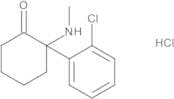
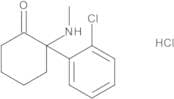
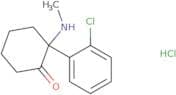
CAS 1867-66-9
:Cloridrato de cetamina
- (±)-2-(o-Chlorophenyl)-2-(methylamino)cyclohexanone hydrochloride
- 2-(2-Chlorophenyl)-2-(Methylamino)Cyclohexanone
- 2-(2-Chlorophenyl)-2-(Methylamino)Cyclohexanone Hydrochloride (1:1)
- 2-(2-Chlorophenyl)-2-(methylamino)cyclohexanone hydrochloride
- Calipsol
- Ci 581
- Cl369
- Cyclohexanone, 2-(2-chlorophenyl)-2-(methylamino)-, hydrochloride
- Cyclohexanone, 2-(2-chlorophenyl)-2-(methylamino)-, hydrochloride (1:1)
- Cyclohexanone, 2-(o-chlorophenyl)-2-(methylamino)-, hydrochloride, (±)-
- Kalipsol
- Ketaject
- Ketalar
- Ketamil
- Ketamine HCl
- Ketanarkon
- Ketanest
- Ketaset
- Ketavet
- Ketavet 100
- Ketmin 50
- Ketolar
- Vetalar
- Vetanarcol
- Ketamine Hcl USP24
- ci581
- Ketamini Hydrochloridum
- 2-(2-chlorophenyl)-2-(methylamino)-,hydrochloride,(+-)-cyclohexanon
- 2-(o-chlorophenyl)-2-(methylamino)cyclohexanonehydrochloride
- (+-)-2-(o-chlorophenyl)-2-(methylamino)cyclohexanonehydrochloride
- cn-52,372-2
- ketavet100
- 2-(o-chlorophenyl)-2-(methylamino)-cyclohexanonhydrochloride
- Ver mais sinónimos
Ketamine Hydrochloride 1.0 mg/ml in Methanol (as free base)
CAS:Produto ControladoCor e Forma:Single SolutionKetamine Hydrochloride
CAS:Produto ControladoFórmula:C13H16ClNO·ClHCor e Forma:NeatPeso molecular:274.19Ketamine Hydrochloride (1 mg/mL in Methanol)
CAS:Produto ControladoFórmula:C13H16ClNO·ClHCor e Forma:ColourlessPeso molecular:274.19Ketamine Hydrochloride
CAS:Produto ControladoApplications Anesthetic and antidepressant (intravenous). Controlled substance (depressant).Studies in mouse suggest that ketamine changes neuron structure and funcetion and is able to restore lost synapses.
References Sass, W.C., et al.: Anal. Profiles Drug Subs., 6, 297 (1977), Reich, D.L., et al.: Can. J. Anaesth., 36, 186 (1989); Chem. and Eng. News April 15, 2019 page 7Fórmula:C13H16ClNO·ClHCor e Forma:WhitePeso molecular:274.19KETAMINE HYDROCHLORIDE CRS - * NARC
CAS:Produto ControladoKETAMINE HYDROCHLORIDE CRS - * NARCFórmula:C13H17Cl2NOCor e Forma:PowderPeso molecular:274.1862Ketamine hydrochloride
CAS:Produto ControladoKetamine hydrochlorideFórmula:C13H16ClNOPureza:86.5% for UV / 86.5% for HPLCCor e Forma:WhitePeso molecular:237.09204Ketamine-d6 HydrochlorideReplaces K165302.
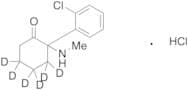
CAS:Produto ControladoFórmula:C13D6H10ClNO·HClCor e Forma:NeatPeso molecular:280.223Ketamine-d6 Hydrochloride (100 μg/mL in Methanol)
CAS:Produto ControladoFórmula:C13D6H10ClNO·HClCor e Forma:Single SolutionPeso molecular:280.223Ketamine Hydrochloride CIII
CAS:Produto ControladoAmino-aldehydes, amino-ketones and amino-quinones, other than those containing more than one kind of oxygen function; salts thereof, nesoiFórmula:C13H16ClNO·HClCor e Forma:White Crystalline PowderPeso molecular:237.09204Ketamine hydrochloride
CAS:Produto ControladoKetamine hydrochloride is a dissociative anesthetic that has been used in human and veterinary medicine. It can be given intravenously, intramuscularly, subcutaneously, or orally. Ketamine produces analgesia, anesthesia, and amnesia. It also has a number of other clinical uses including sedation for critically ill patients who require mechanical ventilation and as an adjunct to general anesthesia. Ketamine is a racemic mixture of two stereoisomers: S-ketamine (d-isomer) and R-ketamine (l-isomer). The mechanism of action of ketamine is not fully understood but it appears to block the N-methyl-D-aspartate receptor in the central nervous system. Ketamine is metabolized by the liver into norketamine and hydroxynorketamines which are excreted mainly by the kidneys. The half life of ketamine in humans is about 2 hours.
Fórmula:C13H17Cl2NOPureza:(Titration) Min. 98%Peso molecular:274.19 g/molRef: 3D-Q-201266
Produto descontinuado