


CAS 18991-62-3
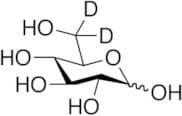
:D-Glicose-6,6-D2
- D-Glucose-6,6-d2 (pyrogen free)
D-Glucose-6,6-d2
CAS:Produto ControladoApplications Labelled D-Glucose is a simple sugar that is present in plants. A monosaccharide that may exist in open chain or cyclic conformation if in solution. It plays a vital role in photosynthesis and fuels the energy required for cellular respiration. D-Glucose is used in various metabolic processes including enzymic synthesis of cyclohexyl-α and β-D-glucosides. Can also be used as a diagnostic tool in detection of type 2 diabetes mellitus and potentially Huntington's disease through analysis of blood-glucose in type 1 diabetes mellitus.
References Wang, R., et al.: J. Mol. Catal. B. Enz., 56, 131 (2009); Springhorn, C. et al.: J. Clin. Endocrinol. Metab., 97, 4640 (2012); Hashimoto, K. et al.: J. Clin. Endocrinol. Metab., 97, 3016 (2012); Avelange, M. et al.: Plant. Phys., 94, 1157 (1990); Cramer, C. et al.: J. Chem. Soc., 115, 5745 (1993);Fórmula:C62H2H10O6Cor e Forma:NeatPeso molecular:182.17D-[6,6'-2H2]Glucose
CAS:Produto ControladoD-[6,6'-2H2]Glucose is a carbohydrate that is present in many foods and also produced by the cells of the human body. It can be used as a biomarker for cancer cells because it is taken up by malignant cells at a higher rate than normal cells. D-[6,6'-2H2]Glucose is often used to assess the response of patients to chemotherapy treatment. The uptake of D-[6,6'-2H2]Glucose by malignant cells can be measured using vibrational spectroscopy or chromatographic science. The deformation of glucose molecules can be quantified using nuclear magnetic resonance (NMR) spectroscopy and this data can then be used to estimate the degree of glycolysis in specific tissues.Fórmula:C6D2H10O6Pureza:Min. 95%Peso molecular:182.17 g/molRef: IN-DA002E4F
Produto descontinuado





![D-[6,6'-2H2]Glucose](/_next/image/?url=https%3A%2Fstatic.cymitquimica.com%2Fproducts%2F3D%2Fthumb%2FMG74985.jpg&w=3840&q=75)

