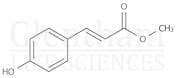
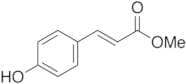
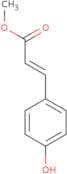
CAS 19367-38-5
:Ácido 2-propenoico, 3-(4-hidroxifenil)-, éster metílico, (E)-
Descrição:
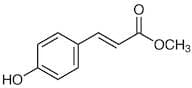
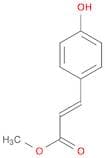
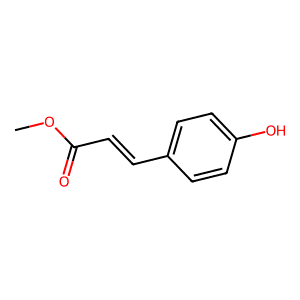
Ácido 2-propenoico, 3-(4-hidroxifenil)-, éster metílico, (E)-, comumente conhecido como metila 4-hidroxicinamato, é um composto orgânico caracterizado por seu grupo funcional éster e um sistema de ligações duplas conjugadas. Este composto apresenta um grupo metóxi ligado a uma estrutura fenólica, o que contribui para suas potenciais propriedades antioxidantes. Normalmente é um líquido incolor a amarelo pálido com um aroma agradável, tornando-o útil em aplicações cosméticas e de fragrâncias. A configuração (E) indica que os substituintes ao redor da dupla ligação estão em lados opostos, o que pode influenciar sua reatividade e interações com sistemas biológicos. O metila 4-hidroxicinamato é solúvel em solventes orgânicos e exibe solubilidade moderada em água. Sua estrutura química permite que participe de várias reações químicas, incluindo polimerização e esterificação. Além disso, tem sido estudado por seus potenciais benefícios à saúde, incluindo atividades anti-inflamatórias e antimicrobianas. Assim como muitos compostos orgânicos, o manuseio adequado e as precauções de segurança são essenciais devido à sua potencial reatividade e efeitos.
Fórmula:C10H10O3
Sinónimos:- methyl (2E)-3-(4-hydroxyphenyl)prop-2-enoate
- Methyl 4-hydroxyphenylacrylate
Ordenar por
Pureza (%)
0
100
|
0
|
50
|
90
|
95
|
100
12 produtos.
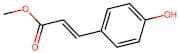
Methyl trans-p-Coumarate
CAS:Fórmula:C10H10O3Pureza:>98.0%(GC)Cor e Forma:White to Light yellow to Light orange powder to crystalPeso molecular:178.192-Propenoic acid, 3-(4-hydroxyphenyl)-, methyl ester, (2E)-
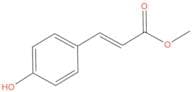
CAS:Fórmula:C10H10O3Pureza:98%Cor e Forma:SolidPeso molecular:178.1846(E)-Methyl 4-coumarate
CAS:(E)-Methyl 4-coumarate (OMpCA) is a predicted metabolite generated by BioTransformer1 that is produced by the metabolism of methyl 3-phenylprop-2-enoate.Fórmula:C10H10O3Pureza:99.68% - 99.97%Cor e Forma:White Crystal PowderPeso molecular:178.18Methyl 4-Hydroxy Cinnamate
CAS:Produto ControladoApplications Cinnamic acid derivative used in structure-antifungal activity relationship study against Aspergillus flavus, Aspergillus terreus, and Aspergillus niger. An antifungal agent.
References Bisagno, F., et al.: J. Agric. Food Chem., 55, 10645 (2007),Fórmula:C10H10O3Cor e Forma:NeatPeso molecular:178.18Methyl 4-hydroxycinnamate
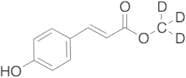
CAS:Methyl 4-hydroxycinnamate is a protocatechuic acid that can be produced by the reaction of hydrochloric acid and b16 mouse melanoma. This chemical has been shown to have an anti-inflammatory effect in rats with inflammatory bowel disease. Methyl 4-hydroxycinnamate is also a natural compound found in plants, such as celery, cinnamon, and apples. The mechanism of this chemical's action is unknown but it has been shown to inhibit the activity of rat liver microsomes. It is theorized that methyl 4-hydroxycinnamate may inhibit the production of proinflammatory substances by altering the membrane composition or activity of enzymes.br>br> br>br> Methyl 4-hydoxycinnamate may be synthesized from anhydrous sodium acetate and an acid complex in a model system using reaction solution. The product is then purified using column chromatography before being reacted with methylamine and sulfurFórmula:C10H10O3Pureza:Min. 95%Cor e Forma:PowderPeso molecular:178.18 g/mol(Methyl-d3) 4-Hydroxy Cinnamate
CAS:Produto ControladoFórmula:C10D3H7O3Cor e Forma:NeatPeso molecular:181.203