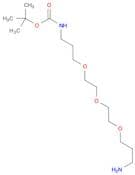
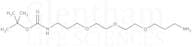
CAS 194920-62-2
:BOC-TOTA
- 1-(T-Butyloxycarbonyl-Amino)-4,7,10-Trioxa-13-Tridecanamine
- 1-(Tert-Butyloxycarbonyl-Amino)-4,7,10-Trioxa-13-Tridecanamine
- 3-[2-(2-(3-(Boc-Amino)Propyloxy)Ethoxy)Ethoxy]Propylamine
- Boc-1-Amino-4,7,10-Trioxa-13-Tridecanamine
- N-Boc-4,7,10-Trioxa-1,13-Tridecanediamine
Boc-1-amino-4,7,10-trioxa-13-tridecanamine
CAS:Boc-1-amino-4,7,10-trioxa-13-tridecanamineFórmula:C15H32N2O5Pureza:97%Cor e Forma: light yellow oilPeso molecular:320.42g/molN-Boc-4,7,10-trioxa-1,13-tridecanediamine
CAS:Fórmula:C15H32N2O5Pureza:>95.0%(T)(qNMR)Cor e Forma:Colorless to Light yellow clear liquidPeso molecular:320.43N-Boc-C1-PEG3-C3-NH2
CAS:N-Boc-C1-PEG3-C3-NH2 is a PEG-based linker for PROTACs which joins two essential ligands, crucial for forming PROTAC molecules.Fórmula:C15H32N2O5Cor e Forma:SolidPeso molecular:320.42Boc-1-amino-4,7,10-trioxa-13-tridecanamine
CAS:Boc-1-amino-4,7,10-trioxa-13-tridecanamine (BocAT) is a triazine compound that has been used to synthesize azides as well as to inhibit the growth of cancer cells. The inhibition of tumor cells is achieved through the covalent attachment of BocAT to lysine residues on the cell surface. This process leads to cell death by preventing the synthesis of proteins necessary for cell division and metabolism. BocAT has also been shown to bind gadolinium and other metal ions with high specificity. It can be used in vivo for tumor tissue localization and imaging with magnetic resonance imaging (MRI).Fórmula:C15H32N2O5Pureza:Min. 95%Cor e Forma:Yellow LiquidPeso molecular:320.43 g/moltert-Butyl (3-(2-(2-(3-aminopropoxy)ethoxy)ethoxy)propyl)carbamate
CAS:Fórmula:C15H32N2O5Pureza:95%Cor e Forma:Viscous Liquid, OilPeso molecular:320.43tert-Butyl (3-(2-(2-(3-Aminopropoxy)ethoxy)ethoxy)propyl)carbamate
CAS:Produto ControladoApplications tert-Butyl (3-(2-(2-(3-Aminopropoxy)ethoxy)ethoxy)propyl)carbamate is used as a reactant in the synthesis of gallium-labeled PET imaging agents for CXCR4 for potential cancer diagnosis.
References Poty, Sophie, et al.: Bioconjugate Chem., 27(3), 752-761 (2016)Fórmula:C15H32N2O5Cor e Forma:NeatPeso molecular:320.42t-Boc-N-Amido-dPEG®3-Amine
CAS:t-Boc-N-Amido-dPEG®3-Amine is a PEG compound with two different functional groups (also known as heterobifunctional). Unlike homobifunctional PEG compounds (same functional group on both ends), this type of compounds are more versatile as have two different anchor points. t-Boc-N-Amido-dPEG®3-Amine is used as a linker and spacer to add a PEG moiety, via pegylation (a bioconjugation technique) to proteins, peptides, oligonucleotides, small molecules and nanoparticles.
Pureza:Min. 95%Peso molecular:320.43 g/molBiotin-dPEG®3-MAL
CAS:Biotin-dPEG®3-MAL is a PEG compound with two different functional groups (also known as heterobifunctional). Unlike homobifunctional PEG compounds (same functional group on both ends), this type of compounds are more versatile as have two different anchor points. Biotin-dPEG®3-MAL is used as a linker and spacer to add a PEG moiety, via pegylation (a bioconjugation technique) to proteins, peptides, oligonucleotides, small molecules and nanoparticles.
Fórmula:C15H32N2O5Pureza:Min. 95%Peso molecular:320.43 g/mol