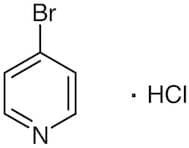
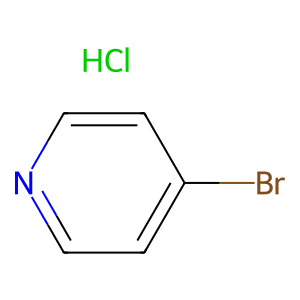
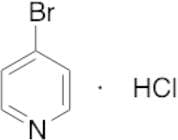
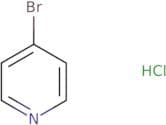
CAS 19524-06-2
:Cloridrato de 4-bromopiridina
- 2-(Tert-Butoxycarbonyl)-1,2,3,4-Tetrahydroisoquinoline-5-Carboxylic Acid
- 4-Bromopyridine HCL
- 4-Bromopyridine Hydrochloride (1:1)
- 4-Bromopyridine monohydrochloride
- 4-Bromopyridinium Chloride
- Pyridine, 4-bromo-, hydrochloride
- Pyridine, 4-bromo-, hydrochloride (1:1)
- 4-Bromopyridine hydrochloride
4-Bromopyridine Hydrochloride
CAS:Fórmula:C5H4BrN·HClPureza:>98.0%(T)Cor e Forma:White to Almost white powder to crystalPeso molecular:194.464-Bromopyridine hydrochloride, 99%
CAS:4-Bromopyridine hydrochloride is used as a useful synthetic intermediate. It is also used as an important raw material and intermediate used in Organic Synthesis, Pharmaceuticals, Agrochemicals and Dyestuff. This Thermo Scientific Chemicals brand product was originally part of the Alfa Aesar productFórmula:C5H4BrClNPureza:99%Cor e Forma:White to cream to yellow to red, Crystals or powder or crystalline powder or lumps or fused solidPeso molecular:193.454-Bromopyridine hydrochloride
CAS:4-Bromopyridine hydrochlorideFórmula:C5H4BrN·ClHPureza:95%Cor e Forma: white to off-white solidPeso molecular:194.4569g/mol4-Bromopyridine hydrochloride
CAS:Fórmula:C5H5BrClNPureza:98%Cor e Forma:Off-white powderPeso molecular:194.464-Bromopyridine Hydrochloride
CAS:Produto ControladoApplications 4-Bromopyridine Hydrochloride (cas# 19524-06-2) is a compound useful in organic synthesis.
Fórmula:C5H4BrN·ClHCor e Forma:NeatPeso molecular:194.464-Bromopyridine hydrochloride
CAS:4-Bromopyridine HCl is a chemical compound with the molecular formula C6H5BrN. It is an aromatic heterocycle and is used in organic synthesis as a coupling partner in cross-coupling reactions. The bromine atom of 4-bromopyridine is replaced by chloride, resulting in 4-chloropyridine. The chlorination reaction can be conducted using either hydrochloric acid or thionyl chloride. This process can be done on an industrial scale and the chlorinated product has been used in the manufacture of pharmaceuticals, dyes, and pesticides. The reaction mechanism for this substitution reaction involves a nucleophilic attack by chlorine on the pyridine ring at carbon atom 2 followed by displacement of hydrogen from the adjacent position on nitrogen atom 3. Acylation reactions are oxidation processes that involve conversion of carboxylic acids to acyl halides or acyl chlorides through treatment with acidified halogenating agents such
Fórmula:C5H4BrN•HClPureza:Min. 95%Cor e Forma:White PowderPeso molecular:194.46 g/mol