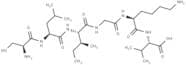
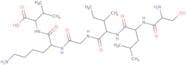
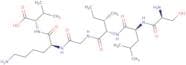
CAS 202933-49-1
:H-Ser-Leu-Ile-Gly-Lys-Val-Oh
Descrição:
A substância química conhecida como H-Ser-Leu-Ile-Gly-Lys-Val-Oh, com o número CAS 202933-49-1, é um peptídeo composto por uma sequência de aminoácidos. Este peptídeo apresenta uma combinação de resíduos hidrofílicos e hidrofóbicos, o que contribui para sua potencial atividade biológica e interações. A presença de serina (Ser), leucina (Leu), isoleucina (Ile), glicina (Gly), lisina (Lys) e valina (Val) indica uma ampla gama de propriedades, incluindo a capacidade de participar em ligações de hidrogênio e interações hidrofóbicas. O grupo hidroxila terminal (OH) sugere que pode ter uma solubilidade aumentada em ambientes aquosos. Peptídeos como este podem desempenhar papéis significativos em vários processos biológicos, incluindo vias de sinalização e funções enzimáticas. Além disso, a sequência específica de aminoácidos pode influenciar a conformação, estabilidade e reatividade do peptídeo, tornando-o de interesse em campos como bioquímica, farmacologia e biotecnologia. Estudos adicionais seriam necessários para elucidar suas funções e aplicações específicas.
Ordenar por
Pureza (%)
0
100
|
0
|
50
|
90
|
95
|
100
4 produtos.
PAR-2 (1-6) (human)
CAS:PAR-2 (1-6) (human) (SLIGKV), a peptide ligand, is a PAR-2 agonist [1] .Fórmula:C28H53N7O8Cor e Forma:SolidPeso molecular:615.76H-Ser-Leu-Ile-Gly-Lys-Val-OH
CAS:H-Ser-Leu-Ile-Gly-Lys-Val-OH is a potent inhibitor of the enzyme soybean trypsin. It is a member of the class of chemical inhibitors that are active against enzymes that regulate cell signaling and inflammatory responses. H-Ser-Leu-Ile-Gly-Lys-Val-OH inhibits toll receptor signaling, which triggers an inflammatory response in cells. This compound has been shown to be effective in animal models for bowel disease and asthma. H Ser Leu Ile Gly Lys Val OH also has low potency, which may be due to its ability to form covalent bonds with other molecules, such as DNA polymerase.Fórmula:C28H53N7O8Pureza:Min. 95%Peso molecular:615.76 g/molPAR-2 (1-6) (human) trifluoroacetate salt
CAS:PAR-2 is a cytosolic protein that is activated by calcium. PAR-2 activation induces the synthesis of prostaglandins and other inflammatory mediators, which stimulate the release of substances from cells such as cytokines and chemokines. PAR-2 also has an important role in cell proliferation, differentiation, apoptosis, and cancer development. PAR-2 activation is induced by proteases such as trypsin or soybean trypsin inhibitor. The trifluoroacetate salt form of PAR-2 (1-6) has been used to inhibit protease activity in colon cancer cells and prostate cancer cells. PAR-2 (1-6) (human) trifluoroacetate salt H-Ser-Leu-Ile-Gly-Lys-Val-OH trifluoroacetate salt is a potent chemical inhibitor of trypsin activity with IC50 values of 0.5 µM for soybean trypsin inhibitorFórmula:C28H53N7O8Pureza:Min. 95%Peso molecular:615.76 g/molPAR-2 (1-6) (human)
CAS:The PAR-2 agonist SLIGKV can be used for the investigation of receptor functions.
Fórmula:C28H53N7O8Pureza:98.6%Cor e Forma:White LyophilisatePeso molecular:615.77