CAS 2050-46-6
:1,2-Dietoxibenzeno
Descrição:
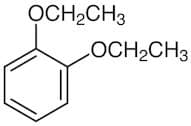
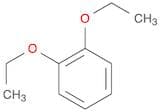
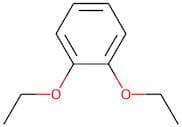
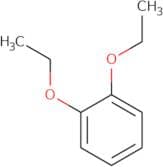
1,2-Dietoxibenzeno, também conhecido como o-Dietoxibenzeno, é um composto orgânico caracterizado pela presença de dois grupos etóxi (-OCH2CH3) ligados a um anel benzênico nas posições 1 e 2. Este composto é um líquido incolor a amarelo pálido com um odor doce e aromático. É relativamente não polar, o que influencia sua solubilidade em solventes orgânicos, sendo menos solúvel em água. A presença dos grupos etóxi aumenta sua reatividade, tornando-o útil em várias sínteses químicas, incluindo a produção de moléculas orgânicas mais complexas. 1,2-Dietoxibenzeno pode passar por reações típicas de substituição aromática e pode ser usado como solvente ou reagente em química orgânica. Suas propriedades físicas, como ponto de ebulição e densidade, são influenciadas pelos substituintes etóxi, que também afetam sua volatilidade e estabilidade. Precauções de segurança devem ser tomadas ao manusear este composto, pois pode representar riscos à saúde se inalado ou ingerido.
Fórmula:C10H14O2
InChI:InChI=1S/C10H14O2/c1-3-11-9-7-5-6-8-10(9)12-4-2/h5-8H,3-4H2,1-2H3
Chave InChI:InChIKey=QZYDOKBVZJLQCK-UHFFFAOYSA-N
SMILES:O(CC)C1=C(OCC)C=CC=C1
Sinónimos:- 1,2-Diethoxybenzene,(Catechol diethyl ether)
- Benzene, 1,2-diethoxy-
- Benzene, o-diethoxy-
- Catechol diethyl ether
- NSC 6189
- o-Diethoxybenzene
- 1,2-Diethoxybenzene
Ordenar por
Pureza (%)
0
100
|
0
|
50
|
90
|
95
|
100
5 produtos.
1,2-Diethoxybenzene
CAS:Fórmula:C10H14O2Pureza:>98.0%(GC)Cor e Forma:White to Almost white powder to crystalPeso molecular:166.22Catechol diethyl ether
CAS:Catechol diethyl ether is an activated form of the catechol. It is used as a control agent in Friedel-Crafts reactions to convert alkenes to epoxides and chlorohydrins. It is also used in the hydrochlorination of aromatic hydrocarbons. This compound has been shown to be an effective activator for the synthesis of monomeric polyester polyurethane from dimeric diols and diisocyanates, with phosphotungstic acid as catalyst. Catechol diethyl ether is soluble in organic solvents such as chloroform or benzene, but insoluble in water. The optimal reaction conditions involve the use of hydroxide solution at pH 9-10 and magnetic resonance spectroscopy at room temperature. Catechol diethyl ether reacts with trifluoromethanesulfonic acid to produce hydrogen chloride gas, which can be removed by passing dry nitrogen gas through it.Fórmula:C10H14O2Pureza:Min. 95%Cor e Forma:Clear LiquidPeso molecular:166.22 g/mol1,2-Diethoxybenzene
CAS:Fórmula:C10H14O2Pureza:95.0%Cor e Forma:White to almost white powderPeso molecular:166.22