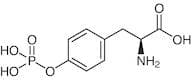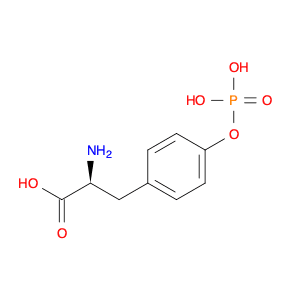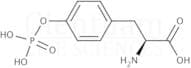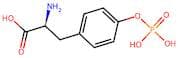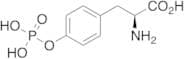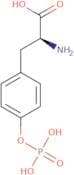
CAS 21820-51-9
:Fosfo-L-tirosina
- (2S)-2-Amino-3-(4-phosphonooxyphenyl)propanoic acid
- <span class="text-smallcaps">L</span>-Phosphotyrosine
- <span class="text-smallcaps">L</span>-Tyrosine, O-phosphono-
- <span class="text-smallcaps">L</span>-Tyrosine, dihydrogen phosphate (ester)
- <span class="text-smallcaps">L</span>-Tyrosine-O-phosphate
- H-Tyr(PO3)-OH
- N-phosphonotyrosine
- O-Phospho-<span class="text-smallcaps">L</span>-tyrosine
- O-Phosphono-<span class="text-smallcaps">L</span>-tyrosine
- O-Phosphotyrosine
- O-phosphono-L-tyrosine
- Phospho-<span class="text-smallcaps">L</span>-tyrosine
- Phosphotyrosine
- Tyrosine O-phosphate
- Tyrosine, di-H phosphate
- Tyrosine, dihydrogen phosphate (ester), <span class="text-smallcaps">L</span>-
- Tyrosine, phosphate
- L-Tyrosine, dihydrogen phosphate (ester)
- Tyrosine, dihydrogen phosphate (ester), L-
- Ver mais sinónimos
O-Phospho-L-tyrosine
CAS:Fórmula:C9H12NO6PPureza:>97.0%(T)(HPLC)Cor e Forma:White to Almost white powder to crystalPeso molecular:261.17H-Tyr(PO₃H₂)-OH
CAS:L-Phosphotyrosine can be used in the detection and quantification of tyrosine phosphorylation in proteins and as starting material in the synthesis of fluorescent substrates for protein tyrosine phosphatase assays. Furthermore, it has been incorporated in cyclic hexapeptides for studying intramolecular quenching of tryptophan fluorescence. L-Phosphotyrosine inhibits cellular growth by activating protein tyrosine phosphatases (Mishra and Hamburger). The phosphorylated amino acid protects TP53 wild-type cells against ionizing radiation.Fórmula:C9H12NO6PPureza:> 99%Cor e Forma:Whitish PowderPeso molecular:261.17Ref: IN-DA003THO
1g119,00€5g296,00€10g682,00€25gA consultar10mg30,00€50mg50,00€100mg55,00€250mg71,00€O-Phospho-L-tyrosine
CAS:Fórmula:C9H12NO6PPureza:≥ 95.0%Cor e Forma:White to off-white powderPeso molecular:261.17O-Phospho-L-tyrosine
CAS:Applications Useful in the study of tyrosine-phosphorylation, which has been linked with the malignant transformation of cells by some RNA tumour viruses.
References Sefton, B.M., et al.: Cell, 20, 807 (1980), Erikson, R., et al.: Perspect. Virol., 11, 93 (1981), Lee, E-S, et al.: J. Org. Chem., 59, 2086 (1994)Fórmula:C9H12NO6PCor e Forma:NeatPeso molecular:261.17O-Phospho-L-tyrosine
CAS:O-Phospho-L-tyrosine is a phosphorylated form of L-tyrosine. It is used as an immunogen in the production of monoclonal antibodies. O-Phospho-L-tyrosine has also been shown to inhibit the enzyme indole alkaloids, which are responsible for the development of oral pathogens. The dephosphorylation of O-Phospho-L-tyrosine by tyrosine phosphatases leads to its conversion back to L-tyrosine. This compound can be detected by chromatographic analysis and is commonly used in analytical methods to identify natural compounds.
Fórmula:C9H12NO6PPureza:Min. 95%Cor e Forma:PowderPeso molecular:261.17 g/mol