CAS 2199-49-7
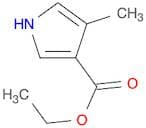
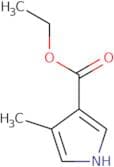
:Etil 4-metilpirrol-3-carboxilato
Descrição:
Etil 4-metilpirrol-3-carboxilato é um composto orgânico caracterizado por sua estrutura de anel de pirrol, que é um heterociclo aromático de cinco membros contendo nitrogênio. Este composto apresenta um grupo funcional de éster etílico, que contribui para suas propriedades de reatividade e solubilidade. A presença do grupo metila na posição 4 do anel de pirrol influencia suas propriedades eletrônicas e a hindrance estérica, o que pode afetar sua reatividade em várias reações químicas. Etil 4-metilpirrol-3-carboxilato é tipicamente um líquido ou sólido incolorido a amarelo pálido, dependendo de sua pureza e forma. É solúvel em solventes orgânicos, tornando-o útil na síntese orgânica e como intermediário na produção de produtos farmacêuticos e agroquímicos. O composto pode exibir atividade biológica, o que é de interesse na química medicinal. Os dados de segurança devem ser consultados para manuseio, assim como com qualquer substância química, para garantir que as precauções adequadas sejam tomadas durante o uso.
Fórmula:C8H11NO2
InChI:InChI=1/C8H11NO2/c1-3-11-8(10)7-5-9-4-6(7)2/h4-5,9H,3H2,1-2H3
SMILES:CCOC(=O)c1c[nH]cc1C
Sinónimos:- ethyl 4-methyl-1H-pyrrole-3-carboxylate
Ordenar por
Pureza (%)
0
100
|
0
|
50
|
90
|
95
|
100
5 produtos.
Ethyl 4-methyl-1H-pyrrole-3-carboxylate
CAS:Fórmula:C8H11NO2Pureza:97%Cor e Forma:SolidPeso molecular:153.1784Ethyl 4-methyl-1H-pyrrole-3-carboxylate
CAS:Ethyl 4-methyl-1H-pyrrole-3-carboxylatePureza:95%Peso molecular:153.181g/molEthyl 4-methyl-1H-pyrrole-3-carboxylate
CAS:Fórmula:C8H11NO2Pureza:95%Cor e Forma:SolidPeso molecular:153.181Ethyl 4-methylpyrrole 3-carboxylate
CAS:Ethyl 4-methylpyrrole 3-carboxylate is a monomer that belongs to the group of functional groups. It is used in the polymerization process and has been shown to be able to imprint or introduce other functional groups into polymers. The following are some of its properties: it can be used as an operational group, it has chemical interactions with other functional groups, and it can be used for selectivity techniques. It also has isomeric properties, which depend on the type of functional group attached. Some examples of these properties are electrochemical polymerization and electropolymerization. The molecule also interacts with different polarities depending on the type of functional group attached.Fórmula:C8H11NO2Pureza:Min. 95%Cor e Forma:Yellow PowderPeso molecular:153.18 g/mol