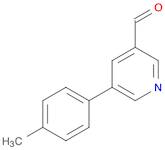
CAS 229008-16-6
:Fórmula:C13H11NO
InChI:InChI=1S/C13H11NO/c1-10-2-4-12(5-3-10)13-6-11(9-15)7-14-8-13/h2-9H,1H3
Chave InChI:ANPGUJZUWRYNKV-UHFFFAOYSA-N
SMILES:CC1=CC=C(C=C1)C2=CN=CC(=C2)C=O
Filtrar por
Percentagem de pureza
0
100
|
0
|
50
|
90
|
95
|
100
Foram encontrados 5 produtos.
- Preços em ordem crescente
- Preços em ordem decrescente
- Menor grau de pureza
- Maior grau de pureza
- Estimativa de entrega mais rápida
5-P-Tolylpyridine-3-carbaldehyde
CAS:5-P-Tolylpyridine-3-carbaldehydeFórmula:C13H11NOPureza:95%Peso molecular:197.232535-(4-Methylphenyl)-3-pyridinecarbaldehyde
CAS:Fórmula:C13H11NOPureza:95%Cor e Forma:SolidPeso molecular:197.23255-(4-Methylphenyl)-3-pyridinecarbaldehyde
CAS:5-(4-Methylphenyl)-3-pyridinecarbaldehydeFórmula:C13H11NOPureza:98%Peso molecular:197.235-(p-Tolyl)nicotinaldehyde
CAS:5-(p-Tolyl)nicotinaldehyde (5-PTN) is an organic compound that can be synthesized in a number of ways. It is a member of the cycloisomerization family of reactions, which are used to form ring systems with six or more carbon atoms. 5-PTN is also possible to make by combining nicotinic acid and p-tolyl bromide, or by reacting acetophenone with p-tolylmagnesium bromide. This compound has been shown to form adducts with biomolecules such as DNA and proteins. It also has analogs that can be synthesized from it, including intramolecular and intermolecular compounds.Fórmula:C13H11NOPureza:Min. 95%Peso molecular:197.23 g/mol