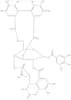
CAS 23094-71-5
:Ácido chebulágico
Descrição:
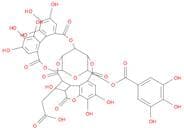
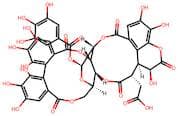
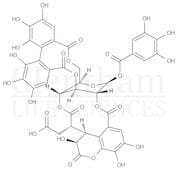
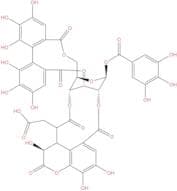
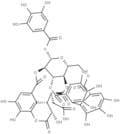
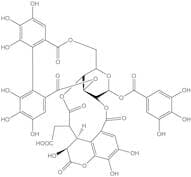
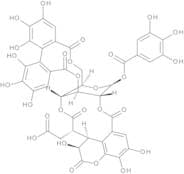
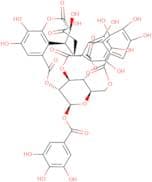
Ácido chebulágico é um composto polifenólico que ocorre naturalmente, encontrado principalmente no fruto da árvore Terminalia chebula, que é comumente utilizado na medicina tradicional. É classificado como um tanino e é conhecido por suas propriedades antioxidantes, contribuindo para seus potenciais benefícios à saúde. A estrutura química de Ácido chebulágico apresenta múltiplos grupos hidroxila, que aumentam sua capacidade de eliminar radicais livres e exibir efeitos anti-inflamatórios. Este composto despertou interesse por suas potenciais aplicações terapêuticas, incluindo seu papel na promoção da saúde digestiva e suas possíveis propriedades anticancerígenas. Além disso, Ácido chebulágico pode influenciar várias vias bioquímicas, tornando-se um assunto de pesquisa em farmacologia e nutracêuticos. Sua solubilidade em água e solventes orgânicos varia, o que pode afetar sua biodisponibilidade e eficácia em diferentes formulações. No geral, Ácido chebulágico representa uma área significativa de estudo na química de produtos naturais e suas implicações para a saúde e o bem-estar.
Fórmula:C41H30O27
InChI:InChI=1S/C41H30O27/c42-13-1-8(2-14(43)24(13)49)35(56)68-41-34-33-31(64-39(60)12(6-19(47)48)22-23-11(38(59)67-34)5-17(46)27(52)32(23)65-40(61)30(22)55)18(63-41)7-62-36(57)9-3-15(44)25(50)28(53)20(9)21-10(37(58)66-33)4-16(45)26(51)29(21)54/h1-5,12,18,22,30-31,33-34,41-46,49-55H,6-7H2,(H,47,48)
Chave InChI:InChIKey=HGJXAVROWQLCTP-UHFFFAOYSA-N
SMILES:C(C(O)=O)C1C2C=3C(C(=O)OC4C5C(OC1=O)C(OC4OC(=O)C6=CC(O)=C(O)C(O)=C6)COC(=O)C=7C(C=8C(C(=O)O5)=CC(O)=C(O)C8O)=C(O)C(O)=C(O)C7)=CC(O)=C(O)C3OC(=O)C2O
Sinónimos:- 10,24-(Epoxymethano)-11H-dibenzo[8,9:10,11][1,6]dioxacyclododecino[2,3-d]pyrano[4,3,2-ij][2,6]benzodioxacycloundecin, β-D-glucopyranose deriv.
- Chebulagic acid
- β-D-Glucopyranose, cyclic 3,6-[(1R)-4,4′,5,5′,6,6′-hexahydroxy[1,1′-biphenyl]-2,2′-dicarboxylate] 1-(3,4,5-trihydroxybenzoate), cyclic 2→5:4→1-ester with (2S)-[(3S,4S)-5-carboxy-3,4-dihydro-3,7,8-trihydroxy-2-oxo-2H-1-benzopyran-4-yl]butanedioic acid
- β-D-Glucopyranose, cyclic 3,6-[(1R)-4,4′,5,5′,6,6′-hexahydroxy[1,1′-biphenyl]-2,2′-dicarboxylate] 1-(3,4,5-trihydroxybenzoate), cyclic 2→2:4→1-ester with (2S)-[(3S,4S)-5-carboxy-3,4-dihydro-3,7,8-trihydroxy-2-oxo-2H-1-benzopyran-4-yl]butanedioic acid
- β-D-Glucopyranose, cyclic 3,6-[(1R)-4,4′,5,5′,6,6′-hexahydroxy[1,1′-biphenyl]-2,2′-dicarboxylate] 1-(3,4,5-trihydroxybenzoate), cyclic 2→2:4→1-ester with (2S)-2-[(3S,4S)-5-carboxy-3,4-dihydro-3,7,8-trihydroxy-2-oxo-2H-1-benzopyran-4-yl]butanedioic acid
Ordenar por
Pureza (%)
0
100
|
0
|
50
|
90
|
95
|
100
10 produtos.
Chebulagic Acid
CAS:Other glycosides, natural or reproduced by synthesis, and their salts, ethers, esters and other derivativesFórmula:C41H30O27Cor e Forma:Off-White PowderPeso molecular:954.09745Chebulagic acid
CAS:Fórmula:C41H30O27Pureza:≥ 95.0%Cor e Forma:White, off-white or pale brown powderPeso molecular:954.66Chebulagic acid
CAS:Chebulagic acid, isolated from the fruits of Terminalia, it shows potent COX–LOX dual inhibition activity with IC50 values of 15 ± 0.288, 0.92 ± 0.011 and 2.1 ± 0.057 μM for COX-1, COX-2 and 5-LOX respectively, it also shows anti-proliferative activity against HCT-15, COLO-205, MDA-MB-231, DU-145 and K562 cell lines, it induces apoptosis in COLO-205 cell line.Fórmula:C41H30O27Pureza:95%~99%Cor e Forma:PowderPeso molecular:954.664Chebulagic acid
CAS:Chebulagic acid, isolated from the Terminalia chebula Retz, is a COX-LOX dual inhibitor.Fórmula:C41H30O27Pureza:97.82% - 99.8%Cor e Forma:SolidPeso molecular:954.66Ref: TM-TQ0180
1mg74,00€5mg157,00€10mg225,00€1mL*10mM (DMSO)244,00€25mg376,00€50mg560,00€100mg798,00€Chebulagic acid
CAS:Natural glycosideFórmula:C41H30O27Pureza:≥ 90.0 % (HPLC)Cor e Forma:PowderPeso molecular:954.67Chebulagic acid
CAS:Produto ControladoChebulagic acid is a type of polyphenolic compound, which is derived from the dried fruits of the Terminalia chebula plant, an important species in traditional medicine practices such as Ayurveda. This compound exhibits significant bioactivity primarily due to its antioxidant and anti-inflammatory properties. The mode of action of chebulagic acid involves the scavenging of free radicals and modulation of oxidative stress pathways, thereby protecting cells from oxidative damage.Fórmula:C41H30O27Pureza:Min. 95%Cor e Forma:PowderPeso molecular:954.66 g/mol