CAS 2411440-41-8
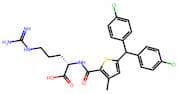
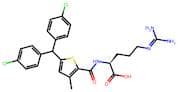
:L-Arginina, N2-[[5-[bis(4-clorofenil)metil]-3-metil-2-tienil]carbonil]-
- 5-(Bis(4-chlorophenyl)methyl)-3-methylthiophene-2-carbonyl)-l-arginine hydrochloride
- L-Arginine, N2-[[5-[bis(4-chlorophenyl)methyl]-3-methyl-2-thienyl]carbonyl]-
- JR14a
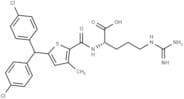
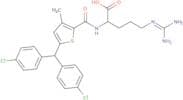
- (S)-2-(5-(Bis(4-chlorophenyl)methyl)-3-methylthiophene-2-carboxamido)-5-guanidinopentanoic acid
(S)-2-(5-(Bis(4-chlorophenyl)methyl)-3-methylthiophene-2-carboxamido)-5-guanidinopentanoic acid
CAS:Fórmula:C25H26Cl2N4O3SPureza:95%Cor e Forma:SolidPeso molecular:533.4699(S)-2-(5-(Bis(4-Chlorophenyl)Methyl)-3-Methylthiophene-2-Carboxamido)-5-Guanidinopentanoic Acid
CAS:(S)-2-(5-(Bis(4-Chlorophenyl)Methyl)-3-Methylthiophene-2-Carboxamido)-5-Guanidinopentanoic AcidPureza:≥98%Peso molecular:533.47g/molJR14a
CAS:JR14a (5-(Bis(4-chlorophenyl)methyl)-3-methylthiophene-2-carbonyl)-l-arginine hydrochloride) is a potent antagonist of human complement C3a receptor.Fórmula:C25H26Cl2N4O3SPureza:99.76%Cor e Forma:SolidPeso molecular:533.47JR14a
CAS:JR14a is an analog inhibitor of protein kinases, which has shown promising results in the treatment of cancer. It is derived from indirubin, a natural compound found in Chinese urine that has been used for centuries in traditional medicine. JR14a specifically targets tumor cells and induces apoptosis, or programmed cell death, thereby inhibiting the growth and spread of cancer cells. This anticancer drug works by inhibiting protein kinases involved in cellular signaling pathways that regulate cell growth and division. JR14a has shown potential as a therapeutic agent for various types of cancer, including breast, lung, and colon cancer. Its ability to selectively target cancer cells without affecting healthy cells makes it a promising candidate for the development of new anticancer drugs.
Fórmula:C25H26Cl2N4O3SPureza:Min. 95%Peso molecular:533.5 g/mol