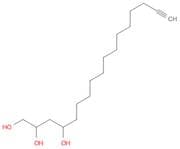
CAS 24607-05-4
:heptadec-16-ino-1,2,4-triol
Descrição:
heptadec-16-ino-1,2,4-triol, com o número CAS 24607-05-4, é um composto químico caracterizado por sua longa cadeia de carbono e múltiplos grupos funcionais. Especificamente, apresenta uma espinha dorsal de 17 carbonos com um grupo alquino terminal e três grupos hidroxila (-OH) localizados nas posições 1, 2 e 4. Essa estrutura confere propriedades tanto hidrofóbicas quanto hidrofílicas, tornando-o anfifílico. A presença do grupo alquino sugere que ele pode participar de várias reações químicas, incluindo reações de adição típicas de alquinos. Os grupos hidroxila contribuem para sua potencial solubilidade em solventes polares e sua capacidade de formar ligações de hidrogênio, o que pode influenciar sua reatividade e interações com outras moléculas. heptadec-16-ino-1,2,4-triol pode ser de interesse em aplicações bioquímicas, particularmente no estudo do metabolismo lipídico ou como um potencial surfactante devido às suas características estruturais únicas. Suas propriedades específicas, como ponto de fusão, ponto de ebulição e reatividade, dependeriam das condições sob as quais é estudado.
Fórmula:C17H32O3
InChI:InChI=1/C17H32O3/c1-2-3-4-5-6-7-8-9-10-11-12-13-16(19)14-17(20)15-18/h1,16-20H,3-15H2
Chave InChI:InChIKey=OHLQBKZXSJYBMK-IAGOWNOFSA-N
SMILES:C#CCCCCCCCCCCCC(CC(CO)O)O
Sinónimos:- (2R,4R)-1,2,4-Trihydroxyheptadec-16-yne
- (2R,4R)-16-Heptadecyne-1,2,4-triol
- 16-Heptadecyne-1,2,4-triol
- 16-Heptadecyne-1,2,4-triol, (2R,4R)-
- 16-Heptadecyne-1,2,4-triol, [R-(R*,R*)]-
- Avocadyne
Ordenar por
Pureza (%)
0
100
|
0
|
50
|
90
|
95
|
100
3 produtos.
Avocadyne
CAS:Avocadyne is a bioactive compound, which is sourced from avocados, specifically from the lipids extracted from the fruit. Its mode of action involves interacting with cellular pathways that are relevant to inflammation and metabolic regulation, showcasing effects that may influence various biochemical processes.Avocadyne has been primarily studied for its potential roles in therapeutic applications due to its anti-inflammatory and antioxidant properties. Research suggests that this compound may modulate signaling pathways related to lipid metabolism and oxidative stress, thus offering potential benefits in the management of conditions such as metabolic disorders and chronic inflammation. Additionally, its ability to interact with these pathways positions Avocadyne as a compound of interest for further investigation in the context of neurodegenerative diseases and certain cancers. Scientifically, the exploration of Avocadyne's effects on cellular models aims to elucidate its mechanism of action and optimize its potential therapeutic applications. This necessitates a thorough understanding of its biochemical interactions and the possible modulation of various molecular targets within diseased states.Fórmula:C17H32O3Pureza:Min. 95%Peso molecular:284.43 g/mol