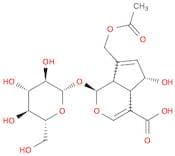
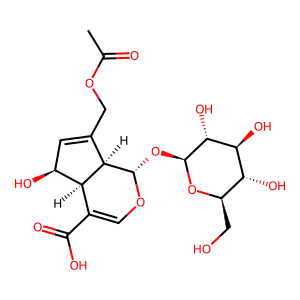
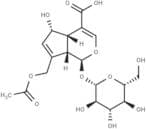
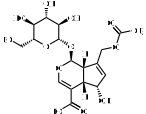
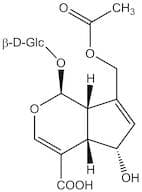
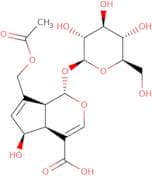
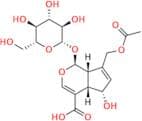
CAS 25368-11-0
:Ácido asperulosídico
Descrição:
Ácido asperulosídico é um glicosídeo iridoide que ocorre naturalmente, encontrado principalmente em várias espécies de plantas, particularmente na família Rubiaceae. É caracterizado por sua complexa estrutura molecular, que inclui um grupo de açúcar ligado a um núcleo iridoide. Este composto é conhecido por suas potenciais propriedades farmacológicas, incluindo atividades anti-inflamatórias, antioxidantes e antimicrobianas. Ácido asperulosídico é frequentemente estudado por seu papel na medicina tradicional e suas potenciais aplicações terapêuticas. É tipicamente solúvel em solventes polares, o que facilita sua extração de materiais vegetais. A estabilidade e reatividade do composto podem ser influenciadas por fatores ambientais, como pH e temperatura. Além disso, sua presença em formulações herbais destaca sua importância na fitoterapia e na pesquisa de produtos naturais. No geral, Ácido asperulosídico representa um assunto de estudo interessante devido às suas propriedades bioativas e potenciais benefícios à saúde.
Fórmula:C18H24O12
InChI:InChI=1S/C18H24O12/c1-6(20)27-4-7-2-9(21)12-8(16(25)26)5-28-17(11(7)12)30-18-15(24)14(23)13(22)10(3-19)29-18/h2,5,9-15,17-19,21-24H,3-4H2,1H3,(H,25,26)/t9-,10+,11+,12-,13+,14-,15+,17-,18-/m0/s1
Chave InChI:InChIKey=DGDWCRWJRNMRKX-DILZHRMZSA-N
SMILES:O([C@H]1[C@]2([C@@](C(C(O)=O)=CO1)([C@@H](O)C=C2COC(C)=O)[H])[H])[C@@H]3O[C@H](CO)[C@@H](O)[C@H](O)[C@H]3O
Sinónimos:- Cyclopenta[c]pyran-4-carboxylic acid, 1α-(β-D-glucopyranosyloxy)-1,4aα,5,7aα-tetrahydro-5β-hydroxy-7-(hydroxymethyl)-, 7-acetate
- (1S,4aS,5S,7aS)-7-[(Acetyloxy)methyl]-1-(β-D-glucopyranosyloxy)-1,4a,5,7a-tetrahydro-5-hydroxycyclopenta[c]pyran-4-carboxylic acid
- Cyclopenta[c]pyran-4-carboxylic acid, 7-[(acetyloxy)methyl]-1-(β-D-glucopyranosyloxy)-1,4a,5,7a-tetrahydro-5-hydroxy-, (1S,4aS,5S,7aS)-
- Asperulosidic acid
- Cyclopenta[c]pyran-4-carboxylic acid, 7-[(acetyloxy)methyl]-1-(β-D-glucopyranosyloxy)-1,4a,5,7a-tetrahydro-5-hydroxy-, [1S-(1α,4aα,5β,7aα)]-
Ordenar por
Pureza (%)
0
100
|
0
|
50
|
90
|
95
|
100
9 produtos.
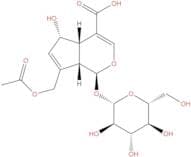
Asperulosidic acid
CAS:Asperulosidic acid has been recently used in chinese medicine as a useful drug against some tumors. It has anticlastogenic activity, since the anticlastogenic irridoids have an alpha-unsaturated carbonyl group, this structure is considered to play an important role in the anticlastogenicity. Asperulosidic acid can inhibit the seed germination and growth of seedlings of large crabgrass. Asperulosidic acid, and 6-O-(beta-D-glucopyranosyl)-1-O-octanoyl-beta-D-glucopyranose are effective in suppressing 12-O-tedtradecanoylphorbol-13-acetate (TPA)- or epidermal growth factor (EGF)-induced cell transformation and associated AP-1 activity.Fórmula:C18H24O12Pureza:95%~99%Cor e Forma:PowderPeso molecular:432.378Asperulosidic acid
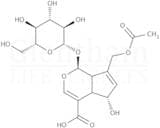
CAS:Fórmula:C18H24O12Pureza:≥ 98.0%Cor e Forma:White to off-white solidPeso molecular:432.38Asperulosidic acid
CAS:Asperulosidic acid (ASPA) has anti-tumor, anti-oxidant, and anti-inflammatory activities. ASPA is related to the inhibition of inflammatory cytokines.Fórmula:C18H24O12Pureza:99.47%Cor e Forma:SolidPeso molecular:432.38Ref: TM-TN1410
1mg120,00€2mg170,00€5mg260,00€1mL*10mM (DMSO)286,00€10mg432,00€25mg708,00€50mg964,00€100mg1.288,00€Asperulosidic acid
CAS:Natural glycosideFórmula:C18H24O12Pureza:≥ 90.0 % (HPLC)Cor e Forma:PowderPeso molecular:432.38Asperulosidic acid
CAS:Asperulosidic acid is a glycoside derivative that belongs to the natural compounds. It has been shown to be an enzyme inducer in bacteria, yeast and plants. Asperulosidic acid can be found in the leaves of asperula odorata, a plant commonly known as sweet woodruff. It is also found in fructus asperuli, which is made from the fruit of asperula odorata. Asperulosidic acid has been shown to increase the activity of enzymes such as β-glucuronidase and esterase in bacteria, which may have an effect on their metabolism. This compound also increases the activity of proteases and other enzymes in plants and yeast. The matrix effect can be used to determine the concentration of this compound by measuring its effects on enzyme activity. Matrix effects can be measured using a plate test or by plasma mass spectrometry. Asperulosidic acid has been shown to have growthFórmula:C18H24O12Pureza:Min. 95%Cor e Forma:SolidPeso molecular:432.38 g/mol