CAS 26041-51-0
:L-Tirosina, N-acetil-O-(4-hidroxi-3,5-diiodofenil)-3,5-diiodo-
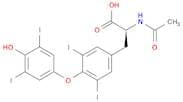
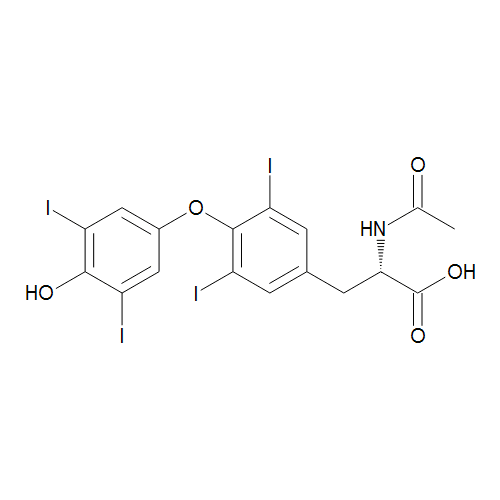
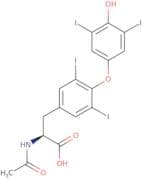
N-Acetyl Thyroxine (N-Acetyl-O-(4-hydroxy-3,5-diiodophenyl)-3,5-diiodo-L-tyrosine)
CAS:Aromatic amino-alcohol-phenols, aromatic amino-acid-phenols and other aromatic amino compounds with oxygen functionFórmula:C17H13I4NO5Cor e Forma:Off-White PowderPeso molecular:818.69726N-Acetyl-o-(4-hydroxy-3,5-diiodophenyl)-3,5-diiodo-l-tyrosine
CAS:Fórmula:C17H13I4NO5Pureza:95%Cor e Forma:SolidPeso molecular:818.9067Levothyroxine Related Compound 5
CAS:Fórmula:C17H13I4NO5Cor e Forma:Off-White SolidPeso molecular:818.91N-Acetylthyroxine
CAS:N-Acetylthyroxine is a kind of Thyroxine analogue for the treatment of diagnosing and treating diabetes.Fórmula:C17H13I4NO5Cor e Forma:SolidPeso molecular:818.91N-Acetyl-L-Thyroxine (N-Acetyllevothyroxine)
CAS:Produto ControladoFórmula:C17H13I4NO5Cor e Forma:NeatPeso molecular:818.91N-Acetyl L-Thyroxine(>90%)
CAS:Produto ControladoImpurity Levothyroxine N-Acetyl Impurity; 1 N-Acetyl-T4 (USP)
Applications N-Acetyl L-Thyroxine (Levothyroxine N-Acetyl Impurity; 1 N-Acetyl-T4 (USP)) is a Thyroxine (T425600) analogue, a thyroid hormone for use in diagnosing and treating diabetes.
References Gonzales, M., et al.: J. Biol. Chem., 272, 11288 (1997), de Wolf, F., et al.: Pharm. Rev., 52, 207 (2000), Waner, M., et al.: Biophys. J., 87, 2701 (2004),Fórmula:C17H13I4NO5Pureza:>90%Cor e Forma:White To Off-WhitePeso molecular:818.91N-Acetyl L-thyroxine
CAS:N-Acetyl L-thyroxine is a molecule that has two acetyl groups, one at the amino and one on the phenol. It is synthesized by the addition of an acetyl group to thyronine. N-Acetyl L-thyroxine can be found in human serum and hydroxycobalamin. N-Acetyl L-thyroxine binds with proteins to form a labile complex. This binding can be increased with a hydroxyl group, diphenyl ether, or chlorine. N-Acetyl L-thyroxine is also involved in hormone synthesis and metabolism, as well as being converted into l-glutamic acid and then into acid analysis. Halogens are known to cause the cleavage of N-acetyl L-thyroxine at the C5 position, which leads to its degradation by oxidation.
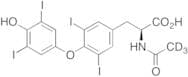
Fórmula:C17H13I4NO5Pureza:Min. 95%Cor e Forma:White PowderPeso molecular:818.91 g/molN-Acetyl L-Thyroxine-d3
CAS:Produto ControladoFórmula:C17H10D3I4NO5Cor e Forma:NeatPeso molecular:821.93