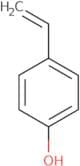
CAS 2628-17-3
:4-Vinilfenol
Descrição:
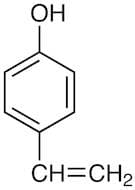
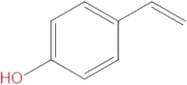
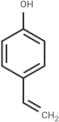
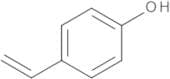
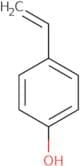
4-Vinilfenol, também conhecido como p-vinilfenol, é um composto orgânico caracterizado por uma estrutura fenólica com um grupo vinílico ligado à posição para do anel aromático. Sua fórmula molecular é C8H8O e apresenta um grupo hidroxila (-OH) que confere propriedades fenólicas típicas, como reatividade e a capacidade de formar ligações de hidrogênio. Este composto é um líquido incolor a amarelo claro à temperatura ambiente e possui um odor característico. 4-Vinilfenol é solúvel em solventes orgânicos e apresenta solubilidade moderada em água. É utilizado principalmente na produção de polímeros e resinas, particularmente na síntese de resinas fenólicas e como monômero em várias aplicações de copolímeros. Além disso, pode servir como um intermediário na síntese orgânica e tem aplicações potenciais no campo da ciência dos materiais. Devido ao seu grupo vinílico reativo, 4-Vinilfenol pode sofrer polimerização e outras reações químicas, tornando-se um composto valioso em vários processos industriais. Devem ser tomadas precauções de segurança ao manusear esta substância, pois pode causar irritação na pele e nos olhos.
Fórmula:C8H8O
InChI:InChI=1S/C8H8O/c1-2-7-3-5-8(9)6-4-7/h2-6,9H,1H2
Chave InChI:InChIKey=FUGYGGDSWSUORM-UHFFFAOYSA-N
SMILES:C(=C)C1=CC=C(O)C=C1
Sinónimos:- 4-Ethenylphenol
- 4-Hydroxystyrene
- P-Vinilfenol
- Phenol, 4-ethenyl
- Phenol, p-vinyl-
- p-Hydroxystyrene
- p-Oxystyrene
- p-Vinylphenol
Ordenar por
Pureza (%)
0
100
|
0
|
50
|
90
|
95
|
100
Foram encontrados 12 produtos.
4-Vinylphenol (ca. 10% in Propylene Glycol)
CAS:Fórmula:C8H8OCor e Forma:Light yellow to Yellow to Orange clear liquidPeso molecular:120.154-Vinylphenol, min 10% soln. in propylene glycol
CAS:4-Vinylphenol acts as a monomer and used in the preparation of poly-4-vinylphenol polymer, which is used in electronics as a dielectric layer in organic transistors in organic thin-film-transistor liquid-crystal displays (TFT LCD). It is a phenolic compound and presents in wine and beer. This ThermFórmula:C8H8OCor e Forma:Liquid, Clear colorless to yellow or orangePeso molecular:120.154-Vinylphenol
CAS:Fórmula:C8H8OPureza:>98.0%(GC)Cor e Forma:White to Light yellow powder to crystalPeso molecular:120.154-Vinylphenol
CAS:4-Vinylphenol, a metabolite from lactic acid bacteria in wine, induces apoptosis. Found in Hedyotis diffusa Willd.Fórmula:C8H8OPureza:97.07%Cor e Forma:SolidPeso molecular:120.154-Vinylphenol, 10 wt.% In Propylene Glycol
CAS:Applications 4-Vinylphenol, 10 wt.% In propylene glycol (cas# 2628-17-3) is a useful research chemical.
Fórmula:C8H8OCor e Forma:Single SolutionPeso molecular:120.144-Vinylphenol, 10 wt % in propylene glycol
CAS:4-Vinylphenol is a chemical compound that has the molecular formula CH2=CHC6H4OH. It is a hydroxyl derivative of phenol and has the chemical structure of a phenolic acid. This compound is used in the laboratory to study the effects of cationic polymerization on surface methodology and activation energies. 4-Vinylphenol inhibits Saccharomyces cerevisiae strain, which is commonly found in urine samples as well as in recombinant cells, by inhibiting cell growth and reducing ATP production. The inhibition of Saccharomyces cerevisiae strain by 4-vinylphenol can be reversed with p-hydroxybenzoic acid or cationic polymerization. The molecule also contains two nitrogen atoms that can form hydrogen bonds with other molecules, such as water molecules. It is possible that these hydrogen bonds are what allow 4-vinylphenol to inhibit Saccharomyces cerevisiae strain, although this hypothesis hasFórmula:C8H8OPureza:Min. 95 Area-%Cor e Forma:Colorless Clear LiquidPeso molecular:120.15 g/mol4-Vinylphenol
CAS:4-Vinylphenol is a phenolic compound that is used as an industrial chemical. It has been shown to inhibit the growth of bacteria in nonpolar solvents, including aerobacter aerogenes and Saccharomyces cerevisiae. 4-Vinylphenol inhibits bacterial growth through its ability to disrupt the hydrogen bonds between proteins and nucleic acids. This results in increased hydroxyl groups on the protein surface and cationic polymerization of the DNA gyrase enzyme, which disrupts its function. 4-Vinylphenol has also been shown to activate mouse CD-1 cells by increasing their sensitivity to chemical inhibitors, such as ethidium bromide or 2',7'-dichlorofluorescin diacetate (DCFH2DA).Fórmula:C8H8OPureza:Min. 95%Cor e Forma:LiquidPeso molecular:120.15 g/mol4-Vinylphenol 10% solution in Propylene glycol
CAS:Fórmula:C8H8OPureza:95.0%Cor e Forma:SolidPeso molecular:120.151