CAS 26305-03-3
:pepstatina A ~120'000 U/mg
- Pepstatin A
- pepstatin A from microbial source
- Pepstatin (microbial product)
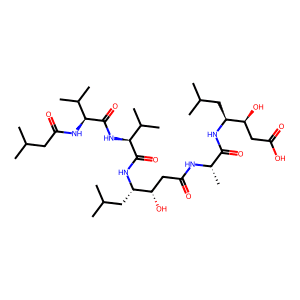
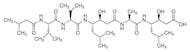
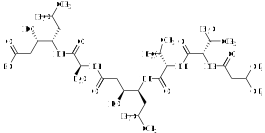
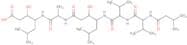
- Isovaleryl-Val-Val-Sta-Ala-Sta-OH
- N-(3-methylbutanoyl)-L-valyl-N-[(1S,2S)-4-{[(1S)-2-({(1S)-1-[(1S)-2-carboxy-1-hydroxyethyl]-3-methylbutyl}amino)-1-methyl-2-oxoethyl]amino}-2-hydroxy-1-(2-methylpropyl)-4-oxobutyl]-L-valinamide
- (3S,4R)-3-hydroxy-4-[[(2R)-2-[[(3R,4S)-3-hydroxy-6-methyl-4-[[(2R)-3-methyl-2-[[(2R)-3-methyl-2-(3-methylbutanoylamino)butanoyl]amino]butanoyl]amino]heptanoyl]amino]propanoyl]amino]-6-methyl-heptanoic acid
- Pepstatin
Pepstatin A
CAS:Pepstatin A (isovaleryl-pepstatin), a low molecular weight inhibitor of acid proteases, e.g. pepsin, renin, cathepsin D, and plasmepsin II. For the Plasmodium falciparum aspartyl protease plasmepsin II, Hill et al determined an IC₅₀ of 0.1 nM.Fórmula:C34H63N5O9Pureza:> 99%Cor e Forma:White PowderPeso molecular:685.9Pepstatin
CAS:Pepstatin (Pepsin Inhibitor S 735A) is a specific and orally aspartate protease inhibitor that also inhibits HIV protease activity. Cost effective and quality assured.Fórmula:C34H63N5O9Pureza:96.74% - 99.94%Cor e Forma:SolidPeso molecular:685.89L-Alaninamide,N-(3-methyl-1-oxobutyl)-L-valyl-L-valyl-(3S,4S)-4-amino-3-hydroxy-6-methylheptanoyl-N-[(1S)-1-[(1S)-2-carboxy-1-hydroxyethyl]-3-methylbutyl]-
CAS:Fórmula:C34H63N5O9Pureza:75%Cor e Forma:SolidPeso molecular:685.8921Ref: IN-DA00I50B
1gA consultar1mg54,00€5mg101,00€10mg109,00€25mg152,00€50mg184,00€100mg265,00€250mgA consultarPepstatin A
CAS:Pepstatin AFórmula:C34H63N5O9Pureza:By hplc: 98.2% (220 nm) (Typical Value in Batch COA)Cor e Forma: white to off white powderPeso molecular:685.89212g/molPepstatin A
CAS:Fórmula:C34H63N5O9Pureza:>90.0%(HPLC)Cor e Forma:White to Light yellow powder to crystalPeso molecular:685.90Pepstatin A
CAS:Fórmula:C34H63N5O9Pureza:≥ 98.0%Cor e Forma:White to off-white powderPeso molecular:685.90Pepstatin A (Purity Higher than 90% by HPLC)
CAS:Pepstatin A is a natural product that inhibits the activity of proteases, particularly chymotrypsin and trypsin. It binds to the active site of these enzymes, blocking access to their substrate. Pepstatin A has been shown to have synergistic effects with other drugs in vitro, such as dapsone and clindamycin. Pepstatin A has inhibitory properties against infectious diseases, including HIV-1 and HIV-2, influenza virus type A (H1N1), herpes simplex virus type 1 (HSV-1), human papilloma virus type 18 (HPV-18), hepatitis C virus (HCV) types 1a and 1b, as well as dengue fever virus. Pepstatin A is also effective in inhibiting polymerase chain reaction amplification of mitochondrial DNA from patients with mitochondrial disorders. The biological sample for this research was obtained from calf thymus tissue. The natural compound pepstatin A hasFórmula:C34H63N5O9Pureza:Higher Than 90% By Hplc)Peso molecular:685.89 g/molPepstatin A
CAS:Pepstatin A was originally purified from Actinomycetes species. The peptide is unusual in containing the amino acid statine (4-amino-hydroxy-6-methylheptanoic acid also known as AMHA). Pepstatin A competitively binds with acid proteases in a highly selective reversible manner to inhibit protease activity. Pepstatin A is ineffective on thiol, neutral and serine proteases. The functions of proteases have been investigated by the application of pepstatin A such as renin, pepsin, bovine chymosin and retroviral proteases from HIV. Characterisation of HIV protease using pepstatin A has been vital in development of HIV treatment to block viral replication. Pepstatin A is also a reagent to disrupt autophagy- this helps characterise the function of proteosome degradation in research such as during influenza A replication and improving drug delivery of therapeutic cancer treatments.Peso molecular:685.89 g/molPepstatin A (Synthetic)
CAS:Pepstatin A is a natural product that has been synthesized for use as an inhibitor of proteolytic enzymes. It inhibits the activity of a wide range of proteases and is used in vitro to study the biochemical properties of these enzymes. Pepstatin A inhibits the activity of many important proteases, including those involved in infectious diseases, such as HIV and hepatitis C virus. Pepstatin A binds to the active site on serine proteases, blocking access by their substrates and thereby inhibiting enzyme activity. The binding site is highly conserved among different types of serine protease, with approximately 90% homology between trypsin and chymotrypsin. The inhibitory mechanism involves a specific interaction between pepstatin A's hydrophobic side chain and the catalytic triad residues His57, Asp102, and Ser195 in trypsin or His57, Asp102, and Ser188 in chymotrypsin.
Fórmula:C34H63N5O9Pureza:Min. 95%Peso molecular:685.89 g/mol