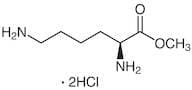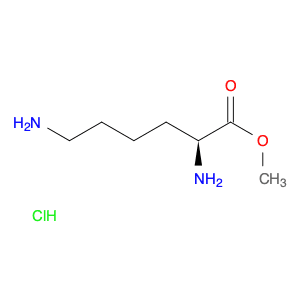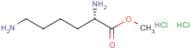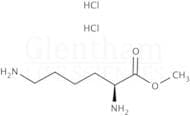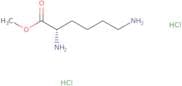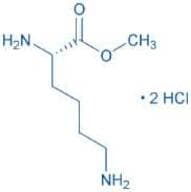
CAS 26348-70-9
:L-Lisina, éster metílico, cloridrato (1:2)
Descrição:
L-Lisina, éster metílico, cloridrato (1:2) é um derivado do aminoácido lisina, caracterizado pela presença de um grupo éster metílico e uma forma de sal hidroclorídrico. Este composto é tipicamente um pó cristalino branco, solúvel em água, o que melhora sua biodisponibilidade e o torna adequado para várias aplicações, incluindo suplementos nutricionais e formulações farmacêuticas. Como um derivado de aminoácido, desempenha um papel na síntese de proteínas e pode estar envolvido em processos metabólicos. A forma hidroclorídrica melhora a estabilidade e solubilidade, facilitando seu uso em formulações. A L-Lisina é essencial para a saúde humana, contribuindo para o crescimento, reparo de tecidos e produção de enzimas e hormônios. Também é conhecida por seus potenciais benefícios no suporte à função imunológica e na promoção da absorção de cálcio. O perfil de segurança do composto é geralmente favorável, mas como todas as substâncias, deve ser usado de acordo com as diretrizes recomendadas para evitar potenciais efeitos colaterais. No geral, a L-Lisina, éster metílico, hidroclorídrico é valorizada por suas propriedades funcionais em contextos dietéticos e terapêuticos.
Fórmula:C7H18Cl2N2O2
InChI:InChI=1/C7H16N2O2/c1-11-7(10)6(9)4-2-3-5-8/h6H,2-5,8-9H2,1H3/p+2/t6-/m0/s1
Chave InChI:InChIKey=SXZCBVCQHOJXDR-ILKKLZGPSA-N
SMILES:[C@H](CCCCN)(C(OC)=O)N.Cl
Sinónimos:- (5S)-6-methoxy-6-oxohexane-1,5-diaminium
- <span class="text-smallcaps">L</span>-Lysine dihydrochloride methyl ester
- <span class="text-smallcaps">L</span>-Lysine, methyl ester, dihydrochloride
- <span class="text-smallcaps">L</span>-Lysine, methyl ester, hydrochloride (1:2)
- H-Lys-OMe.2HCl
- H-Lys-OMe・2HCl
- L-Lysine Methyl Ester Dihydrochloride
- L-Lysine methyl・dihydrochloride
- Lysine methyl ester dihydrochloride
- Lysine, methyl ester, dihydrochloride, <span class="text-smallcaps">L</span>-
- Lysoome.2hcl
- Methyl <span class="text-smallcaps">L</span>-lysinate dihydrochloride
- Methyl Lysinate
- NSC 83256
- methyl L-lysinate dihydrochloride
- Lysine, methyl ester, dihydrochloride, L-
- L-Lysine, methyl ester, hydrochloride (1:2)
- (s)-2,6-diaminohexanoic acid methyl ester dihydrochloride
- H-LYS-OME
- L-Lysine Methyl Ester 2HCl
- METHYL (S)-2,6-DIAMINOHEXANOIC ACID DIHYDROCHLORIDE
- L-LYSINE METHYL ESTER DIHCL
- L-LYSINE METHYL ESTER DIHYDROCHLORIDE SALT
- L-Lysine methyl·dihydrochloride
- LYSINE-OME 2 HCL
- L-LYSINE METHYL ESTER DIHYDROCHLORIDE 99%
- L-Lysinemethylesterdihydrochloride,99%
- H-L-Lys-OMe*2HCl
- LYS.OME.2HCL
- Methyl L-Lysine Dihydrochloride
- Ver mais sinónimos
Ordenar por
Pureza (%)
0
100
|
0
|
50
|
90
|
95
|
100
9 produtos.
L-Lysine Methyl Ester Dihydrochloride
CAS:Fórmula:C7H16N2O2·2HClPureza:>98.0%(N)Cor e Forma:White to Almost white powder to crystalPeso molecular:233.13L-Lysine methyl ester dihydrochloride, 99%
CAS:L-Lysine methyl ester dihydrochloride is used in the production of lysine methyl ester based cationic surfactants and hydrogels. This Thermo Scientific Chemicals brand product was originally part of the Alfa Aesar product portfolio. Some documentation and label information may refer to the legacy brFórmula:C7H18Cl2N2O2Pureza:99%Cor e Forma:White to pale cream, Crystals or powder or crystalline powderPeso molecular:233.13L-Lysine, methyl ester, hydrochloride (1:2)
CAS:Fórmula:C7H18Cl2N2O2Pureza:95%Cor e Forma:SolidPeso molecular:233.1360L-Lysine methyl ester dihydrochloride
CAS:L-Lysine methyl ester dihydrochloridePureza:98%Peso molecular:233.14g/molL-Lysine methyl ester dihydrochloride
CAS:Fórmula:C7H16N2O2·2HClPureza:≥ 98.0%Cor e Forma:White to almost white powder or crystalsPeso molecular:233.14H-Lys-OMe.2HCl
CAS:M03024 - H-Lys-OMe.2HCl
Fórmula:C7H18Cl2N2O2Pureza:95%Cor e Forma:SolidPeso molecular:233.13L-Lysine Methyl Ester Dihydrochloride
CAS:Produto ControladoApplications Used in the synthesis of peptides containing histidine and lysine.
References Bizzozero, S., et al.: Eur. J. Biochem., 122, 251 (1982), Schellenberger, V., et al.: Biochim. Biophys Acta., 869, 54 (1986), Jakubke, H., et al.: Biol. Chem., 377, 455 (1996),Fórmula:C7H18Cl2N2O2Cor e Forma:NeatPeso molecular:233.14L-Lysine methyl ester 2HCl
CAS:L-Lysine methyl ester 2HCl is a lysine derivative that has been synthesized by reacting L-lysine with methanol and hydrochloric acid. This compound's cytotoxicity has been demonstrated in an inhibition study using calf thymus dna. L-Lysine methyl ester 2HCl contains amide, acid, and ester linkages, as well as hydrogen bonds that are typical of natural compounds. It is also biologically active and has a molecular weight of 246.3 g/mol. The chemical structure of this compound consists of a central l-lysine molecule with two methyl groups on the nitrogen atom. The compound also contains a carboxyl group on the end of the chain and an ester group on the second carbon atom from the end of the chain. L-Lysine methyl ester 2HCl can be found in soybeans and bovine fetal tissue. It exhibits morphological properties similar to otherFórmula:C7H16N2O2·2HClPureza:Min. 95%Cor e Forma:PowderPeso molecular:233.14 g/molH-Lys-OMe · 2 HCl
CAS:Bachem ID: 4002480.
Fórmula:C7H16N2O2·2HClPureza:> 99%Cor e Forma:White PowderPeso molecular:233.14