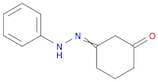
CAS 27385-45-1
:1,3-Ciclohexanodiona, 1-(2-fenilhidrazona)
Descrição:
1,3-Ciclohexanodiona, 1-(2-fenilhidrazona) é um composto orgânico caracterizado pelo seu grupo funcional hidrazona, que se forma a partir da reação de 1,3-ciclohexanediona com fenilhidrazina. Este composto geralmente aparece como um sólido e é conhecido por suas potenciais aplicações em síntese orgânica e como reagente em várias reações químicas. Apresenta um anel de ciclohexano com dois grupos cetona nas posições 1 e 3, contribuindo para sua reatividade e capacidade de formar derivados. A presença do grupo fenilhidrazona melhora suas propriedades, tornando-o útil no desenvolvimento de corantes e produtos farmacêuticos. Além disso, este composto pode exibir propriedades ópticas específicas devido à sua configuração estrutural, que podem ser exploradas na química analítica. Assim como muitos compostos orgânicos, é importante manuseá-lo com cuidado, considerando sua reatividade potencial e a necessidade de protocolos de segurança adequados durante o uso.
Fórmula:C12H14N2O
InChI:InChI=1S/C12H14N2O/c15-12-8-4-7-11(9-12)14-13-10-5-2-1-3-6-10/h1-3,5-6,13H,4,7-9H2
Chave InChI:InChIKey=ASBKHKGFGCNQJB-UHFFFAOYSA-N
SMILES:N(NC1=CC=CC=C1)=C2CC(=O)CCC2
Sinónimos:- 1,3-Cyclohexanedione, 1-(2-phenylhydrazone)
- 1,3-Cyclohexanedione, mono(phenylhydrazone)
Ordenar por
Pureza (%)
0
100
|
0
|
50
|
90
|
95
|
100
3 produtos.
3-(2-phenylhydrazin-1-ylidene)cyclohexan-1-one
CAS:Fórmula:C12H14N2OPureza:95%Cor e Forma:SolidPeso molecular:202.2524(Z)-3-(2-Phenylhydrazono)cyclohexanone
CAS:The method involves refluxing ethanol with a solid acid catalyst and a condensation agent. The reaction is catalyzed by the acid catalyst, which can be either an inorganic or organic acid. The reaction time is typically 3 to 4 hours. Effective catalysts include aluminum chloride, zinc chloride, and titanium tetrachloride. Carvedilol is an effective product of this reaction because it has a high yield and a low production cost. Solid-acid catalysts are used for this synthesis because they have excellent stability in the presence of water and air and can be easily recovered from the reaction mixture. The reactants are heated at reflux until the desired product is formed. This process is typically carried out using a reflux apparatus equipped with an efficient condenser and an ice bath to maintain the temperature below boiling point. The yields of the desired product are typically high, ranging from 80% to 95%.Fórmula:C12H14N2OPureza:Min. 95%Peso molecular:202.25 g/mol