CAS 27913-58-2
:Ácido 4-(P-iodofenil)butírico
Descrição:
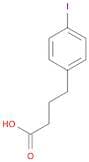
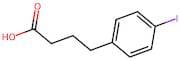
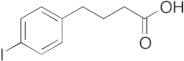
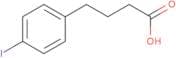
Ácido 4-(P-iodofenil)butírico, com o número CAS 27913-58-2, é um composto orgânico caracterizado por sua estrutura, que inclui um grupo de ácido butírico ligado a um grupo para-iodofenila. Este composto geralmente exibe propriedades associadas tanto a compostos aromáticos quanto alifáticos, incluindo solubilidade moderada em solventes orgânicos e reatividade potencial devido à presença do átomo de iodo, que pode participar de várias reações químicas. O substituinte de iodo pode influenciar as propriedades eletrônicas do composto, tornando-o útil em química medicinal e como um potencial intermediário na síntese orgânica. Além disso, o grupo funcional ácido carboxílico contribui para sua acidez e potencial para formar sais ou ésteres. O composto também pode exibir atividade biológica, que pode ser explorada em estudos farmacológicos. No geral, Ácido 4-(P-iodofenil)butírico é notável por suas características estruturais únicas e aplicações potenciais em pesquisa e indústria.
Fórmula:C10H11IO2
InChI:InChI=1/C10H11IO2/c11-9-6-4-8(5-7-9)2-1-3-10(12)13/h4-7H,1-3H2,(H,12,13)
SMILES:C(Cc1ccc(cc1)I)CC(=O)O
Sinónimos:- 4-(4-Iodophenyl)Butanoic Acid
Ordenar por
Pureza (%)
0
100
|
0
|
50
|
90
|
95
|
100
5 produtos.
Ref: IN-DA003KA2
1g28,00€5g73,00€10g113,00€1kgA consultar25g199,00€50g496,00€100g584,00€250gA consultar500gA consultar250mg26,00€4-(p-Iodophenyl)butyric Acid
CAS:Applications 4-(p-Iodophenyl)butyric Acid is a reactant involved in the synthesis of meta- and paracyclophanes containing unsaturated amino acids and intramolecular Friedel-Crafts reactions for synthesis of 1-tetralones.
References Gibson, S., et al.: Tetrahedron, 60, 6945 (2004); Cui, D., et al.: Tetrahedron Lett., 44, 4007 (2003)Fórmula:C10H11IO2Cor e Forma:NeatPeso molecular:290.14-(p-Iodophenyl)butyric acid
CAS:4-(p-iodophenyl)butyric acid (4-IBBA) is a radiolabeled, non-toxic compound that is used in biotherapeutics to detect and treat cancer. 4-IBBA can be labeled with a small amount of radioactive iodine, which is then taken up by the tumor cells. The radioactivity can then be detected using a nuclear medicine imaging technique such as positron emission tomography (PET) or single photon emission computed tomography (SPECT). This compound also binds to human albumin and has been shown to bind to herpes simplex virus type 1 glycoprotein B. 4-IBBA has been shown to have pharmacokinetic properties that are similar to those of butyric acid, with rapid uptake into the gut and rapid excretion from the body. There are no long-term toxicities associated with this drug.Fórmula:C10H11IO2Pureza:Min. 95%Cor e Forma:PowderPeso molecular:290.1 g/mol