


CAS 2873-36-1
:L-leucil-L-prolina lactama
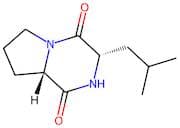
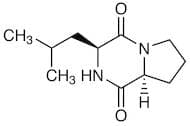
- (3S,8aS)-3-(2-methylpropyl)hexahydropyrrolo[1,2-a]pyrazine-1,4-dione
- (3S,8aS)-Hexahydro-3-(2-methylpropyl)pyrrolo[1,2-a]pyrazine-1,4-dione
- 3-(2-Methylpropyl)Hexahydropyrrolo[1,2-A]Pyrazine-1,4-Dione
- <span class="text-smallcaps">L</smallcap>-Leucyl-<smallcap>L</span>-proline lactam
- <span class="text-smallcaps">L</smallcap>-Leucyl-<smallcap>L</span>-prolyl lactam
- Brn 0085716
- Cyclo(-Leu-Pro)
- Cyclo(<span class="text-smallcaps">L</smallcap>-Leu-<smallcap>L</span>-Pro)
- Cyclo(<span class="text-smallcaps">L</smallcap>-Pro-<smallcap>L</span>-Leu)
- Cyclo(<span class="text-smallcaps">L</smallcap>-leucyl-<smallcap>L</span>-prolyl)
- Cyclo(<span class="text-smallcaps">L</smallcap>-prolyl-<smallcap>L</span>-leucyl)
- Cyclo(Pro-Leu)
- Cyclo(proline-leucine)
- Cyclo-<span class="text-smallcaps">L</smallcap>-prolyl-<smallcap>L</span>-leucine
- Cyclo-L-leu-L-pro
- Gancidin W
- Maculosin 6
- Pyrrolo(1,2-a)pyrazine-1,4-dione, hexahydro-3-(2-methylpropyl)-, (3S-trans)-
- Pyrrolo(1,2-a)pyrazine-1,4-dione, hexahydro-3-isobutyl-, stereoisomer
- Pyrrolo[1,2-a]pyrazine-1,4-dione, hexahydro-3-(2-methylpropyl)-, (3S,8aS)-
- cis-Cyclo(<span class="text-smallcaps">L</smallcap>-Leu-<smallcap>L</span>-Pro)
- L-Leucyl-L-proline lactam
- (3S-trans)-Hexahydro-3-isobutylpyrrolo(1,2-a)pyrazine-1,4-dione
- 5-24-07-00347 (Beilstein Handbook Reference)
- Cyclo-L-prolyl-L-leucine
- Cyclo(-L-Leu-L-Pro)≥ 99% (TLC)
- gancidinw
- 3-Isobutylhexahydropyrrolo[1,2-a]pyrazine-1,4-dione
- (3S,8aS)-2,3,6,7,8,8a-Hexahydro-3-(2-methylpropyl)pyrrolo[1,2-a]pyrazine-1,4-dione
- (3S,8aS)-3-Isobutylhexahydropyrrolo[1,2-a]pyrazine-1,4-dione
- 3-isobutyl-2,3,6,7,8,8a-hexahydropyrrolo[1,2-a]pyrazine-1,4-quinone
- (3S,8aS)-Octahydro-3-(2-methylpropyl)pyrrolo[1,2-a]pyrazine-1,4-dione
- Cyclo(L-prolyl-L-leucyl)
- L-Leucyl-L-prolyl lactaM
- 3-(2-methylpropyl)-2,3,6,7,8,8a-hexahydropyrrolo[1,2-a]pyrazine-1,4-dione
- Cyclo(L-Pro-L-Leu-)
- Cyclo(L-leucyl-L-prolyl-)
- 4-dione,hexahydro-3-(2-methylpropyl)-2-a)pyrazine-(3s-trans)-pyrrolo(
- Cyclo(L-Pro-D-Leu)
- (3S-trans)-Hexahydro-3-(2-Methylpropyl)-pyrrolo[1,2-a]pyrazine-1,4-dione
- Ver mais sinónimos
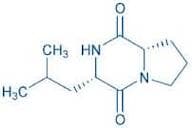
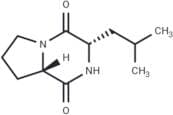
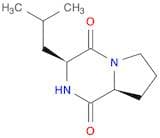
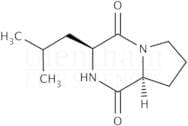
Cyclo(-Leu-Pro)
CAS:Cyclo(Leu-Pro) showed antibacterial activity. Yan et al. observed that Cyclo(Leu-Pro) produced by Achromobacter xylosoxidans inhibited aflatoxin production by Aspergillus parasiticus. The diketopiperazine was shown to inhibit catecholamine release in vitro. It could play a role in the hypothalamic modulation of appetite suppressant circuitry.Fórmula:C11H18N2O2Pureza:> 99%Cor e Forma:White PowderPeso molecular:210.28Cyclo(L-Leu-L-Pro)
CAS:Cyclo(L-Leu-L-Pro) is a compound from Pseudomonas sesquiterpenes BC42 with antifungal activity that inhibits fungal pathogens.Fórmula:C11H18N2O2Pureza:>99.99%Cor e Forma:SolidPeso molecular:210.27Cyclo(L-Pro-L-Leu)
CAS:Fórmula:C11H18N2O2Pureza:>95.0%(HPLC)Cor e Forma:White to Light yellow powder to crystalPeso molecular:210.28Cyclo(L-prolyl-L-leucyl)
CAS:Produto ControladoApplications Sorbicillin analog. A bioactive secondary metabolites from terrestrial Streptomyces species TN262.
References Ma, L. et al. : J. Anitibiot. 64, 645 (2011); Elleuch, L. et al.: Appl. Biochem. Biotech. 162, 579 (2010)Fórmula:C11H18N2O2Cor e Forma:NeatPeso molecular:210.27Cyclo(L-prolyl-L-leucyl)
CAS:Cyclo(L-prolyl-L-leucyl) is a cyclic lipopeptide that inhibits the transcription of DNA. It binds to the polymerase chain and blocks the transcription process, which prevents the production of RNA. Cyclo(L-prolyl-L-leucyl) has been shown to have an inhibitory effect on human pathogens such as fungi, protozoa, or bacteria. Cyclo(L-prolyl-L-leucyl) also has anti-cancer properties and is used for cancer treatment. Cyclo(L-prolyl-L-leucyl) is extracted from an acetate extract and purified by chromatography. The purified product is then tested in vitro using assays including magnetic resonance spectroscopy.
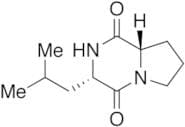
Fórmula:C11H18N2O2Pureza:Min. 95%Cor e Forma:PowderPeso molecular:210.27 g/mol(3S,8aS)-3-Isobutylhexahydropyrrolo[1,2-a]pyrazine-1,4-dione
CAS:Fórmula:C11H18N2O2Pureza:95%Cor e Forma:SolidPeso molecular:210.277










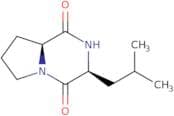

![(3S,8aS)-3-Isobutylhexahydropyrrolo[1,2-a]pyrazine-1,4-dione](/_next/image/?url=https%3A%2Fstatic.cymitquimica.com%2Fproducts%2F10%2Fthumb%2FF463133.jpg&w=3840&q=75)
