CymitQuimica logo

CAS 2909-84-4

:

Benzenamina, 2,4-bis(1,1-dimetiletil)-

Descrição:
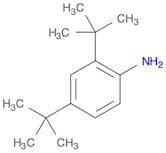
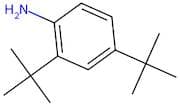
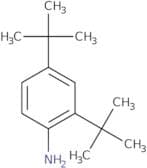
Benzenamina, 2,4-bis(1,1-dimetiletil)-, também conhecido como 2,4-di-tert-butilanilina, é um composto orgânico caracterizado pelo seu grupo funcional amina ligado a um anel benzênico, que é ainda substituído nas posições 2 e 4 por grupos tert-butilo. Essa estrutura confere uma significativa hindrance estérica, influenciando sua reatividade e propriedades físicas. O composto é tipicamente um líquido ou sólido incoloro a amarelo pálido, dependendo da temperatura e pureza. É conhecido por sua baixa solubilidade em água, mas boa solubilidade em solventes orgânicos, tornando-o útil em várias aplicações químicas. Os derivados de benzenamina são frequentemente utilizados como intermediários na síntese de corantes, produtos farmacêuticos e agroquímicos. Além disso, a presença dos grupos tert-butilo melhora sua estabilidade térmica e resistência à oxidação. As considerações de segurança incluem manuseá-lo com cuidado devido a potenciais propriedades irritantes e a necessidade de equipamento de proteção pessoal adequado durante o uso.
Fórmula:C14H23N
Sinónimos:
  • 2,4-Di-tert-butyl aniline
Ordenar por

Pureza (%)
0
100
|
0
|
50
|
90
|
95
|
100
4 produtos.
  • 2,4-Di-tert-butylaniline

    CAS:
    Fórmula:C14H23N
    Pureza:98%
    Cor e Forma:Liquid
    Peso molecular:205.3391

    Ref: IN-DA007LVG

    1g
    338,00€
    5g
    A consultar
    100mg
    110,00€
    250mg
    191,00€
  • 2,4-Di-Tert-Butylaniline

    CAS:
    2,4-Di-Tert-Butylaniline
    Pureza:98%
    Peso molecular:205.34g/mol

    Ref: 54-OR1026485

    1g
    388,00€
    5g
    1.138,00€
    100mg
    178,00€
    250mg
    217,00€
  • 2,4-di-tert-Butylaniline hydrochloride

    CAS:
    <p>The reaction mechanism of 2,4-di-tert-butylaniline hydrochloride is the alkylation of anilines with protonated tert-butyl chloride. This reaction proceeds by a substitution process in which one or more hydrogen atoms are replaced by the substituent. The selectivity of this reaction depends on the parameters and conditions used to carry it out. The reaction can be carried out under autogenous conditions or with the addition of a catalyst such as nickel (Ni), palladium (Pd) or platinum (Pt). The product obtained can be modified by changing the catalyst, solvent, temperature, pressure and other parameters. Reaction kinetics is affected by additives such as water, alcohols and acids that may be added during the reaction process. The size and shape of nanoparticles can also affect kinetic properties.<br>2,4-di-tert-Butylaniline hydrochloride has been shown to have high activity for organic synthesis in hom</p>
    Fórmula:C14H24ClN
    Pureza:Min. 95%
    Cor e Forma:White Powder
    Peso molecular:241.8 g/mol

    Ref: 3D-FD67134

    1g
    305,00€
    2g
    435,00€
    250mg
    139,00€
    500mg
    205,00€
  • 2,4-Di-tert-butylaniline

    CAS:
    Pureza:98%
    Peso molecular:205.3450012

    Ref: 10-F626420

    1g
    424,00€
    5g
    1.310,00€
    100mg
    113,00€
    250mg
    189,00€