CAS 29934-17-6
:trans-Diclorobis(triciclohexilfosfina)paládio(II)
Descrição:
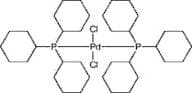
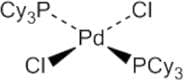
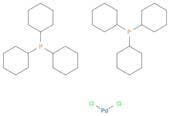
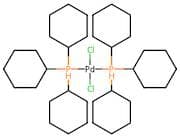
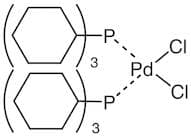
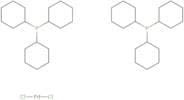
trans-Diclorobis(triciclohexilfosfina)paládio(II) é um complexo de coordenação de paládio com a fórmula PdCl2(P(C6H11)3)2. Este composto apresenta um centro de paládio coordenado a dois íons cloreto e dois ligandos triclorohexilfosfina, resultando em uma geometria quadrada plana típica dos complexos de paládio(II). Os ligandos de triclorohexilfosfina contribuem para a carga estérica e as propriedades eletrônicas do complexo, aumentando sua estabilidade e reatividade em várias reações químicas, particularmente em catálise. A configuração trans indica que os ligandos de cloreto estão posicionados um em frente ao outro, o que influencia a reatividade do composto e sua interação com substratos. Este complexo é frequentemente utilizado em síntese orgânica, especialmente em reações de acoplamento cruzado, devido à sua capacidade de facilitar a formação de ligações carbono-carbono. Além disso, exibe solubilidade em solventes orgânicos, tornando-o adequado para uso em vários ambientes sintéticos. Precauções de segurança devem ser observadas ao manusear este composto, uma vez que os complexos de paládio podem ser tóxicos e devem ser gerenciados de acordo com os protocolos de segurança de laboratório apropriados.
Fórmula:C36H66Cl2P2Pd
InChI:InChI=1/2C18H33P.2ClH.Pd/c2*1-4-10-16(11-5-1)19(17-12-6-2-7-13-17)18-14-8-3-9-15-18;;;/h2*16-18H,1-15H2;2*1H;/q;;;;+2/p-2
SMILES:C1CCC(CC1)P(C1CCCCC1)C1CCCCC1.C1CCC(CC1)P(C1CCCCC1)C1CCCCC1.Cl.Cl.[Pd]
Sinónimos:- Dichlorobis(tricyclohexylphosphine)palladium(II)
- Dichloropalladium-Tricyclohexylphosphane (1:2)
- Bis(tricyclohexylphosphine)palladium(II) Dichlorid
Ordenar por
Pureza (%)
0
100
|
0
|
50
|
90
|
95
|
100
9 produtos.
Dichlorobis(tricyclohexylphosphine)palladium(II)
CAS:It is used as catalyst for C-C and C-N coupling reaction. It is used in the homogeneous carbonylation of chloroarenes under mild conditions. This Thermo Scientific Chemicals brand product was originally part of the Alfa Aesar product portfolio. Some documentation and label information may refer to tFórmula:C36H66Cl2P2PdPeso molecular:738.18trans-Dichlorobis(tricyclohexylphosphine)palladium(II), 99%
CAS:trans-Dichlorobis(tricyclohexylphosphine)palladium(II), 99%
Fórmula:PdCl2(C6H11)3PPureza:99%Cor e Forma:light yellow pwdr.Peso molecular:738.19Dichlorobis(tricyclohexylphosphine)palladium(II)
CAS:Fórmula:C36H66Cl2P2PdPureza:98%Cor e Forma:SolidPeso molecular:738.1828Ref: IN-DA0034PI
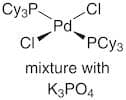
50gA consultar100gA consultar250mg26,00€100mg28,00€1g52,00€5g146,00€10g206,00€25g652,00€trans-Dichlorobis(tricyclohexylphosphine)palladium(II)/potassium phosphate admixture [CatKit single-use vials - 6.62 wt% Pd complex]
CAS:trans-Dichlorobis(tricyclohexylphosphine)palladium(II)/potassium phosphate admixture [CatKit single-use vials - 6.62 wt% Pd complex]
Fórmula:PdCl2(C6H11)3PK3PO4Cor e Forma:off-white pwdr.Peso molecular:736.30516Dichlorobis(tricyclohexylphosphine)palladium(II)
CAS:Dichlorobis(tricyclohexylphosphine)palladium(II)Fórmula:C36H68Cl2P2PdPureza:98%Cor e Forma: light yellow to yellow solidPeso molecular:740.20g/molBis(tricyclohexylphosphine)palladium(II) Dichloride
CAS:Fórmula:C36H66Cl2P2PdPureza:>97.0%(T)Cor e Forma:Light orange to Yellow to Green powder to crystalPeso molecular:738.19Dichloro(tricyclohexylphosphine)palladium (II)
CAS:Fórmula:C36H66Cl2P2PdPureza:95%Cor e Forma:SolidPeso molecular:738.19Bis(Tricyclohexylphosphine)Palladium(II) Dichloride extrapure, 98%
CAS:Fórmula:C36H66Cl2P2PCor e Forma:Yellow, PowderPeso molecular:738.1Bis(tricyclohexylphosphine)palladium(II) Dichloride
CAS:Produto ControladoBis(tricyclohexylphosphine)palladium(II) Dichloride is a cross-coupling agent that is used for the synthesis of organic and organometallic compounds. It reacts with terminal alkynes to form a phosphine oxide, which can then be converted into an arylated product. The reaction proceeds by the formation of a palladium-carbon bond and subsequent cleavage of the carbon-palladium bond in the presence of ammonium formate. Bis(tricyclohexylphosphine)palladium(II) Dichloride is insoluble in water, but soluble in organic solvents such as dichloromethane, 1,2-dichloroethane, or chloroform. This reagent has been shown to enhance the rate of transfer reactions between monomers.Fórmula:C36H66Cl2P2PdPureza:Min. 95%Peso molecular:738.18 g/mol