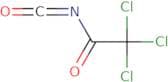
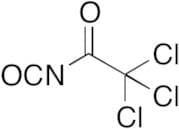
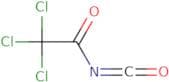
CAS 3019-71-4
:Isocianato de tricloracetilo
- 2,2,2-Trichloroacetyl isocyanate
- Acetic acid, trichloro-, anhydride with isocyanic acid
- Acetyl isocyanate, 2,2,2-trichloro-
- Acetyl isocyanate, trichloro-
- Isocyanic acid, anhydride with trichloroacetic acid
- α,α,α-Trichloroacetyl isocyanate
Trichloroacetyl Isocyanate
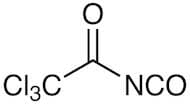
CAS:Fórmula:C3Cl3NO2Pureza:>97.0%(N)Cor e Forma:Colorless to Almost colorless clear liquidPeso molecular:188.39Trichloroacetyl isocyanate, 97%
CAS:Trichloroacetyl isocyanate is used as an in-situ derivatizing reagent for characterization of alcohols, glycols, phenols, and amines by nuclear magnetic resonance. It is also used in anion chemical ionization mass spectrometry and in catalytic one-pot dehydrative glycosylation of 1-hydroxy carbohydrFórmula:C3Cl3NO2Pureza:97%Cor e Forma:Clear colorless to pale yellow, LiquidPeso molecular:188.39Trichloroacetyl isocyanate
CAS:Trichloroacetyl isocyanatePureza:96%Cor e Forma:Clear LiquidPeso molecular:188.40g/molTrichloroacetyl isocyanate
CAS:Trichloroacetyl isocyanate (TCA) is a high-quality, versatile chemical intermediate that can be used as a reagent or in the production of fine chemicals. It is also a speciality chemical, which possesses an excellent reactivity for use as a building block in the synthesis of various complex compounds. TCA has been shown to be an efficient and useful scaffold for the preparation of valuable research chemicals. It is also a versatile building block that can be used to synthesize many different types of compounds. The reaction conditions are mild and allow for selective reactions with a wide range of functional groups, making it an excellent choice for reactions with complex substrates.
Fórmula:C9H19BrOPeso molecular:223.15 g/molTrichloroacetyl Isocyanate
CAS:Applications Trichloroacetyl Isocyanate is used as an in situ derivatizing reagent for characterization of alcohols, glycols, phenols, and amines by nuclear magnetic resonance (NMR).
Not a dangerous good if item is equal to or less than 1g/ml and there is less than 100g/ml in the package
References Bose, A.K., et al.: Tetrahedron, 31, 3025 (1975); Goodlett, V.W.: Anal. Chem., 37, 431 (1965); Stokker, G.: J. Org. Chem., 48, 2613 (1983)Fórmula:C3Cl3NO2Cor e Forma:NeatPeso molecular:188.42,2,2,-Trichloroacetyl isocyanate
CAS:2,2,2-Trichloroacetyl isocyanate is a fluorescent derivative of acetone that can be used to probe the biochemical properties of cells. This compound has been shown to react with methanol in solution and form hydrogen bonds. The reaction mechanism of 2,2,2-trichloroacetyl isocyanate with methyl glycosides was studied using an LC-MS/MS method. The hydroxyl group on the 2 position reacts with the ester linkages on the 3 position to form a new carbon-carbon bond in the product. 2,2,2-Trichloroacetyl isocyanate has been shown to be effective against pandemic influenza viruses and Mycobacterium tuberculosis. Pharmacokinetic studies have been conducted in rats and dogs for different doses of 2,2,2-trichloroacetyl isocyanate over a 24 hour period.
Fórmula:C3Cl3NO2Pureza:Min. 95%Cor e Forma:PowderPeso molecular:188.4 g/molRef: 3D-FT00298
Produto descontinuado