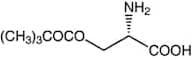
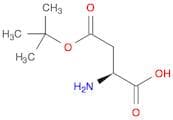
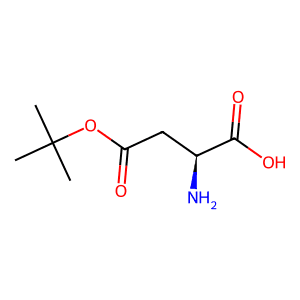
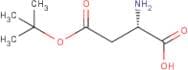
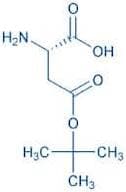
CAS 3057-74-7
:4-(1,1-Dimetiletil) hidrogênio L-aspartato
Descrição:
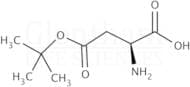
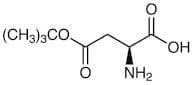
4-(1,1-Dimetiletil) hidrogênio L-aspartato, também conhecido pelo seu número CAS 3057-74-7, é um derivado de aminoácido que apresenta um grupo tert-butilo ligado ao carbono alfa do L-aspartato. Este composto é caracterizado por sua complexidade estrutural, que inclui tanto um grupo amino quanto um grupo carboxílico, típico dos aminoácidos. A presença do volumoso grupo tert-butilo influencia suas propriedades estéricas e pode afetar sua solubilidade e reatividade. Em geral, derivados de aminoácidos como este são de interesse na pesquisa bioquímica e em aplicações farmacêuticas devido aos seus papéis potenciais na síntese de proteínas e nas vias metabólicas. O composto pode exibir atividades biológicas específicas, embora estudos detalhados sejam necessários para elucidar suas funções e interações exatas em sistemas biológicos. Além disso, sua estabilidade e comportamento em vários solventes podem ser influenciados pela presença do grupo tert-butilo, tornando-o um assunto de interesse tanto na síntese orgânica quanto na química medicinal.
Fórmula:C8H15NO4
InChI:InChI=1S/C8H15NO4/c1-8(2,3)13-6(10)4-5(9)7(11)12/h5H,4,9H2,1-3H3,(H,11,12)/t5-/m0/s1
Chave InChI:InChIKey=MXWMFBYWXMXRPD-YFKPBYRVSA-N
SMILES:C(C(OC(C)(C)C)=O)[C@@H](C(O)=O)N
Sinónimos:- (2R)-2-ammonio-4-tert-butoxy-4-oxobutanoate
- (2S)-2-Amino-4-(tert-butoxy)-4-oxobutanoic acid
- (2S)-2-Amino-4-[(2-methylpropan-2-yl)oxy]-4-oxobutanoic acid
- (2S)-2-ammonio-4-tert-butoxy-4-oxobutanoate
- (S)-2-Amino-4-tert-butoxy-4-oxobutanoic acid
- 2-Amino-4-Tert-Butoxy-4-Oxobutanoic Acid (Non-Preferred Name)
- 4-(1,1-Dimethylethyl) hydrogen <span class="text-smallcaps">L</span>-aspartate
- <span class="text-smallcaps">L</span>-Aspartic acid 4-tert-butyl ester
- <span class="text-smallcaps">L</span>-Aspartic acid β-tert-butyl ester
- <span class="text-smallcaps">L</span>-Aspartic acid, 4-(1,1-dimethylethyl) ester
- Aspartic acid β-tert-butyl ester
- Aspartic acid, 4-tert-butyl ester
- L-Aspartic acid-4-tert-butyl ester
- β-tert-Butyl <span class="text-smallcaps">L</span>-aspartate
- β-tert-Butyl aspartate
- 4-(1,1-Dimethylethyl) hydrogen L-aspartate
- L-Aspartic acid, 4-(1,1-dimethylethyl) ester
- Ver mais sinónimos
Ordenar por
Pureza (%)
0
100
|
0
|
50
|
90
|
95
|
100
10 produtos.
L-Aspartic acid 4-tert-butyl ester, 98%
CAS:This Thermo Scientific Chemicals brand product was originally part of the Alfa Aesar product portfolio. Some documentation and label information may refer to the legacy brand. The original Alfa Aesar product / item code or SKU reference has not changed as a part of the brand transition to Thermo SciFórmula:C8H15NO4Pureza:98%Peso molecular:189.21L-Aspartic acid 4-tert-butyl ester
CAS:Fórmula:C8H15NO4Pureza:98%Cor e Forma:SolidPeso molecular:189.2090Ref: IN-DA0037P3
1kgA consultar5kgA consultar1g26,00€5g27,00€10g36,00€25g68,00€100g166,00€500g556,00€(2S)-2-Amino-4-tert-butoxy-4-oxo-butanoic acid
CAS:(2S)-2-Amino-4-tert-butoxy-4-oxo-butanoic acidPureza:98%Peso molecular:189.21g/mol4-tert-Butyl L-Aspartate
CAS:Fórmula:C8H15NO4Pureza:>98.0%(T)Cor e Forma:White to Almost white powder to crystalPeso molecular:189.21L-Aspartic acid 4-tert-butyl ester
CAS:H-Asp(OtBu)-OH (L-Aspartic acid 4-tert-butyl ester) is an aspartic acid derivative that can be used for the synthesis of short peptides.Fórmula:C8H15NO4Pureza:99.77% - 99.87%Cor e Forma:SolidPeso molecular:189.21H-Asp(OtBu)-OH
CAS:M03010 - H-Asp(OtBu)-OH
Fórmula:C8H15NO4Pureza:98%Cor e Forma:Solid, White powderPeso molecular:189.211L-Aspartic Acid 4-tert-Butyl Ester
CAS:Produto ControladoStability Hygroscopic
Applications L-Aspartic acid 4-tert-butyl ester is a protected form of L-Aspartic acid (A790024). L-Aspartic acid is a nonessential amino acid that is used to biosynthesize other amino acids within the human body. L-Aspartic acid also increases membrane conductance of mammalian neurons by voltage-dependent means, causing depolarization and nerve impulses that travel to key areas of the central nervous system.
References Anderson, H., et al.: J. Nutr., 99, 82 (1969); Honey, C., et al.: Neurosci. Lett., 61, 135 (1985); MacDonald, J., et al.: Brain Res., 237, 248 (1982)Fórmula:C8H15NO4Cor e Forma:NeatPeso molecular:189.21H-Asp(OtBu)-OH
CAS:Bachem ID: 4002930.
Fórmula:C8H15NO4Pureza:> 99%Cor e Forma:White PowderPeso molecular:189.21