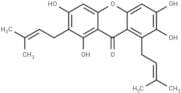
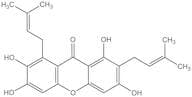
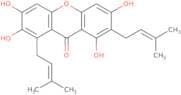
CAS 31271-07-5
:γ-Mangostina
Descrição:
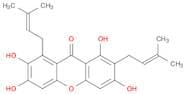
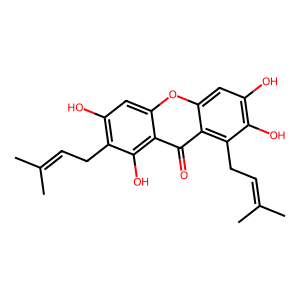
γ-Mangostina é um composto polifenólico natural encontrado principalmente no pericarpo do fruto do mangostão (Garcinia mangostana). Pertence à classe de compostos chamados xantonas e é reconhecido por seus potenciais benefícios à saúde, incluindo propriedades antioxidantes, anti-inflamatórias e antimicrobianas. A fórmula molecular de γ-Mangostina é C18H18O6, e apresenta uma estrutura complexa que inclui múltiplos grupos hidroxila, contribuindo para sua atividade biológica. Este composto despertou interesse na pesquisa farmacológica por seus potenciais efeitos terapêuticos contra várias doenças, incluindo câncer e distúrbios metabólicos. Além disso, γ-Mangostina exibe baixa toxicidade, tornando-se um candidato para estudos adicionais em aplicações nutracêuticas e farmacêuticas. Suas características de solubilidade variam, muitas vezes exigindo solventes específicos para extração e análise eficazes. No geral, γ-Mangostina representa uma área significativa de estudo na química de produtos naturais e suas implicações para a saúde e o manejo de doenças.
Fórmula:C23H24O6
InChI:InChI=1S/C23H24O6/c1-11(2)5-7-13-15(24)9-18-20(22(13)27)23(28)19-14(8-6-12(3)4)21(26)16(25)10-17(19)29-18/h5-6,9-10,24-27H,7-8H2,1-4H3
Chave InChI:InChIKey=VEZXFTKZUMARDU-UHFFFAOYSA-N
SMILES:C(C=C(C)C)C1=C2C(OC=3C(C2=O)=C(O)C(CC=C(C)C)=C(O)C3)=CC(O)=C1O
Sinónimos:- 1,3,6,7-Tetrahydroxy-2,8-bis(3,3-dimethylallyl)xanthone
- 1,3,6,7-Tetrahydroxy-2,8-bis(3-methyl-2-buten-1-yl)-9H-xanthen-9-one
- 1,3,6,7-Tetrahydroxy-2,8-bis(3-methylbut-2-enyl)xanthen-9-one
- 2,8-Bis(3-methyl-2-butenyl)-1,3,6,7-tetrahydroxy-9H-xanthen-9-one
- 7-O-Demethyl-α-mangostin
- 9H-Xanthen-9-one, 1,3,6,7-tetrahydroxy-2,8-bis(3-methyl-2-butenyl)-
- 9H-xanthen-9-one, 1,3,6,7-tetrahydroxy-2,8-bis(3-methyl-2-buten-1-yl)-
- Gamma-Mangostin
- Mangostin, demethyl-
- Normangostin
- Xanthen-9-one, 1,3,6,7-tetrahydroxy-2,8-bis(3-methyl-2-butenyl)-
- Ver mais sinónimos
Ordenar por
Pureza (%)
0
100
|
0
|
50
|
90
|
95
|
100
7 produtos.
Ref: IN-DA00BE5P
1mg120,00€5mg166,00€10mg205,00€25mg346,00€50mg520,00€100mgA consultar250mgA consultarγ-mangostin
CAS:gamma-Mangostin is a dual agonist that activates both PPARδ and PPARα, is also a novel competitive antagonist for the 5-HT2A receptors in vascular smooth muscles and platelets.gamma-Mangostin has free radical scavenging activity, and antiproliferative and apoptotic activity in HepG2 cells, and exhibits antihypertensive, anti-inflammatory, analgesic effects. gamma-Mangostin could as a preventive agent of the metabolic syndrome, and could serve as a micronutrient for colon cancer prevention.Fórmula:C23H24O6Pureza:95%~99%Peso molecular:396.439γ-Mangostin
CAS:Gamma-Mangostin (Normangostin) has free radical scavenging activity, and antiproliferative and apoptotic activity. Gamma-Mangostin is an antihypertensive agent.Fórmula:C23H24O6Pureza:98.55% - 99.08%Cor e Forma:SolidPeso molecular:396.43Γ-mangostin
CAS:Oxygen-heterocyclic compoundFórmula:C23H24O6Pureza:≥ 95.0 % (HPLC)Cor e Forma:PowderPeso molecular:396.44gamma-Mangostin
CAS:Mangostin is a natural compound found in the rinds of Garcinia mangostana, commonly known as the mangosteen fruit. It has been shown to inhibit aromatase, an enzyme that converts androgens to estrogens. Mangostin also inhibits the production of reactive oxygen species and prevents oxidative injury by scavenging free radicals. Mangostin has also been shown to have beneficial effects on infectious diseases such as HIV and malaria, cancerous cells such as colorectal adenocarcinoma, and insulin resistance in diabetes mellitus. The mechanism for this effect is not yet fully understood, but it is thought that mangostin may inhibit the activity of human macrophages or increase insulin-stimulated glucose uptake by fat cells.Fórmula:C23H24O6Pureza:Min. 95%Peso molecular:396.43 g/mol