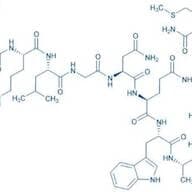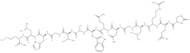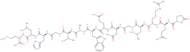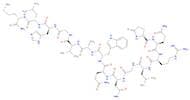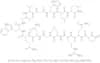
CAS 31362-50-2
:bombesina
Descrição:
bombesina é um peptídeo que consiste em 14 aminoácidos e é conhecido por seu papel como neuropeptídeo e fator de crescimento. Foi isolado originalmente da pele do sapo-de-fogo europeu, Bombina bombina, daí seu nome. bombesina exibe várias atividades biológicas, incluindo a estimulação da secreção de ácido gástrico e a influência na liberação de outros hormônios. Interage com receptores específicos, conhecidos como receptores de bombesina, que são encontrados em vários tecidos, incluindo o trato gastrointestinal e o sistema nervoso central. O peptídeo também é estudado por suas potenciais aplicações na pesquisa do câncer, particularmente na mira dos receptores de bombesina em certos tumores. Em termos de sua estrutura química, bombesina é caracterizado por uma sequência de aminoácidos que inclui resíduos hidrofóbicos e hidrofílicos, contribuindo para sua atividade biológica e ligação a receptores. Seu número CAS, 31362-50-2, é um identificador único usado para facilitar a identificação deste composto em bancos de dados químicos e literatura.
Fórmula:C71H110N24O18S
InChI:InChI=1/C71H110N24O18S/c1-34(2)24-47(92-62(105)43(14-11-22-79-71(76)77)89-64(107)45(15-18-52(72)96)90-63(106)44-17-20-55(99)85-44)61(104)81-31-56(100)87-51(28-54(74)98)69(112)91-46(16-19-53(73)97)65(108)94-49(26-38-29-80-41-13-10-9-12-40(38)41)66(109)84-37(7)60(103)95-58(36(5)6)70(113)82-32-57(101)86-50(27-39-30-78-33-83-39)68(111)93-48(25-35(3)4)67(110)88-42(59(75)102)21-23-114-8/h9-10,12-13,29-30,33-37,42-51,58,80H,11,14-28,31-32H2,1-8H3,(H2,72,96)(H2,73,97)(H2,74,98)(H2,75,102)(H,78,83)(H,81,104)(H,82,113)(H,84,109)(H,85,99)(H,86,101)(H,87,100)(H,88,110)(H,89,107)(H,90,106)(H,91,112)(H,92,105)(H,93,111)(H,94,108)(H,95,103)(H4,76,77,79)/t37-,42-,43-,44-,45-,46-,47-,48-,49-,50-,51-,58-/m0/s1
SMILES:CC(C)C[C@@H](C(=NCC(=N[C@@H](CC(=N)O)C(=N[C@@H](CCC(=N)O)C(=N[C@@H](Cc1c[nH]c2ccccc12)C(=N[C@@H](C)C(=N[C@@H](C(C)C)C(=NCC(=N[C@@H](Cc1cnc[nH]1)C(=N[C@@H](CC(C)C)C(=N[C@@H](CCSC)C(=N)O)O)O)O)O)O)O)O)O)O)O)N=C([C@H](CCCNC(=N)N)N=C([C@H](CCC(=N)O)N=C([C@@H]1CCC(=N1)O)O)O)O
Sinónimos:- Bombesin Acetate
- Bombesin, Free Base
- Pyr-Gln-Arg-Leu-Gly-Asn-Gln-Trp-Ala-Val-Gly-His-Leu-Met-NH2
Ordenar por
Pureza (%)
0
100
|
0
|
50
|
90
|
95
|
100
6 produtos.
Bombesin
CAS:A tetradecapeptide isolated from amphibian skin, which is biologically active in both the central nervous system and gastrointestinal tract. It was also shown that bombesin suppresses feeding in rats. Bombesin-like peptides have been biochemically characterized in rat brain.Fórmula:C71H110N24O18SPureza:96.6%Cor e Forma:White PowderPeso molecular:1619.87Bombesin
CAS:Bombesin: 14-amino acid peptide from toad skin with two mammalian homologs, neuromedin B and gastrin-releasing peptide.Fórmula:C71H110N24O18SCor e Forma:While Lyophilized PowderPeso molecular:1619.85Bombesin
CAS:Produto Controlado<p>Bombesin is a small peptide that was first isolated from the skin of a frog, Bombina bombina, with homologs later found to be present in mammalian tissues, including the brain and gastrointestinal tract. It is a member of the bombesin-like peptide family, which includes several related peptides such as gastrin-releasing peptide (GRP) and neuromedin B.<br>Bombesin acts as a neuromodulator and regulates various physiological functions, including gastrointestinal motility and stimulation of gastrin release from G cells. It also plays a role in the regulation of cardiovascular function and neurotransmitter release. In addition, bombesin has been shown to stimulate the growth and proliferation of certain types of cancer cells, including prostate and lung cancer cells, through its interaction with bombesin receptors. It may therefore be used as a potential biomarker for certain cancers.<br>This product is available as a 0.5mg vial.</p>Fórmula:C71H110N24O18SPureza:Min. 95%Peso molecular:1,619.8 g/molBombesin trifluoroacetate salt
CAS:<p>Trifluoroacetate salt</p>Fórmula:C71H110N24O18SPureza:Min. 95%Peso molecular:1,619.85 g/molRef: IN-DA00ILHP
Produto descontinuado