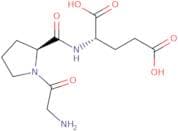
CAS 32302-76-4
:glicil-L-prolil-L-glutâmico ácido
Descrição:
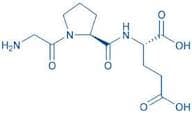
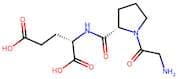
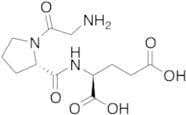
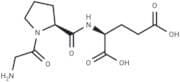
glicil-L-prolil-L-glutâmico ácido, também conhecido pelo seu número CAS 32302-76-4, é um tripeptídeo composto por três aminoácidos: glicina, prolina e ácido glutâmico. Este composto exibe características típicas de peptídeos, incluindo a capacidade de formar ligações de hidrogênio e adotar conformações específicas devido à sua sequência de aminoácidos. glicil-L-prolil-L-glutâmico ácido é conhecido por suas potenciais atividades biológicas, que podem incluir papéis na sinalização celular e modulação de processos fisiológicos. A presença de prolina em sua estrutura pode conferir propriedades conformacionais únicas, influenciando sua estabilidade e interação com outras biomoléculas. Além disso, o resíduo de ácido glutâmico contribui para a carga geral do peptídeo e sua hidrofobicidade, o que pode afetar sua solubilidade em ambientes aquosos. Este tripeptídeo pode ser de interesse em várias áreas, incluindo bioquímica e farmacologia, por suas potenciais aplicações no desenvolvimento de medicamentos e como ferramenta de pesquisa no estudo de interações e funções de peptídeos.
Fórmula:C12H19N3O6
InChI:InChI=1/C12H19N3O6/c13-6-9(16)15-5-1-2-8(15)11(19)14-7(12(20)21)3-4-10(17)18/h7-8H,1-6,13H2,(H,14,19)(H,17,18)(H,20,21)/t7-,8-/m0/s1
SMILES:C1C[C@@H](C(=N[C@@H](CCC(=O)O)C(=O)O)O)N(C1)C(=O)CN
Sinónimos:- L-glutamic acid, glycyl-L-prolyl-
- Glycyl-Prolyl-Glutamic Acid
Ordenar por
Pureza (%)
0
100
|
0
|
50
|
90
|
95
|
100
5 produtos.
IGF-I (1-3)
CAS:This N-terminal tripeptide of IGF-I facilitated the in vitro release of acetylcholine with a several hundredfold higher potency (10⁻¹⁰ – 10⁻⁶ M) than intact IGF-I (4 · 10⁻⁸ M), whereas truncated IGF-I lacking the tripeptide GPE, did not show any significant effect. This raises the possibility that GPE may be the active site of IGF-I. – Although the precise mode of action of GPE is still unknown, another study suggests that local administration of GPE is neuroprotective after brain HI injury via glial cells. In addition, systemic administration of GPE showed a more widespread neuroprotective effect. Therefore, GPE may represent a complementary pathway for central and systemic IGF-1’s antiapoptotic effects.Fórmula:C12H19N3O6Pureza:99.7%Cor e Forma:White PowderPeso molecular:301.3Gly-Pro-Glu
CAS:Produto ControladoApplications GLY-PRO-GLU (cas# 32302-76-4) is a useful research chemical.
Fórmula:C12H19N3O6Cor e Forma:NeatPeso molecular:301.296Glypromate
CAS:Glypromate (Gly-Pro-Glu) is a neuroprotective agent, is a weak NMDA receptor agonistFórmula:C12H19N3O6Pureza:98%Cor e Forma:SolidPeso molecular:301.3IGF-I (1-3)
CAS:IGF-I (1-3) H-Gly-Pro-Glu-OH is a synthetic peptide that has been shown to be effective in treating neuronal death caused by glutamate. It binds to calcium ions and inhibits the activity of gamma-aminobutyric acid, which is an inhibitory neurotransmitter. IGF-I (1-3) H-Gly-Pro-Glu-OH also blocks fatty acid synthesis, leading to necrotic cell death. In vitro assays have shown that this drug can protect against blood group O erythrocytes from pyridoxal phosphate oxidation and protocatechuic acid binding. This drug has also been shown to increase locomotor activity in mice, as well as improve motor function in rats with experimental stroke. IGF-I (1-3) H-Gly-Pro-Glu-OH is synthesized using a polymerase chain reaction technique and consists of amino acids 1 through 3 ofFórmula:C12H19N3O6Pureza:Min. 95%Peso molecular:301.3 g/mol